Source: Microsoft
Microsoft has now opened the registration for the virtual edition of its online-only Build 2020 developer conference, which will take place from May 19 to 20.
Typically, the event draws over 6,000 developers, but because of the coronavirus pandemic, that’s obviously not an option. In contrast to Google, which completely scrapped its I/O developer conference this year, Microsoft decided to go ahead with the virtual event, though. But this will be a very different kind of Build — and not only because it’s online-only.
Not only will the keynotes be shorter (though there will still be Day 1 and Day 2 keynotes). but in response to feedback from developers that have attended previous events, the Microsoft team also decided to focus solely on that audience. In previous years, Microsoft often used Build to announce consumer products, just like Google does at I/O. But that won’t happen this year. And instead of using the keynotes to put an early spotlight on features that won’t be available for half a year or more, the event will be more about providing content that’s immediately useful for developers and new products that are either immediately available or only a couple of months out from getting into the hands of developers.
That also likely means that even though Microsoft CEO Satya Nadella will still keynote, there will be less talk about big picture company philosophy and more about developer tools and APIs.
Some of the keynotes and demos will be live, some will be pre-recorded, but overall, the look and feel of the event shouldn’t be all that different from what developers who previously watched Build from afar experienced. But it will be shorter and more focused than in previous years, which isn’t necessarily a bad thing.

Attendees sit in pods during the Microsoft Developers Build Conference in Seattle, Washington, U.S., on Monday, May 7, 2018. The Build conference, marking its second consecutive year in Seattle, is expected to put emphasis on the company’s cloud technologies and the artificial intelligence features within those services. Photographer: Grant Hindsley/Bloomberg via Getty Images
Microsoft opens registration for its free, online Build 2020 developer conference
Source: Microsoft
About a year ago, Microsoft launched Visual Studio Online, its online code editor based on the popular Visual Studio Code project. It’s basically a full code editor and hosted environment that lives in your browser.
Today, the company announced that it is changing the name of this service to Visual Studio Codespaces. It’s also dropping the price of the service by more than 50% and it’s giving developers the option to run it on relatively low-performance virtual machines that will start at $0.08 per hour.
In today’s announcement, Microsoft’s Scott Hanselman points out that the company learned that most developers who used Visual Studio Online thought of it as being much more than simply an editor in the browser.
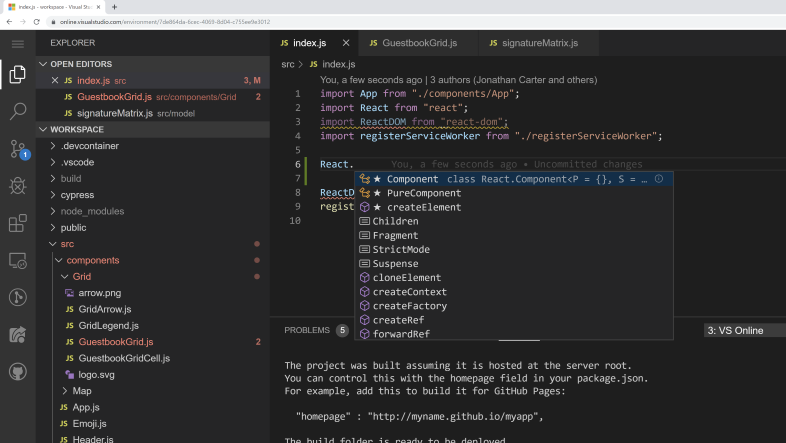
“To better align with that sentiment, and the true value of the service, we’re renaming Visual Studio Online to Visual Studio Codespaces. (It’s true what they say, naming is hard!) Do you want a great experience working on your long-term project? Do it in a Codespace. Need to quickly prototype a new feature or perform some short-term tasks (like reviewing pull requests)? Create a Codespace! Your Codespaces are simply the most productive place to code.”
The new pricing will go into effect on May 19, the first day of Microsoft’s (virtual) Build developer conference. These are pretty significant price drops, down from $0.45 per hour to $0.17 for a machine with 4 cores and 8 GB of memory, for example (you also incur some relatively minor storage costs of $0.0088 for using a 64 GB SDD, too).

Hanselman also points out that a lot of developers don’t need quite that much power, so the company is now introducing a Basic plan with a 2-core machine and 4 GB of RAM for $0.08 per hour. Best I can tell, these will go live for around $0.24 per hour today and then see a price cut on May 19, too. Why not launch it at the reduced price? Only Microsoft knows, so we asked and will update this post once they tell us.
Typically, this is the kind of announcement Microsoft would make at its annual Build developer conference. And while some other companies have decided to fully scrap their events and aren’t even hosting a virtual conference, Microsoft is moving full steam ahead with its Build conference in the middle of May. I expect we’ll hear more about how that event will play out in the near future.
Microsoft’s Visual Studio Online code editor is now Visual Studio Codespaces and gets a price drop
Source: Microsoft
Microsoft today announced a slew of updates to various parts of its Microsoft 365 ecosystem. A lot of these aren’t all that exciting (though that obviously depends on your level of enthusiasm for products like Microsoft Endpoint Manager), but the overall thrust behind this update is to make life easier for the IT admins that help provision and manage corporate Windows — and Mac — machines, something that’s even more important right now, given how many companies are trying to quickly adapt to this new work-from-home environment.
For them, the highlight of today’s set of announcements is surely an update to Windows Virtual Desktop, Microsoft’s service for giving employees access to a virtualized desktop environment on Azure and that allows IT departments to host multiple Windows 10 sessions on the same hardware. The company is launching a completely new management experience for this service that makes getting started significantly easier for admins.
Ahead of today’s announcement, Brad Anderson, Microsoft’s corporate VP for Microsoft 365, told me that it took a considerable amount of Azure expertise to get started with this service. With this update, you still need to know a bit about Azure, but the overall process of getting started is now significantly easier. And that, Anderson noted, is now more important than ever.
“Some organizations are telling me that they’re using on-prem [Virtual Desktop Infrastructure]. They had to go do work to basically free up capacity. In some cases, that means doing away with disaster recovery for some of their services in order to get the capacity,” Anderson said. “In some cases, I hear leaders say it’s going to take until the middle or the end of May to get the additional capacity to spin up the VDI sessions that are needed. In today’s world, that’s just unacceptable. Given what the cloud can do, people need to have the ability to spin up and spin down on demand. And that’s the unique thing that a Windows Virtual Desktop does relative to traditional VDI.”
Anderson also believes that remote work will remain much more common once things go back to normal — whenever that happens and whatever that will look like. “I think the usage of virtualization where you are virtualizing running an app in a data center in the cloud and then virtualizing it down will grow. This will introduce a secular trend and growth of cloud-based VDI,” he said.
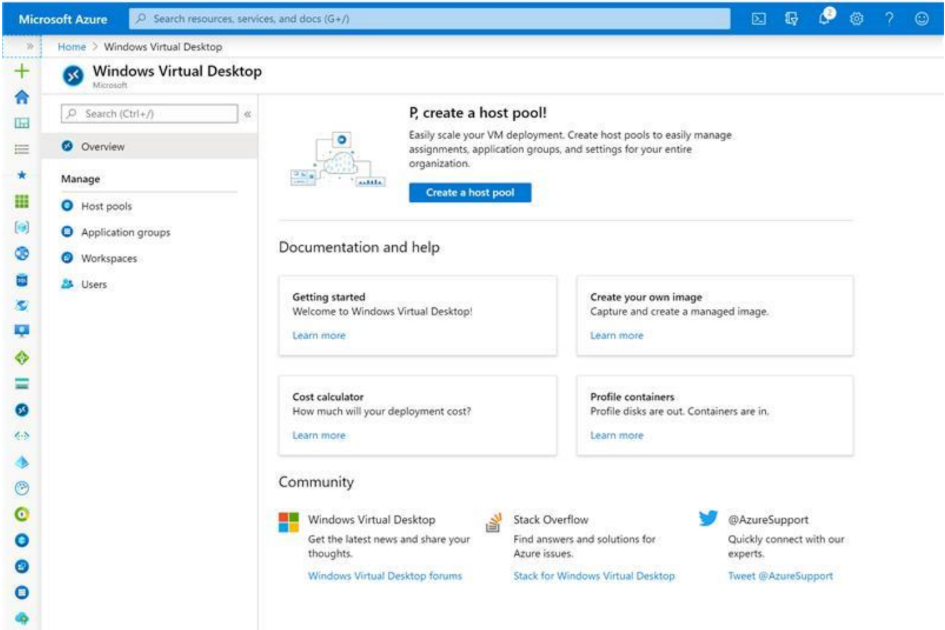
In addition to making the management experience easier, Microsoft is now also making it possible to use Microsoft Teams for video meetings in these virtual desktop environments, using a feature called ‘A/V redirection’ that allows users to connect their local audio and video hardware and virtual machines with low latency. It’ll take another month or so for this feature to roll out, though.
Also new is the ability to keep service metadata about Windows Virtual Desktop usage within a certain Azure region for compliance and regulatory reasons.
For those of you interested in Microsoft Endpoint Manager, the big news here is better support for macOS-based machines. Using the new Intune MDM agent for macOS, admins can use the same tool for managing repetitive tasks on Windows 10 and macOS.
Productivity Score — a product only an enterprise manager would love — is also getting an update. You can now see how people in an organization are reading, authoring and collaborating around content in OneDrive and SharePoint, for example. And if they aren’t, you can write a memo and tell them they should collaborate more.
There are also new dashboards here for looking at how employees work across devices and how they communicate. It’s worth noting that this is aggregate data and not another way for corporate to look at what individual employees are doing.
The one feature here that does actually seem really useful, especially given the current situation, is a new Network Connectivity category that helps IT to figure out where there are networking challenges.
Microsoft makes it easier to get started with Windows Virtual Desktops
Source: Microsoft
Prague based Resistant AI has nabbed a $2.75M seed round. The security startup’s machine learning technology is designed to be deployed on top of AI systems used for financial decision making to protect customers in markets such as financial services and ecommerce from attacks such as targeted manipulation, adversarial machine learning and advanced fraud.
The seed round was co-led by Index Ventures (Jan Hammer) and Credo Ventures (Ondrej Bartos and Vladislav Jez). Seedcamp also participating, along with Daniel Dines, CEO of UiPath; Michal Pechoucek, CTO of Avast and other unnamed angel investors. Bartos joins the board of directors on behalf of the investors.
The startup sells an additional layer of protection that’s specifically designed for tightening security around automated functions such as credit risk scoring and anti-money laundering by using tech to detect fake documents that feed such systems. Its tech is also aimed at uncovering suspicious patterns of transactions which might indicate a strategic attack on the model itself or an attempt to copy sensitive data.
“Historically, all systems that make high-value financial decisions become targeted. This is already happening with the automated systems deployed by our fintech and financial customers and we are here to protect them,” said Martin Rehak, founder and CEO, in a statement.
The seed round is Resistant AI’s first tranche of external funding, with the founders bootstrapping the company since starting up in February 2019.
“We have onboarded the first customers in 2019 and the funding will help us scale our sales organisation to meet the rising demand from banks and fintechs,” Rehak told us. “We are protecting the AI&ML systems used in financial automation from manipulation or misuse by smart attackers.”
Resistant AI has two products it offers its customers at this stage: First, document inspection. It offers a machine learning system that’s designed to flag and reject “malicious documents” submitted for automated processing. “Bank statements, payslips, invoices, purchase orders and KYC documents submitted to fintechs and banks are frequently manipulated or completely falsified,” explained Rehak. “Resistant Documents, our first service, identifies and rejects the suspicious or malicious inputs.”
A second offering — Resistant Transactions — applies AI to spot problematic transaction patterns.
“We work with the fact that most attacks on AI systems require extensive interaction to discover the vulnerability,” he said. “Our system is unique by inspecting all the customer queries (which can take form or payments, money transfers or credit applications assessed by the system we protect) in context of similar queries. By looking at the stream of queries statistically, we can recognise and block the attacks that seek to steal the information embodied in the model (information stealing) or, worse, aim to nudge the system into making the wrong decision by exploiting an existing bias in the system.”
Resistant AI isn’t breaking out customer numbers yet but Rehak said it onboarded its first customers last year. “The funding will help us scale our sales organisation to meet the rising demand from banks and fintechs,” he added, saying also that it will be spending on building out product features and extending functionality, as well as on beefing up the sales and go-to-market team.
“Right now, our target customers are financial and fintech startups, as well as other companies deploying the automated process (both software and RPA) in their financial processes,” he added. “The financial systems are our current focus, but the attacks on machine learning are relevant in many other areas: process automation, e-commerce, manipulation of ‘trend detection’ algorithms in social media and other opportunities.”
It’s using a SaaS model — preferring a value approach to pricing, per Rehak. “Our problem and approach is new, and we feel that the value pricing model aligns the incentives between us and the customer in the optimal way,” he said on that.
Asked who he sees as the main competitors for the business, he cited Google Brain plus the tech giant’s activities in adversarial machine learning.
The majority of work in this area is currently done in-house by the large tech companies building their own proprietary systems — such as Google and Microsoft, he added.
Other competitors he mentioned were Inpher, which is enabling machine learning on encrypted data; Sentilink, which is doing detection of synthetic identities in the US; and Bullwall (Denmark) and YC-backed Inscribe (US/Ireland) which are focused on document forgery.
Resistant AI’s founders have a background in machine learning applied to cyber security problems having founded Cognitive Security, an earlier startup which they subsequently sold to Cisco in 2013. Over some 12 years working in the security industry Rehak said they saw how attackers targeting AI systems were getting increasingly sophisticated in avoiding detection — which gave them the idea for their latest business.
Commenting on the seed funding in a statement, Jan Hammer, general partner at Index Ventures, added: “Automation, efficiency and reliability are cornerstones of financial innovation. As machine learning takes more and more nuanced financial decisions, it needs to be protected. And this is not true only in finance, but the attacks will rapidly spread to other domains as well. More of our activity today takes place online, a trend accelerated by COVID-19, and one we believe will last. With criminals ready to take advantage of every vulnerability, the need for solutions such as those from Resistant AI has never been greater.”
Index and Credo lead a .75M seed in anti-fraud tech, Resistant AI
Source: Microsoft
Today Microsoft reported its third-quarter, fiscal 2020 quarter earnings, the period of time corresponding to Q1 2020 on the regular calendar.
The technology giant generated $35 billion in revenue, up 15% from the year-ago period. That top line led to $13 billion in operating income (+25% YoY), and $10.8 billion in net income (+22% YoY). Microsoft saw $1.40 in earnings per share in the quarter.
Investors had expected the company to report $1.26 in per-share profit off of revenue of $33.66 billion, according to Yahoo Finance. Right after reporting its results, Microsoft shares were up around 1.5%. The firm rallied 4.5% during regular trading hours on the back of a strong day of trading for technology equities.
Other headlines from the company’s earnings report include Azure (its AWS competitor) growing 59% from its year-ago result, 25% growth in Office 365 commercial incomes, LinkedIn top line growing 21% from the year-ago period, and roughly flat results from its Xbox, search, and Surface businesses.
However, calendar Q1 (Q3 F2020 for Microsoft) only included a portion of the world’s COVID-19 response. The results reflected that, with the company noting that “COVID-19 had minimal net impact” on revenue in the quarter, boosting cloud usage, lowering some advertising revenue from LinkedIn, raising gaming engagement, and slowing search advertising top line. The balance of that appears to be largely a wash.
The company will talk more about the future on its earnings call, but the firm did warn in its own report that “the effects of COVID-19 may not be fully reflected in the financial results until future periods.”
Metrics
In case anyone else is interested in other metrics, we’ve collected the most interesting numbers from Microsoft’s earnings slides for your enjoyment. Here they are:
- Q3 F2020 aggregate gross margin: 69%, +2% YoY
- Q3 F2020 aggregate operating margin: 37%, +3% YoY
- The company’s commercial bookings growth dropped sharply compared to preceding quarters; a portion of this was due to currency changes, which lowered growth in the category from 12% to 7% (YoY). The preceding lowest set of results since Q3 F2019 was that year’s Q4 which saw 22% growth (YoY) and 25% on a currency-adjusted basis.
- Commercial cloud revenue at Microsoft as $13.3 billion in the quarter, up 39% YoY. Remember when Microsoft wanted to hit a $20 billion run rate for commercial cloud revenue? Good times.
- LinkedIn got name-checked as a driver of rising operating expenses, which rose 10% to $11.1 billion; the only other category noted was cloud engineers. Which, to be clear, are expensive.
- Microsoft returned $9.9 billion to shareholders in the quarter, and spent $3.9 billion on capital expenditures. (Why aren’t those flipped?)
- And finally, operating cash flow at the company was $17.5 billion in the quarter. Chew on that, startups.
On the whole it was a good quarter for the company, which didn’t take too much damage from COVID-19. Of course, its outlook will matter quite a lot when we get it. For now, investors are content.
Microsoft shares rise after the tech giant posts 15% growth
Source: Microsoft
Good morning and welcome back to TechCrunch’s Equity Monday, a jumpstart for your week.
Regular Equity episodes still drop each and every Friday morning, so if you’ve listened to the show over the years, don’t worry — we’re only adding to the mix. You can catch last week’s show with Danny Crichton and Natasha Mascarenhas right here if you haven’t yet.
Unlike some weeks when the weekend’s crop of news and thought runs fallow, our recent interlude was stuffed with things to talk about:
- Sequoia China and Starbucks are tying up, which is especially notable after the Luckin Coffee story came crashing back to Earth.
- A survey concerning UK startups showed cracks in the EU’s largest startup market, measured by VC activity.
- It’s earnings week, with everyone from Apple to Microsoft, Alphabet, Amazon, Facebook, Spotify and Tesla reporting. Strap in for the busy week. It’s going to be a lot, but should help us figure out what has been going on in the stock market.
- Codota raised $12 million, and we think that its product is neat.
- A new pre-seed/seed fund has raised €50 million in fresh capital, which is notable given the global economic slowdown.
And then, finally, this essay from Founder’s Fund John Luttig, which I encourage you to read. It’s something that everyone is reading, and thus you must even if you don’t want to. We chat about it on the show, but read it yourself anyways. If it’s right, we’re in for a sea change in the startup world. For good, or at least until there’s a new leap forward in tech or technology product distribution. (You can read more on the idea of a SaaS slowdown here.)
Equity drops every Monday at 7:00 AM PT and Friday at 6:00 am PT, so subscribe to us on Apple Podcasts, Overcast, Spotify and all the casts.
Equity Monday: Startups run low on cash, and why some Internet tailwinds are fading
Source: Microsoft
Back in 2018 Templafy — which had come up with a way for enterprises to more easily make templates out of standard documents (yes, it’s a thing) — raised an additional $15 million from existing investors as an extension of its earlier Series B round taking it to $40.2 million raised. The company integrates with enterprise infrastructure to provide corporate content assets, document templates, and automatic validation of created documents for all kinds of clients. On this journey it has used its cash to acquire SlideProof in Berlin, then Veodin and iWRITER in 2019, and opened an office in NYC.
It’s been quite a journey since they started in 2014, and today the journey continues with the news that it’s closed a $25 million Series C funding round led by Insight partners. With additional funding from Dawn Capital, Seed Capital and Damgaard Company, bringing the total external capital raised to almost $70 million.
Templafy plans to use this latest round to boost its M&A activity; advance its product roadmap; and double staff from 200 to 400 full-time employees.
Jesper Theill Eriksen, CEO of Templafy said in a statement: “We set out to establish a new market category and create a high return on investment for companies streamlining their document creation workflow through our platform.”
He says the COVID-19 pandemic’s effect on remote working means “now more than ever, we see the need of global enterprises to support their distributed workforce with solutions that ensure productivity and compliance when documents are created.”
Jonathan Rosenbaum, vice president at Insight Partners said: “Templafy’s software represents a unique nexus of both end-user productivity and document compliance. This is what allows its customers to see real efficiency gains across an entire employee base.”
Templafy says it has more than doubled its revenue in the past year and has now sold over 2 million Templafy licenses worldwide
The total addressable market for Templafy’s document assembly software, in theory, extends to anyone that has to use traditional desktop software. The company’s Microsoft integration, means there are north of 1 billion Microsoft Office users for which Templafy could be used.
Christian Lund, co-founder and CPO at Templafy explained over email to TechCrunch that: “Being a horizontal document production infrastructure, Templafy is agnostic to the type of business document created (presentations, reports, contracts, proposals, pitches, emails, internal / external etc.) This is a key reason why many of the world’s largest enterprises use the platform company-wide.”
Templafy has plenty of competition across all the vertical categories it covers – for example in Template Management (Litera); Creative Content (Frontify, Bynder), Sales Enablement (Showpad, Seismic), Proposal management (Conga, PandaDoc), Email Signature Management (Exclaimer, Xink).
But Templify takes a horizontal approach rather than vertical approach.
Templafy raises M Series C led by Insight partners to deal with enterprise documents
Source: Microsoft
Microsoft founder Bill Gates spoke to the Financial Times (via Fast Company) about how the work of the Bill & Melinda Gates Foundation has shifted “almost entirely” to working on addressing COVID-19, in the interest of making the post impact possible in the ongoing effort to contain and combat the global coronavirus pandemic. Gates told the FT that the spread of COVID-19 could have dire economic consequences which will result in more suffering globally than anyone could’ve anticipated, hence the need to address it with the full weight of the resources of one of the world’s most well-capitalized charitable organizations.
The Bill & Melinda Gates foundation has been funding vaccine trials, clinical studies and basic research related to drug and therapy development for COVID-19 since basically the disease debuted on the world scene. It means that the exiting mandate of the foundation, which includes seeking to eradicate polio and AIDS worldwide, will be temporarily slowed or paused while the organization focuses its resources on the pandemic, but Gates’ decision to focus the group’s significant resources here should only emphasize the seriousness of the situation.
The foundation’s temporary shift is actually, long-term, the best way it can serve its core goals, since the global impact of the coronavirus crisis is likely to have repercussions for every aspect of human life, including access to medical care, testing and therapies, not to mention food and basic necessities. Curbing the disease’s spread early could have the most significant impact in economies ill-prepared to deal with the fallout, and any impact there will eventually result in better ability to work on eradicating those other diseases in a reasonable timeline, instead of undermining local infrastructure and allowing them a longer foothold.
In a 2015 TED talk, Gates predicted the coming of a global outbreak and urged global health organizations and governments to come together to prepare for what to do in case of a large, widespread contagion. Gates was working mostly from the perspective of the 2014 Ebola outbreak, which exposed many of the existing gaps and flaws in the system, but his advice seems prescient in retrospect.
Unfortunately, Gates has been subject to a lot of spreading misinformation and bogus conspiracy theory nonsense owing to heightened paranoia and activity among groups that normally peddle in this kind of falsehood. Based on this interview, Gates seems to essentially expect that as something of a matter of course for high-profile individuals, however, and it doesn’t appear to be impacting the foundation’s ability to focus on potential fixes.
Bill Gates details how his foundation shifted focus “almost entirely” to addressing COVID-19
Source: Microsoft
In his two decades at Apple, Imran Chaudhri worked on many of the company’s most iconic product lines, including the iPhone, iPad and Mac. The designer left the company in 2017 (landing on Microsoft’s HoloLens team two weeks back), but today he’s offering up some fun insight into Apple Watch’s beginnings on the wearable’s fifth birthday.
The thread is a treasure trove of fun facts about the device’s early days. One interesting tidbit that might not be a huge surprise to those following Apple at the time is that an early prototype of the Watch consisted of an iPod nano strapped to a watch band.
Five years before it finally entered the smartwatch market in earnest, Apple introduced a square touchscreen nano. Three years before the arrival of the first Pebble, people were already considering the smartwatch possibilities. Accessory makers quickly took advantage, introducing wrist bands that would let it function as a touchscreen music watch. That sixth-gen product ultimately served as a foundation for the popular device to come.
Per Chaudhri:
i had just wrapped up ios5 and took it down to show the ID team what notification centre and siri was – and what it could be in the future. i never got to share it with steve. we lost him right after ios5.
Other interesting bits here include:
- The Solar watch face was designed as “as a way for muslims observing ramadan to quickly see the position of the sun and for all to understand the sun’s relationship to time.”
- The butterfly animation was created using real (albeit deceased) butterflies (one of which is now framed in his home).
- The touch feature originally went by the name E.T. (electronic touch).
- The Digital Touch drawing feature was inspired by his time as a graffiti artist.
Apple Watch designer reveals the device’s origins on its fifth birthday
Source: Microsoft
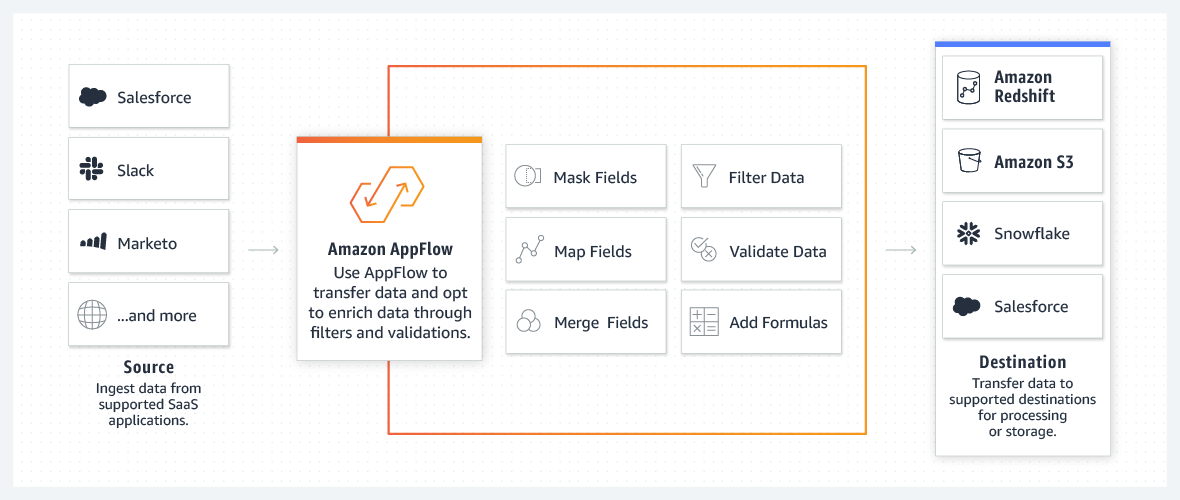
AWS today launched Amazon AppFlow, a new integration service that makes it easier for developers to transfer data between AWS and SaaS applications like Google Analytics, Marketo, Salesforce, ServiceNow, Slack, Snowflake and Zendesk. Like similar services, including Microsoft Azure’s Power Automate, for example, developers can trigger these flows based on specific events, at pre-set times or on-demand.
Unlike some of its competitors, though, AWS is positioning this service more as a data transfer service than a way to automate workflows, and, while the data flow can be bi-directional, AWS’s announcement focuses mostly on moving data from SaaS applications to other AWS services for further analysis. For this, AppFlow also includes a number of tools for transforming the data as it moves through the service.
“Developers spend huge amounts of time writing custom integrations so they can pass data between SaaS applications and AWS services so that it can be analysed; these can be expensive and can often take months to complete,” said AWS principal advocate Martin Beeby in today’s announcement. “If data requirements change, then costly and complicated modifications have to be made to the integrations. Companies that don’t have the luxury of engineering resources might find themselves manually importing and exporting data from applications, which is time-consuming, risks data leakage, and has the potential to introduce human error.”
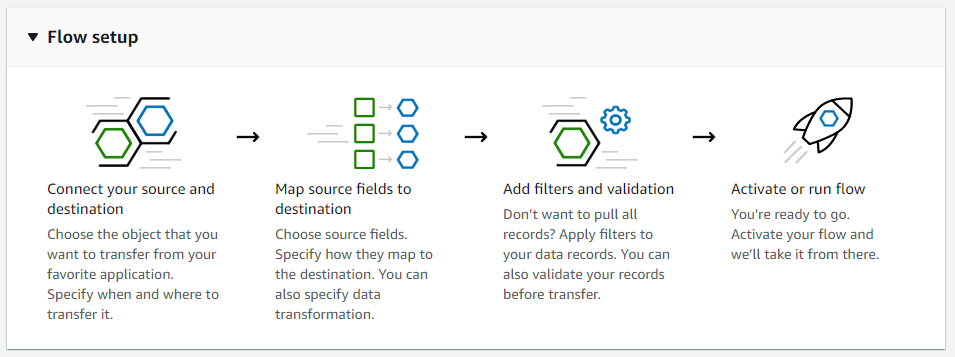 Every flow (which AWS defines as a call to a source application to transfer data to a destination) costs $0.001 per run, though, in typical AWS fashion, there’s also cost associated with data processing (starting at 0.02 per GB).
“Our customers tell us that they love having the ability to store, process, and analyze their data in AWS. They also use a variety of third-party SaaS applications, and they tell us that it can be difficult to manage the flow of data between AWS and these applications,” said Kurt Kufeld, vice president, AWS. “Amazon AppFlow provides an intuitive and easy way for customers to combine data from AWS and SaaS applications without moving it across the public internet. With Amazon AppFlow, our customers bring together and manage petabytes, even exabytes, of data spread across all of their applications — all without having to develop custom connectors or manage underlying API and network connectivity.”
At this point, the number of supported services remains comparatively low, with only 14 possible sources and four destinations (Amazon Redshift and S3, as well as Salesforce and Snowflake). Sometimes, depending on the source you select, the only possible destination is Amazon’s S3 storage service.
Over time, the number of integrations will surely increase, but for now, it feels like there’s still quite a bit more work to do for the AppFlow team to expand the list of supported services.
AWS has long left this market to competitors, even though it has tools like AWS Step Functions for building serverless workflows across AWS services and EventBridge for connections applications. Interestingly, EventBridge currently supports a far wider range of third-party sources, but as the name implies, its focus is more on triggering events in AWS than moving data between applications.
AWS launches Amazon AppFlow, its new SaaS integration service
