Source: Microsoft
Earlier this summer, Microsoft introduced an extra layer of security to its Dropbox competitor, OneDrive. The security features, called OneDrive Personal Vault, allow users to protect their files with two-step verification, like a fingerprint or facial recognition, PIN code or a one-time code sent through email, SMS or Microsoft Authenticator. At the time of launch, however, the feature was only available to select markets. Today, it’s rolling out worldwide and introducing new features, including expandable storage.
The company said OneDrive Personal Vault would initially be available to Australia, New Zealand and Canada, but would reach all OneDrive users by the end of the year.
With today’s expansion, it’s a little ahead of schedule, as it’s just now the end of September.
Personal Vault is available to all OneDrive users, with some limitations.
For those using OneDrive’s free or standalone 100GB storage plan, you’re able to store up to three files in Personal Vault. Office 365 subscribers can store as many files as they want, up to their storage limits.
Stronger authentication is the key selling point for Personal Vault, but it also comes with additional security measures. This includes “Scan and Shoot,” which lets you scan documents or shoot photos directly to Personal Vault, bypassing your device storage, like the camera roll. Personal Vault will also automatically lock files after a period of inactivity, restrict sharing on the files saved to prevent accidental shares and automatically sync files to a BitLocker-encrypted area of the hard drive on Windows 10 PCs.
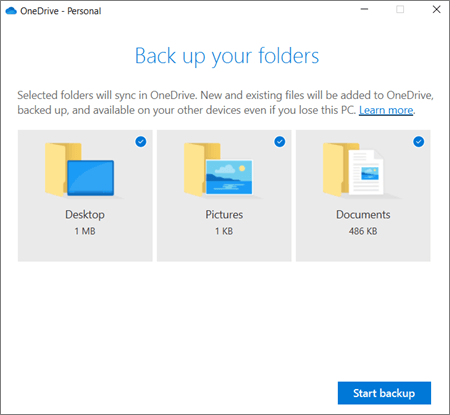 In addition to the global launch of Personal Vault, Microsoft also today introduced new storage options for One Drive, plus new features like PC Folder backup and dark mode.
Starting today, OneDrive users will now be able to add storage to their plans in 200GB increments, starting at $1.99 per month.
Meanwhile, PC Folder backup will allow OneDrive to back up your desktop, documents and picture folders from your Windows PC to the cloud, similar to rival desktop apps from Dropbox and Google Drive, for example. This option is available to Windows 7, 8 and 10 PCs. On Windows 10, it’s integrated so users can even opt to enable it during Windows setup or updates.
And OneDrive will now support a dark mode on iOS 13.
Personal Vault is live globally, as of today.
Microsoft OneDrive Personal Vault rolls out worldwide, launches expandable storage
Source: Microsoft
Microsoft today announced that Windows Virtual Desktop (WVD), its Azure-based system for virtualizing the Windows and Office user experience it announced last September, is now generally available. Using WVD, enterprises can give their employees access to virtualized applications and remote desktops, including the ability to provide multi-session Windows 10 experiences, something that sets Microsoft’s own apart from that of other vendors who offer virtualized Windows desktops and applications.
In addition to making the service generally available, Microsoft is also rolling it out globally, whereas the preview was U.S.-only and the original plan was to slowly roll it out globally. As Scott Manchester, the principal engineering lead for WVD, also told me that over 20,000 companies signed up for the preview. He also noted that Microsoft Teams is getting enhanced support in WVD with a significantly improved video conferencing experience.
Shortly after announcing the preview of WVD, Microsoft acquired a company called FSLogix, which specialized in provisioning the same kind of virtualized Windows environments that Microsoft offers through WVD. As Microsoft’s corporate VP for Microsoft 365 told me ahead of today’s announcement, the company took a lot of the know-how from FSLogix to ensure that the user experience on WVD is as smooth as possible.
Andreson noted that just as enterprises are getting more comfortable with moving some of their infrastructure to the cloud (and have others worry about managing it), there is now also growing demand from organizations that want this same experience for their desktop experiences. “They look at the cloud as a way of saying, ‘listen, let the experts manage the infrastructure. They can optimize it; they can fine-tune it; they can make sure that it’s all done right.’ And then I’ll just have a first-party service — in this case Microsoft — that I can leverage to simplify my life and enable me to spin up and down capacity on demand,” Anderson said. He also noted, though, that making sure that these services are always available is maybe even more critical than for other workloads that have moved to the cloud. If your desktop stops working, you can’t get much done, after all.
Anderson also stressed that if a customer wants a multi-session Windows 10 environment in the cloud, WVD is the only way to go because that is the only way to get a license to do so. “We’ve built the operating system, we built the public cloud, so that combination is going to be unique and this gives us the ability to make sure that that Windows 10 experience is the absolute best on top of that public cloud,” he noted.
He also stressed that the FSLogix acquisition enabled his team to work with the Office team to optimize the user experience there. Thanks to this, when you spin up a new virtualized version of Outlook, for example, it’ll just take a second or two to load instead of almost a minute.
A number of companies are also still looking to upgrade their old Windows 7 deployments. Microsoft will stop providing free security patches for them very soon, but on WVD, these users will still be able to get access to virtualized Windows 7 desktops with free extended security updates until January 2023. Anderson does not believe that this will be a major driver for WVD adoption, but he does see “pockets of customers who are working on their transition.”
Enterprises can access Windows 10 Enterprise and Windows 7 Enterprise on WVD at no additional licensing cost (though, of course, the Azure resources they consume will cost them) if they have an eligible Windows 10 Enterprise or Microsoft 365 license.
Microsoft’s Windows Virtual Desktop service is now generally available
Source: Microsoft
Alastair Mitchell
Contributor
Alastair Mitchell is a partner at multi-stage VC fund
EQT Ventures and the fund’s B2B sales, marketing and SaaS expert. Ali also focuses on helping US companies scale into Europe and vice versa.
After passively watching for many years as tech giants developed dominant market positions that threaten consumer privacy and stifle competition, American antitrust regulators seem to have finally grasped what’s happening and decided to take action.
This increasing scrutiny, which tacitly acknowledges that Europe’s more proactive regulators were perhaps right all along, is helping unleash a wave of tech startups at the expense of big tech. By holding industry titans accountable over the privacy and use of our data, regulators are encouraging long overdue disruption of everything from back-end infrastructure to consumer services.
Over the past decade, Facebook, Google, Amazon and others have tightened their grip on their respective domains by buying up hundreds of smaller rivals, with little U.S. government opposition. But as their dominance has grown, and as egregious privacy violations and mishaps proliferate, regulators can no longer look the other way.
In recent months, American regulators have announced a flurry of new antitrust investigations into big technology companies. The Federal Trade Commission has voted to fine Facebook $5 billion for misusing consumer data, the U.S. House Judiciary Committee is probing the tech industry for antitrust violations and 50 attorneys general announced an antitrust probe into Google. U.S. officials are even considering establishing a digital watchdog agency.
It’s hard to understand why it took so long, though perhaps U.S. officials were loath to target domestic companies that were driving huge economic growth and creating millions of new jobs. In contrast, their counterparts across the pond have been on an antitrust tear under the watch of European Union antitrust commissioner (and now also EVP of digital affairs) Margrethe Vestager.
Now that regulators from both Europe and the United States are pursuing antitrust probes, they have exposed areas where startups can innovate.
Startups take on big tech
Europe shows the way in online privacy
Source: Microsoft
It wasn’t so long ago that Microsoft was betting heavily on its Cortana digital assistant. That’s a bet that didn’t pay off. But since this is the new Microsoft, the company is instead betting on integrating its products with those services that its users do actually use and today, the company announced that you will now be able to control your Xbox One from the Google Assistant. For now, this feature is in beta, but you can expect a full launch later this fall.
To be clear, this doesn’t mean the Google Assistant is now available on your Xbox One and you can’t ask it for the weather. What it does mean is that you’ll be able to ask the Assistant to launch games on the Xbox, pause them, turn up the volume, etc. (“Hey Google, turn off Xbox.”).
You can find a full list of supported commands here.

This will work with virtually every Assistant-enabled device, including your iOS and Android phones. To get started, you set up the Xbox like any other third-party Assistant device in the Google Home app on Android or iOS — and that’s essentially what the Xbox One then becomes in the Assistant ecosystem: just another device you can control with it.
It’s worth noting that Microsoft, which has basically given up on Cortana for the consumer market, is also working with Amazon to bring Alexa to your PC. Microsoft doesn’t really care what you use to control your Microsoft devices, as long as you use a Microsoft or Windows 10 device. Now it’s probably just a matter of time before you can control your PC with the Assistant — or even get full Assistant support in Windows 10.
The Google Assistant can now control your Xbox One
Source: Microsoft
Workplace collaboration software business Slack (NYSE: WORK) has added Sheila Jordan, a senior vice president and chief information officer of Symantec, as an independent member of its board of directors. The hiring comes three months after the business completed a direct listing on the New York Stock Exchange.
Jordan, responsible for driving information technology strategy and operations for Symantec, brings significant cybersecurity expertise to Slack’s board. Prior to joining Symantec in 2014, Jordan was a senior vice president of IT at Cisco and an executive at Disney Destination for nearly 15 years.
With the new appointment, Slack appears to be doubling down on security. In addition to the board announcement, Slack recently published a blog post outlining the company’s latest security strategy in what was likely part of a greater attempt to sway potential customers — particularly those in highly regulated industries — wary of the company’s security processes. The post introduced new features, including the ability to allow teams to work remotely while maintaining compliance to industry and company-specific requirements.
Jordan joins Slack co-founder and chief executive officer Stewart Butterfield, former Goldman Sachs executive Edith Cooper, Accel general partner Andrew Braccia, Nextdoor CEO Sarah Friar, Andreessen Horowitz general partner John O’Farrell, Social Capital CEO Chamath Palihapitiya and former Salesforce chief financial officer Graham Smith on Slack’s board of directors.
“I believe there is nothing more critical than driving organizational alignment and agility within enterprises today,” Jordan said in a statement. “Slack has developed a new category of enterprise software to help unlock this potential and I’m thrilled to now be a part of their story.”
Slack closed up nearly 50% on its first day of trading in June but has since stumbled amid reports of increased competition from Microsoft, which operates a Slack-like product called Teams.
Slack co-founder and chief technology officer Cal Henderson will join us onstage at TechCrunch Disrupt San Francisco next week to discuss the company’s founding, road to the public markets and path forward. Buy tickets here.
Symantec’s Sheila Jordan named to Slack’s board of directors
Source: Microsoft
We’ve come a long way with voice-based interfaces in the last several years: They can find and play the music you like, tell you jokes, set timers, control your lights and help you shop, among many other things. But the battle lines were drawn from the start when it came to territory. The biggest hardware companies — Amazon, Apple, Google, Microsoft and Samsung — have up to now built their own voice assistants, taking a proprietary approach to encourage growth of their own ecosystems of services around their devices.
That model limits consumer choice, however, and it limits the kinds of developments that might spring out of a more collaborative, cacophonous approach.
Now we are seeing small signs of how that might be shifting. This week, Amazon announced the formation of a new consortium called the Voice Interoperability Group, which aims to create a set of standards and technology for hardware to handle one voice service, with users able to trigger one voice over another by way of “wake words.”
“Multiple simultaneous wake words provide the best option for customers,” said Jeff Bezos, Amazon founder and CEO, in a statement. “Utterance by utterance, customers can choose which voice service will best support a particular interaction. It’s exciting to see these companies come together in pursuit of that vision.”
How Amazon is closing out competitors by opening up voice
Source: Microsoft
At its hardware event in Seattle, Amazon today announced that it is launching a new Neural Text to Speech model for its Alexa personal assistant. This new model, which isn’t unlike what some of Amazon’s competitors like Google and Microsoft have launched in the past, uses the latest machine learning techniques to allow the company to build this new model which is meant to be more “emotive and expressive.”
In addition, the company today announced that your Echo can soon sound like Samuel L. Jackson, too. Using the same technology (instead of pre-recorded phrases), Alexa can now mimic celebrity voices, with Jackson’s being the first of them. That Samuel L. Jackson mode also comes in an explicit version.

Additional voices will roll out next year, but they won’t be available for free. Instead, they’ll cost $0.99 each (at least at first). It’s a fun gimmick, I guess, but it’s really not much more than that and harkens back to the days of stand-alone GPS units that often had a similar feature.
“The pace of innovation is incredible and what we can do with machine learning really never ceases to amaze me,” Amazon’s Dave Limp said in today’s keynote. “This same neural network technology though gives us a lot more flexibility now in and around what we can do with the Alexa voice.”

Alexa gets an improved voice and can now sound like Samuel L. Jackson, too
Source: Microsoft
A few months ago, Microsoft announced that PowerPoint would soon get an AI-powered presentation coach that could help you prepare for that important next presentation by giving you immediate feedback. Today, the company is launching this new tool, starting with the web version of PowerPoint.
Public speaking is a skill that takes lots of practice, but few people ever rehearse their presentations. Some don’t because they maybe think they are already great (but aren’t) and others because even the rehearsal makes them nervous. There’s no doubt, though, that practicing a presentation helps.
The new PowerPoint Presentation Coach aims to take the hassle out of practicing. In its current version, the tool looks at three things: pace, slide reading and word choice. Pace is pretty self-explanatory and looks at how fast or slow somebody is speaking. The ‘slide reading’ feature detects when you are simply reading the words from your slides word for word. Nobody wants to sit through that kind of presentation. The ‘word choice’ tool doesn’t just detect how often you say ‘um,’ ‘ah,’ ‘actually,’ or ‘basically,’ but it also gives you feedback when you are using culturally insensitive phrases like ‘you guys’ or ‘best man for the job.’
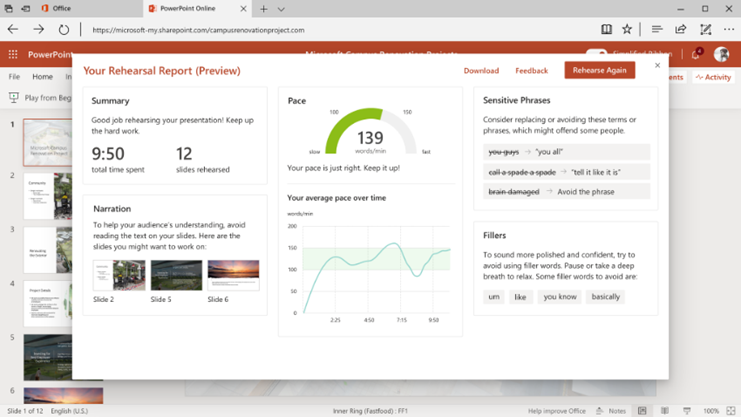 In addition to the new presentation coach, Office 365 is also getting a few other new features today. These include better inking support in PowerPoint, including the ability to replay what you drew on a slide so that you can essentially create animations that way (this is now available on Windows and Mac, with more inking support for Office on the web coming soon). Microsoft is also updating the Microsoft Whiteboard with new templates and teachers with an Office 365 subscription can now make use of 10 new lesson plans that include 23 custom 3D models to bring those lessons to life.
Microsoft launches its AI presentation coach for PowerPoint
Source: Microsoft
Quantum computing is almost ready for prime time, and, according to most experts, now is the time to start learning how to best develop for this new and less than intuitive technology. With multiple vendors like D-Wave, Google, IBM, Microsoft and Rigetti offering commercial and open-source hardware solutions, simulators and other tools, there’s already a lot of fragmentation in this business. QC Ware, which is launching its Forge cloud platform into beta today, wants to become the go-to middleman for accessing the quantum computing hardware and simulators of these vendors.
Forge, which like the rest of QC Ware’s efforts is aimed at enterprise users, will give developers the ability to run their algorithms on a variety of hardware platforms and simulators. The company argues that developers won’t need to have any previous expertise in quantum computing, though having a bit of background surely isn’t going to hurt. From Forge’s user interface, developers will be able to run algorithms for binary optimization, chemistry simulation and machine learning.

“Practical quantum advantage will occur. Most experts agree that it’s a matter of ‘when’ not ‘if.’ The way to pull that horizon closer is by having the user community fully engaged in quantum computing application discovery. The objective of Forge is to allow those users to access the full range of quantum computing resources through a single platform,” said Matt Johnson, CEO, QC Ware. “To assist our customers in that exploration, we are spending all of our cycles working on ways to squeeze as much power as possible out of near-term quantum computers, and to bake those methods into Forge.”
Currently, QC Ware Forge offers access to hardware from D-Wave, as well as open-source simulators running on Google’s and IBM’s clouds, with plans to support a wider variety of platforms in the near future.
Initially, QC Ware also told me that it offered direct access to IBM’s hardware, but that’s not yet the case. “We currently have the integration complete and actively utilized by QC Ware developers and quantum experts,” QC Ware’s head of business development Yianni Gamvros told me. “However, we are still working with IBM to put an agreement in place in order for our end-users to directly access IBM hardware. We expect that to be available in our next major release. For users, this makes it easier for them to deal with the churn. We expect different hardware vendors will lead at different times and that will keep changing every six months. And for our quantum computing hardware vendors, they have a channel partner they can sell through.”
Users who sign up for the beta will receive 30 days of access to the platform and one minute of actual Quantum Computing Time to evaluate the platform.
QC Ware Forge will give developers access to quantum hardware and simulators across vendors
Source: Microsoft
ALTBalaji, a leading video streaming service in India, has partnered with Microsoft and fintech firm Eko as it moves to expand its subscriber base in the country that is already larger than any of its local rivals.
ALTBalaji, which has more than 27 million paying subscribers, said it will use Microsoft’s BlendNet technology to help its users download and access more titles without consuming large amounts of cellular data.
Microsoft is providing ALTBalaji with BlendNet technology that enables videos to be disseminated through a combination of cloud-enabled metadata systems. “The file is transferred onto the recipient’s mobile using peer-to-peer local Wi-Fi. While the creation of this cloud plane might need a data network, the transfer of data will happen over local Wi-Fi,” Microsoft said.
The idea is to move much of the downloading without relying on cellular data connectivity, which remains costly for the masses in India. ALTBalaji subscribers will be able to download files from their nearby Eko retail stores, as well as from other users who have the same files. When neither options are viable, the downloading is paused.
Nachiket Pantvaidya, CEO of ALTBalaji and Group COO of Balaji Telefilms, said he hopes the new feature would help the video streaming service attract new users who don’t have access to cheap and reliable data. He said the firm also expects the feature to boost engagement for other subscribers on the platform who’re watching two to three episodes on the app each day.
“At ALTBalaji it has always been our endeavor to reach out to the masses and enhance our users’ experience through such services, while being affordable. And through this pilot feature, we aim to attract more viewers to our platform from areas with not so good internet connectivity,” said Pantvaidya.
In a statement, Meetul Patel, COO of Microsoft India, said, “Microsoft’s BlendNet is a great example of advanced technologies being used to make information and content accessible to all. It leverages the power of the cloud and intelligent edge networks to address gaps in connectivity and reduces the costs of content distribution.”
ALTBalaji, a wholly owned subsidiary of Balaji Telefilms, has more paying subscribers in India than any other video streaming service in the nation, Pantvaidya told TechCrunch in a recent interview. The service is available for Rs 100 ($1.40) for three months, or comes bundled with offerings from telecom providers.
Unlike most other streaming services, ALTBalaji only serves originally produced locally relevant content on its platform. It has made 45 original TV shows to date. Each year, the firm invests about 1,500 million Indian rupees ($21 million) in production of original shows, Pantvaidya said.
The firm, which employs about 100 people, today fights with more than three dozen companies, including Netflix, Amazon Prime Video and Disney-owned Hotstar. Even as Hotstar claimed to have more than 300 million users earlier this year, it has fewer than 10 million paying subscribers, people familiar with the matter have told TechCrunch.
Netflix has fewer than 3 million subscribers in India, according to industry estimates. It recently launched an aggressively priced mobile-only plan in the country. A person familiar with the matter told TechCrunch that the new price tier has attracted a significant number of new subscribers to Netflix.
India’s ALTBalaji partners with Microsoft to bring online video streaming to offline users
