Source: Microsoft
Microsoft today announced the launch of Azure Edge Zones, which will allow Azure users to bring their applications to the company’s edge locations. The focus here is on enabling real-time low-latency 5G applications. The company is also launching a version of Edge Zones with carriers (starting with AT&T) in preview, which connects these zones directly to 5G networks in the carrier’s data center. And to round it all out, Azure is also getting Private Edge Zones for those who are deploying private 5G/LTE networks in combination with Azure Stack Edge.
In addition to partnering with carriers like AT&T, as well as Rogers, SK Telecom, Telstra and Vodafone, Microsoft is also launching new standalone Azure Edge Zones in more than 10 cities over the next year, starting with L.A., Miami and New York later this summer.
“For the last few decades, carriers and operators have pioneered how we connect with each other, laying the foundation for telephony and cellular,” the company notes in today’s announcement. “With cloud and 5G, there are new possibilities by combining cloud services, like compute and AI with high bandwidth and ultra-low latency. Microsoft is partnering with them bring 5G to life in immersive applications built by organization and developers.”
This may all sound a bit familiar and that’s because only a few weeks ago, Google launched Anthos for Telecom and its Global Mobile Edge Cloud, which at first glance offers a similar promise of bringing applications close to that cloud’s edge locations for 5G and telco usage. Microsoft argues that its offering is more comprehensive in terms of its partner ecosystem and geographic availability. But it’s clear that 5G is a trend all of the large cloud providers are trying to tap into. Microsoft’s own acquisition of 5G cloud specialist Affirmed Networks is yet another example of how it is looking to position itself in this market.
As far as the details of the various Edge Zone versions go, the focus of Edge Zones is mostly on IoT and AI workloads, while Microsoft notes that Edge Zones with Carriers is more about low-latency online gaming, remote meetings and events, as well as smart infrastructure. Private Edge Zones, which combine private carrier networks with Azure Stack Edge, is something only a small number of large enterprise companies is likely to look into, given the cost and complexity of rolling out a system like this.
Microsoft launches Edge Zones for Azure
Source: Microsoft
Work-from-home policies, social distancing, and government lockdowns have increased the demand for video conferencing apps, for both business and personal use. According to a new report from App Annie, out on Monday, business conferencing apps have been experiencing record growth, as a result, and just hit their biggest week ever in March, when they topped 62 million downloads during the week of March 14-21. Meanwhile, social networking video app Houseparty has also seen phenomenal growth in Europe during lockdowns and home quarantines.
While such growth was to be expected, App Annie’s report provides real-world context about just how many new customers these apps are gaining during this time.
For example, the jump in business app downloads to 62 million across iOS and Google Play earlier in March, was up 45% from just the prior week. It was also the highest growth among any category across the app stores that week, the report said. And it was up 90% from the weekly average of business app downloads in 2019.

Much of the growth in the category is due to the increased adoption of apps like Google’s Hangouts Meet, Microsoft Teams, and Zoom Cloud Meetings.
Zoom topped the charts worldwide in February and March, and continues to see high numbers of downloads in the U.S., U.K., and elsewhere in Europe.
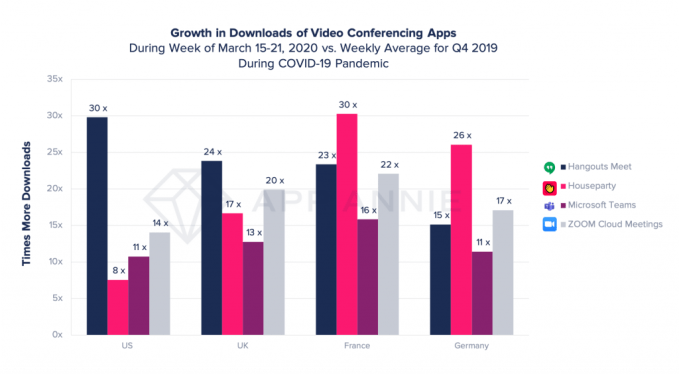
During the record week of downloads, Zoom was downloaded 14 times more than the weekly average during the fourth quarter of 2019 in the U.S. It was also downloaded more than 20 times Q4’s weekly average in the U.K., 22 times more in France, 17 times more in Germany, 27 times more in Spain, and an even larger 55 times more in Italy.
A related report from the app store intelligence firm Sensor Tower saw Zoom’s U.S. downloads somewhat higher in mid-March, but noted that the term “Zoom” wasn’t a top 100 search term in the U.S. App Store before the week of March 9. That meant many new users were being sent the app’s installation page directly — such as via a link shared in a work email, calendar invite, or an intranet site, perhaps.
At the same time in March, Google’s Hangouts Meet was seeing strong downloads in the U.K., U.S., Spain, and Italy, in particular, with 24x, 30x, 64x, and 140x the average weekly downloads in Q4, respectively.
Microsoft Teams saw significant — though not quite as strong — growth in Spain, France, and Italy, at 15x, 16x, and 30x the weekly levels of downloads in Q4, respectively.
In terms of consumer apps, social video conferencing app Houseparty, popular among Gen Z, has been rapidly growing in Europe and elsewhere. The app benefits from network effects — meaning as more friends and family join Houseparty, the app becomes more useful. It then gets launched and used more often, too. In Italy, the week ending on March 21 saw Houseparty downloads surge at 423 times the average weekly number of downloads in Q4 2019.
In Spain, Houseparty skyrocketed with 2360 times the number of downloads in the week ending March 21, compared with Q4. Also notable is that Spain was a market where, before, Houseparty didn’t have any wide-scale penetration. Because of the COVID-19 outbreak, it now has a base in a region where it otherwise may have never reached.
Unlike the business conferencing apps, Houseparty aims to make video chat a more personal and social experience. When you launch the app, it shows you’re free to talk and whose else is online — similar to other messaging apps. But there are also live parties to join and in-app games to play, which signals the app is not meant for your virtual office meetings.

Business apps aren’t the only ones booming at this time, of course.
Educational apps, including Google Classroom and ABCmouse, have also spiked in March as have grocery delivery apps, like Instacart.
“As people face uncertain timelines for the length of social isolation, video conferencing apps have the potential to vastly influence our daily habits — breaking down geological barriers and fostering the ability to work and socialize relatively seamlessly,” noted App Annie, in its report. “It is an unprecedented time for the world and an incredibly dynamic time for mobile — we are seeing shifts in consumer behavior surface daily across virtually every sector,” the firm concluded.
Video conferencing apps saw a record 62M downloads during one week in March
Source: Microsoft
The FDA approves a new procedure that could allow healthcare workers to reuse N95 respirator masks, Microsoft divests from a facial recognition startup and Saudi spies have been taking advantage of a network security flaw. Here’s your Daily Crunch for March 30, 2020.
1. FDA grants emergency authorization to system that decontaminates N95 respirator masks for reuse
Research, development and lab management company Battelle has received special emergency authorization from the U.S. healthcare regulator to put into use a system it developed to decontaminate used N95 respirator masks using concentrated hydrogen peroxide.
The system is able to turn single use respirators into masks that can be used up to 20 times, with a 2.5-hour decontamination process between each use. And it’s already in operation at Battelle’s Ohio facility, with a decontamination capacity of up to 80,000 masks per day.
2. Divesting from one facial recognition startup, Microsoft ends outside investments in the tech
Microsoft’s decision to withdraw its investment from AnyVision, an Israeli company developing facial recognition software, came as a result of an investigation into reports that AnyVision’s technology was being used by the Israeli government to surveil residents in the West Bank.
3. Saudi spies tracked phones using flaws the FCC failed to fix for years
Lawmakers and security experts have long warned of security flaws in the underbelly of the world’s cell networks. Now a whistleblower says the Saudi government is exploiting those flaws to track its citizens across the U.S. as part of a “systematic” surveillance campaign.
4. Test and trace with Apple and Google
Jon Evans looks at what Apple and Google can learn from Singapore, where they use a “TraceTogether” app. The app uses Bluetooth to track nearby phones (without location tracking), keeps local logs of those contacts, and only uploads them to the Ministry of Health when the user chooses to do — presumably after a diagnosis — so those contacts can be alerted.
5. Attract, engage and retain employees in the new remote-work era
Having the right technology in place to sustain work-from-home practices is more important now than ever before. There are four steps that employers can take to successfully integrate and adapt successful virtual hiring technologies into their business continuity plans. (Extra Crunch membership required.)
6. Online tutoring marketplace Preply banks $10M to fuel growth in North America, Europe
The startup said it has seen a record number of daily hours booked on its platform this past week. It also reports a spike in the number of tutors registering in markets including the U.S., U.K., Germany, France, Italy and Spain — which are among the regions where schools have been closed as a coronavirus response measure.
7. This week’s TechCrunch podcasts
The latest full-length Equity episode discusses Stripe’s investment into login/checkout startup Fast, while the Monday news recap covers three funding rounds and a downturn. Meanwhile, Original Content reviews Hulu’s star-studded “Little Fires Everywhere” and the bonkers Netflix documentary “Tiger King.”
The Daily Crunch is TechCrunch’s roundup of our biggest and most important stories. If you’d like to get this delivered to your inbox every day at around 9am Pacific, you can subscribe here.

Daily Crunch: FDA clears procedure for N95 mask decontamination
Source: Microsoft
Microsoft today announced that later this year, it will launch what is essentially a consumer version of Teams, its Slack-like text, audio and video chat application. Teams for your personal life, as Microsoft likes to call it, will feature a number of tools that will make it easier for families and small groups to organize events, share information and get on video calls, too.
As Google has long demonstrated, there can never be enough messaging applications, but it’s interesting to see Microsoft preview this direction for Teams when it has long solely focused on Skype as its personal chat, audio and video call app. But as Yusuf Mehdi, Microsoft’s corporate VP for Modern Life, Search and Devices, told me, Skype isn’t going away. Indeed, he noted that over half a billion people are using tools like Skype today.

“Skype continues,” he said when I asked him about the future of that service. “We remain committed to Skype. Skype today is used by a hundred million people on a monthly basis. The way I think about it is that Skype is a great solution today for personal use. A lot of broadcast companies use it as well. Teams is really the more robust offering, as you will, where in addition to doing video and chat calling, we also bring in rich communications and templates […], we have things like dashboard and it also helps you pull in a richer set of tools.”
With the more personal Teams only launching later this year, Skype remains Microsoft’s main consumer chat service for the time being. Indeed, about 40 million people current use it daily, in part because of the COVID-19 pandemic, and the company is seeing a 220 percent increase in Skype-to-Skype call minutes.
While Microsoft thought about giving this new personal take on Teams a different brand, the company decided that Teams had pretty broad brand awareness already. In addition, the focus of today’s updates was very much on bridging the gap between work life and home life, so it makes sense for the company to try to combine both enterprise and personal features into the same application.
Microsoft Teams is coming to consumers — but Skype is here to stay
Source: Microsoft
Microsoft today announced a ton of new features for its productivity apps, but it also used today’s release to highlight a few new features that are coming to its Chromium-based Edge browser in the near future.
Most of these are pretty straightforward and expected, like its Collections bookmarking feature coming to mobile later this year, but some are quite a surprise. Edge is getting vertical tabs, for example. A lot of browsers have experimented with this in the past but it has often been seen as a niche feature for advanced users. Microsoft clearly doesn’t think of it that way. But you’ll have to wait a bit to try this out, as it’s currently scheduled to roll out to the preview channels in the next few months (or to get a taste of it today, you could try an alternative browser like Vivaldi, which has a number of other advanced tab management features, too).
Also coming to an Edge browser near you in the next few months is Smart Copy. If you’ve ever tried to copy and paste a table from a website in the past, you know that the result is always messy. With Smart Copy, Edge can preserve the formatting when you paste the table into a document. It’ll launch in the Edge Insider channels in the next month.
 Also coming in the next few months is a new Password Monitor in Edge, which Microsoft built from the ground up. Like similar features in other browsers and extensions like Google’s Password Checkup, Password Monitor constantly scans the web to make sure your credentials haven’t been stolen. One nifty feature here is that you don’t just get a notification but that this notification will also take you right to the respective service’s site for changing your password.
It’s no secret that Microsoft is very excited about collections in Edge. You can think of them as a tool for bookmarking related sites, images and even text snippets. That’s a useful feature for when you are planning a trip, organizing a dinner or researching anything online. It’s a bit more ephemeral than bookmarks yet more durable than simply keeping a bunch of tabs open. As Microsoft today announced, Collections are coming to the mobile version of Edge, too, and users will be able to sync their Collections between devices.
Microsoft Edge is getting smart copy and paste, a password monitor and vertical tabs
Source: Microsoft
Microsoft today announced a slew of new products, but at the core of the release is a major change to how the company is marketing its tools and services to consumers.
Office 365, which has long been the brand for the company’s subscription service for its productivity tools like Word, Excel and Outlook, is going away. On April 21, it’ll be replaced by new Microsoft 365 plans, including new personal and family plans (for up to six people) at $6.99 and $9.99 respectively. That’s the same price as the existing Office 365 Personal and Home plans.
“We are basically evolving our subscription from — in our minds — a set of tools to solutions that help you manage across your work and life,” Yusuf Mehdi, Microsoft’s CVP of Modern Life, Search and Devices, told me ahead of today’s announcement.
Microsoft is making similar branding changes to its business plans for Office 365. They are a bit more convoluted, with Office 365 Business Premium now called Microsoft 365 Business Standard and Microsoft 365 Business now becoming Microsoft 365 Business Premium, but for the most part, this is about branding while prices stay the same.
These new Microsoft 365 Personal and Family plans will include access to Outlook and the Office desktop apps for Windows and macOS, 1 terabyte of OneDrive storage per person (including unlimited access to the more secure OneDrive Personal Vault service) and 50 gigabytes of Outlook.com email storage, Skype call recording and 60 minutes of Skype landline and mobile phone calls.
And since this is now Microsoft 365 and not Office 365, you can also get Windows 10 technical support with the subscription, as well as additional security features to protect you from phishing and malware attacks.
More than 37 million people currently have personal Office 365 subscriptions and chances are these lower prices will bring more users to the platform in the long run. As Mehdi stressed, Microsoft’s free offerings aren’t going away.
But with today’s release, Microsoft isn’t just changing the branding and launching these new plans, it’s also highlighting quite a few new capabilities in its various applications that are either launching today or in the coming months.
Microsoft Teams gets a personal edition
The highlight of this launch, especially given the current situation around COVID-19, is likely the announcement of Teams for consumers. Teams is already one of Microsoft’s fastest growing products for businesses with 44 million people using it. But in its efforts to help people bridge their work and personal lives, it will now launch a new Teams edition for consumers, as well.
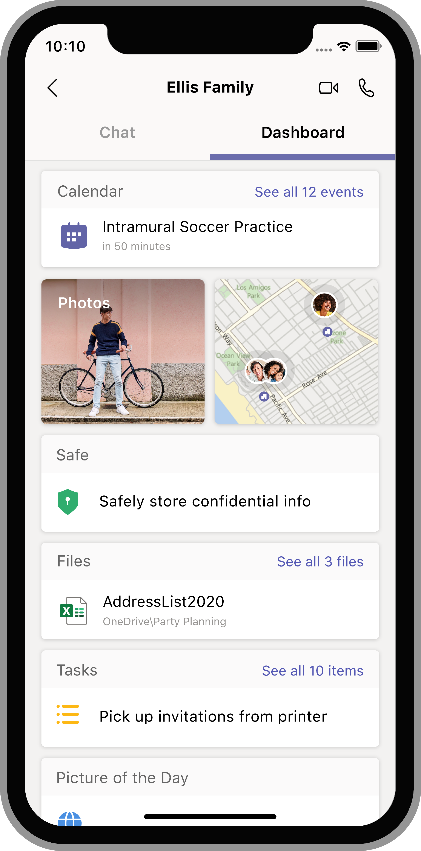
Just like you can switch between work and personal accounts in Outlook, you will soon be able to do the same in Teams. The personal teams view will look a little bit different, with shared calendars for the family, access to OneDrive vaults, photo sharing, etc., but it sits on the same codebase as the business version. You’ll also be able to do video calls and shared to-do lists.
Better writing through AI
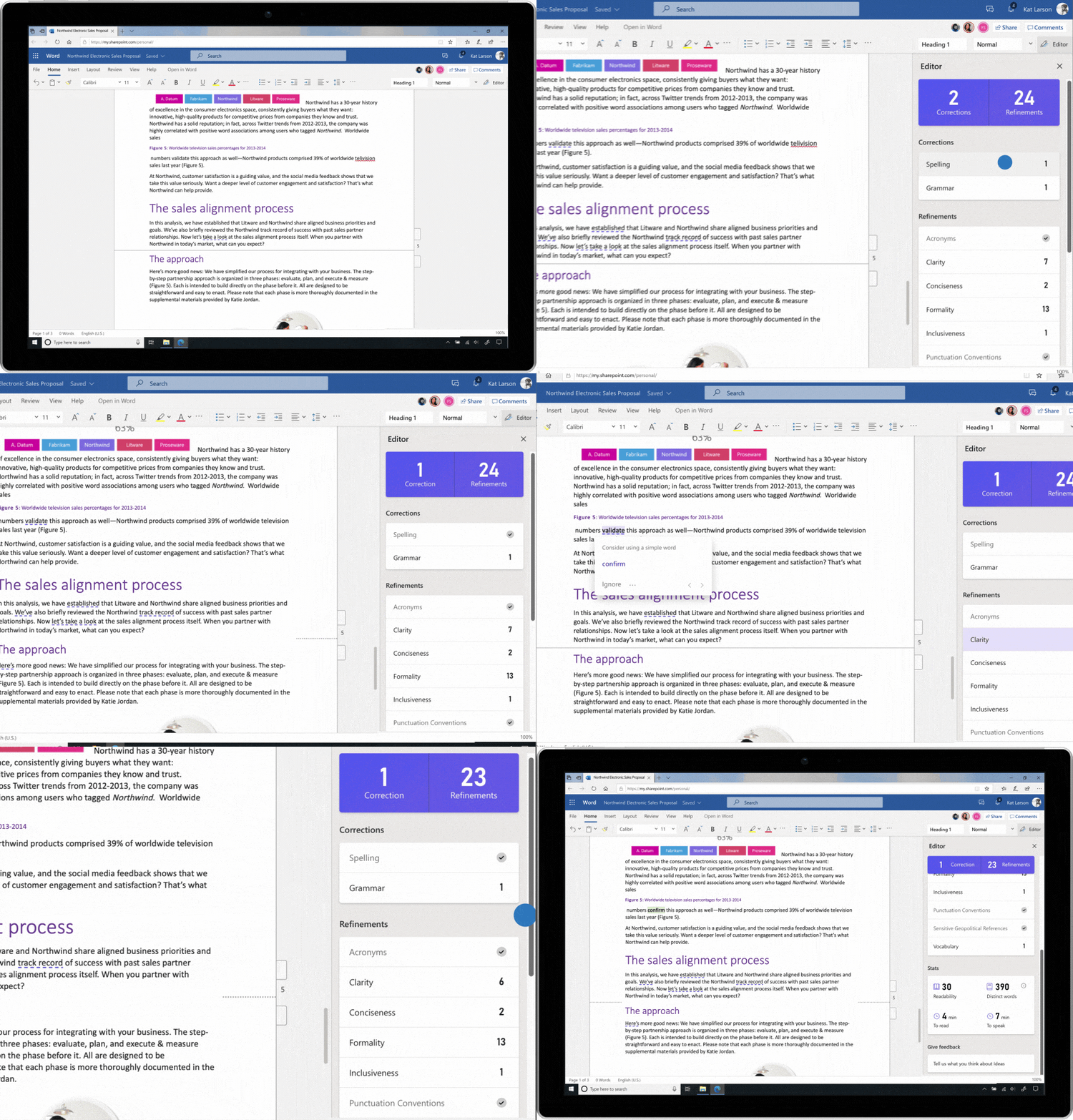
About a year ago, Microsoft announced that Word Online would get a new AI-powered editor that would help you write better. You can think of it as a smarter grammar checker that can fix all of your standard grammar mistakes but can also help you avoid overly complex sentences and bias in your word choices.
This editor is now the Microsoft Editor, and the company is expanding it well beyond Word. The new AI-powered service is now available in 20 languages in Word and Outlook.com — and maybe most importantly, it’ll be available as a Microsoft Edge and Google Chrome plug-in, too.
Free users will get basic spelling and grammar features, while Microsoft 365 subscribers will get a number of more advanced features like the ability to ask the editor to suggest a rewrite of a mangled sentence, a plagiarism checker, style analysis to see if your writing is unclear or too formal and access to an inclusive language critique to help you avoid unintentional bias.
If you’ve used Grammarly in the past, then a lot of this will sound familiar. Both services now offer a similar set of capabilities, but Microsoft may have an edge with its ability to rewrite sentences.
Better presentations through technology
In a similar vein, Microsoft also launched a presentation coach for PowerPoint as a limited test last September. This AI-driven feature helps you avoid filler words and other presentation no-nos.

This feature first launched in the online version of PowerPoint, with a basic set of features. Now, Microsoft 365 subscribers will get two new advanced features, too, that can help you avoid a monotone pitch that puts your audience to sleep and avoid grammar mistakes in your spoken sentences.
Currently, these are still available as a free preview to all but will become Microsoft 365-only features soon.
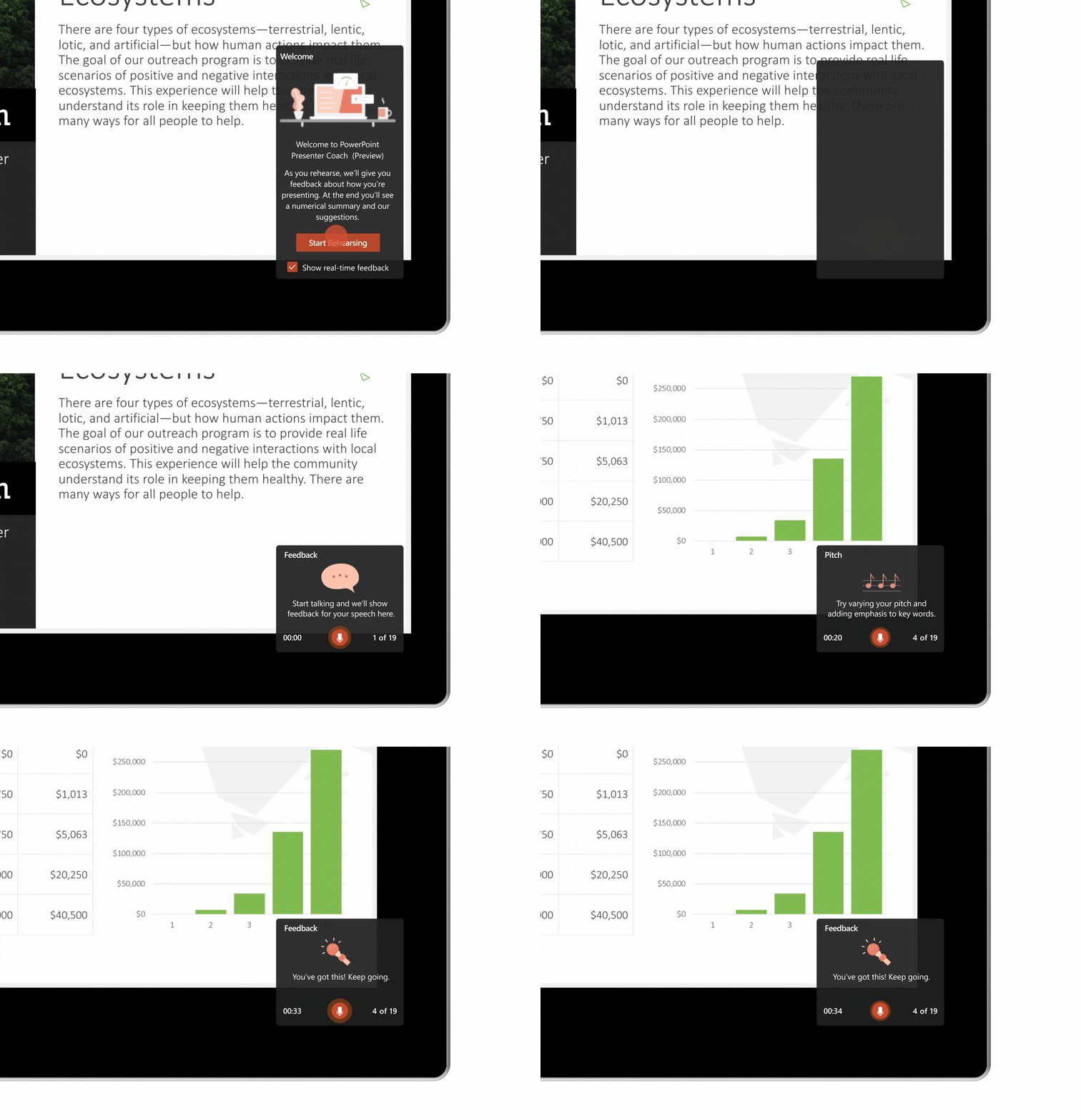 PowerPoint is also getting an updated Designer to help you create better presentations. It can now easily turn text into a timeline, for example, and when you add an image, it can present you with a set of potential slide layouts.
Microsoft 365 subscribers now also get access to over 8,000 images and 175 looping videos from Getty Images, as well as 300 new fonts and 2,800 new icons.
Excel + Plaid
For you spreadsheet jockeys out there, Microsoft also has some good news, especially if you want to use Excel to manage your personal budgets.
In partnership with Plaid, you can now link your bank accounts to Excel and import all of your expenses into your spreadsheets. With that, you can then categorize your spend and build your own personal Mint. This feature, dubbed “Money in Excel,” will launch in the U.S. in the coming months.
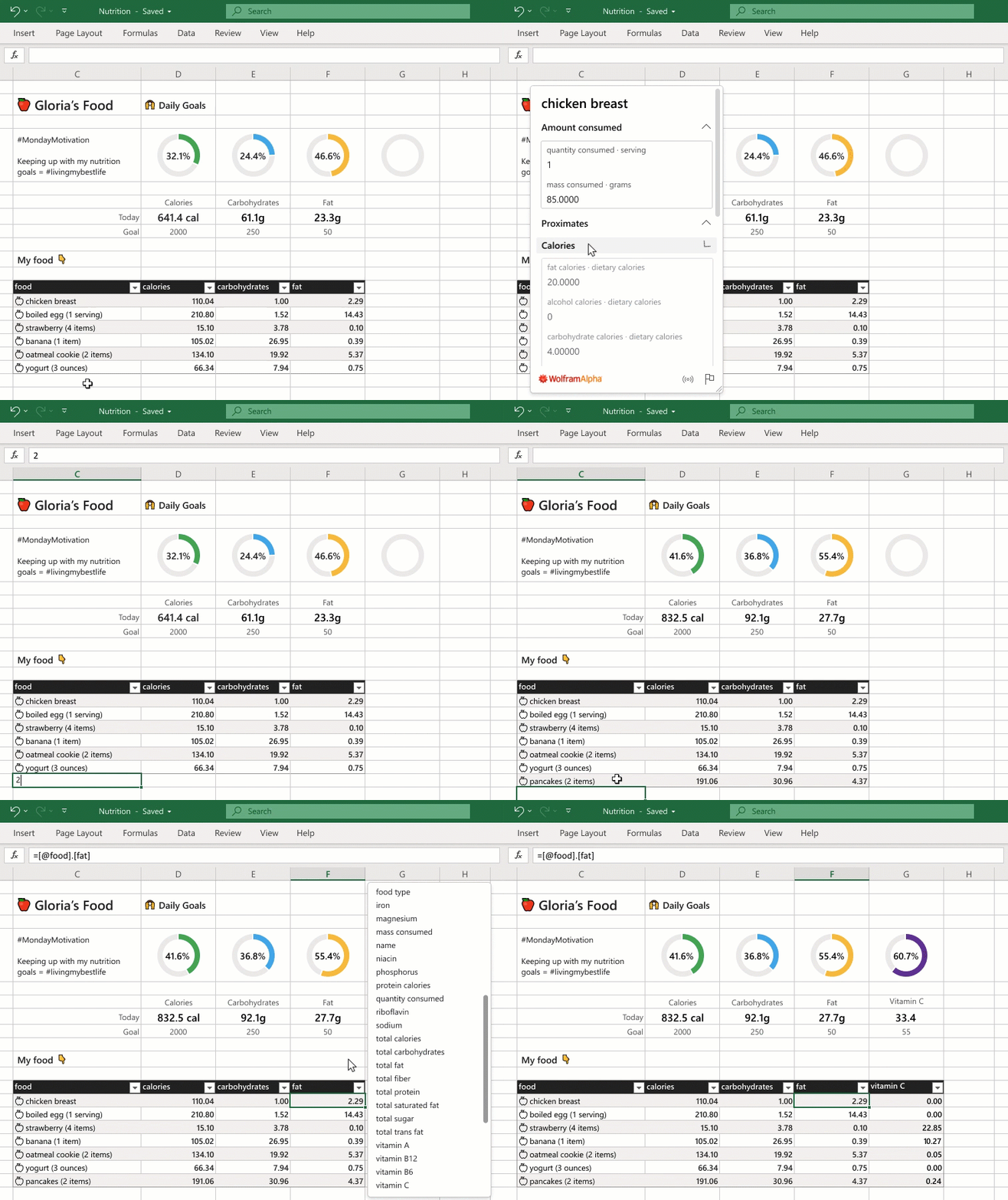
In addition, Excel is getting a lot more cloud- and AI-driven data types that now cover over 100 topics, including nutrition, movies, places, chemistry and — because why not — Pokémon. Like some of the previous features, this is an extension of the work Microsoft did on Excel in the last few years, starting with the ability to pull in stock market and geographical data.
And just like with the previous set of features, you’ll need a Microsoft 365 subscription to get access to these additional data types. Otherwise, you’ll remain restricted to the stock market and geography data types, which will become available to Office Insiders in the spring and then Personal and Family subscribers in the U.S. in the coming months.
Outlook gets more personal
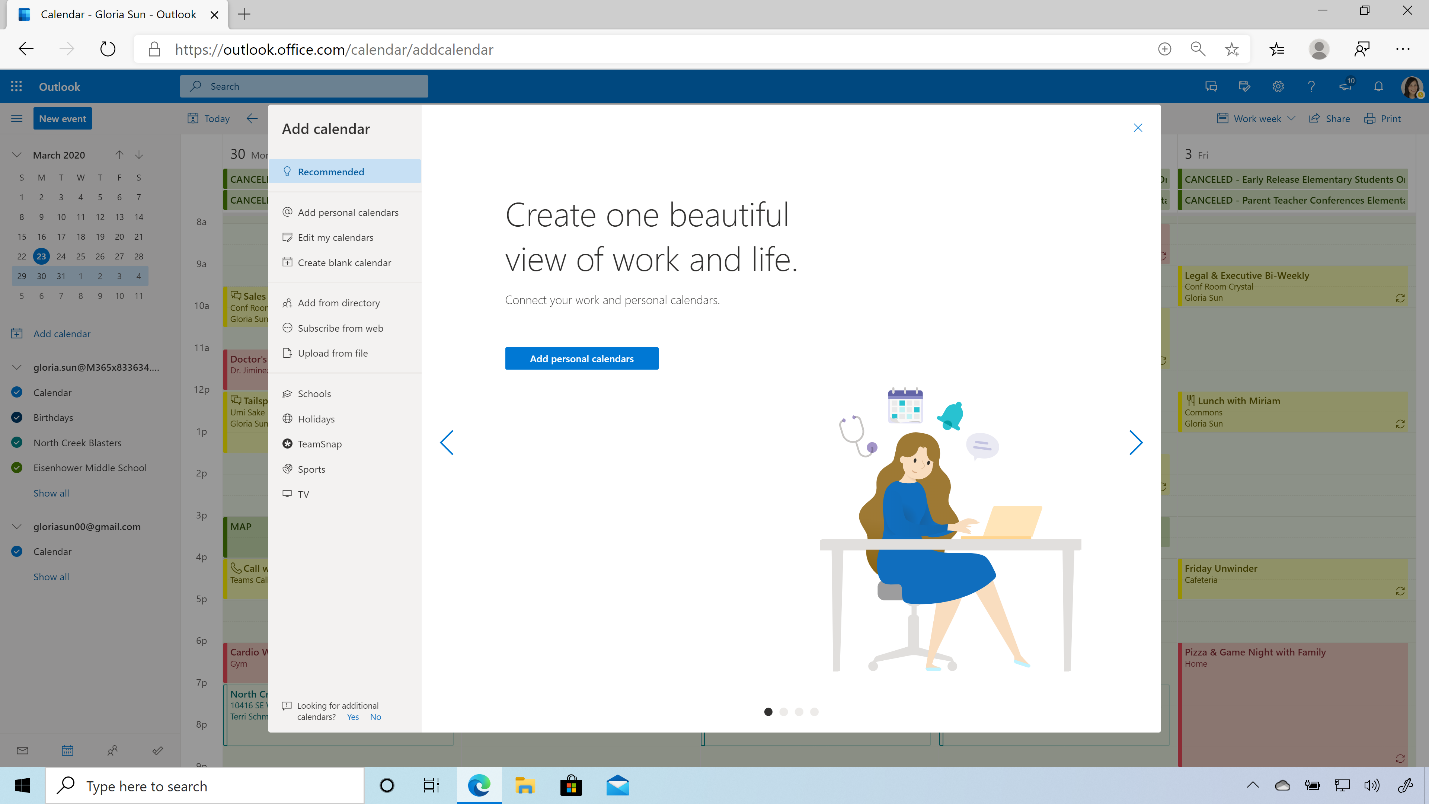
Even though you may want to forget about Outlook and ignore your inbox for a while, Microsoft doesn’t. In Outlook on the web, you can now link your personal and work calendars to ensure you don’t end up with a work meeting in the middle of a personal appointment, because Chris from marketing really needs another sync meeting during your gym time even though a short email would suffice.
Outlook for Android can now summarize and read your emails aloud for you, too. This feature will roll out in the coming months.
Family Safety
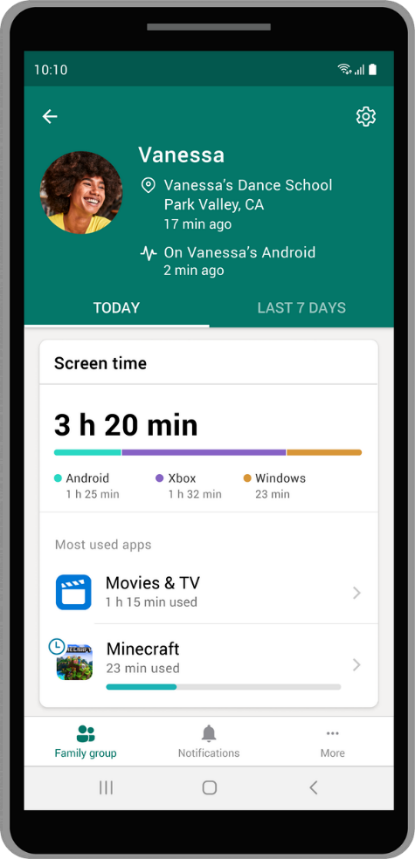
While most of the new features here focus on existing applications, Microsoft is also launching one completely new app: Microsoft Family Safety. This app is coming to Microsoft 365 subscribers on iOS and Android and will bring together a set of tools that can help families manage their online activities and track the location of family members.
The app lets families manage the screen time of their kids (and maybe parents, too) across Windows, Android and Xbox, for example. Parents can also set content filters that only allow kids to download age-appropriate apps. But it also allows parents to track their kids in the real world through location tracking and even driving reports. This, as Mehdi stressed, is a feature that kids can turn off, but they’ll probably have to explain themselves to their parents then. Indeed, he stressed that a lot of what the app does is give parents a chance to have a dialog with their kids. What makes the service unique is that it works across platforms, with iOS support coming in the future.
This app is launching as a limited preview now and will be available in the coming months (I think you can spot a trend here).
Partner benefits
Mehdi noted that Microsoft is also partnering with companies like Adobe, Bark, Blinkist, Creative Live, Experian, Headspace and TeamSnap to provide Microsoft 365 subscribers with additional benefits like limited-time access to their products and services. Subscribers will get three months of free access to Adobe’s Creative Cloud Photography plan, for example.
At the core of today’s updates, though, is a mission to bring a lot of the productivity tools that people know from their work life to their personal life, too, with the personal edition of Teams being the core example.
“We’re very much excited to bring this type of value — not increase the price of Office 365 — take a big step forward, and then move to this,” Mehdi said. “We think now more than ever, it is valuable for people to have the subscription service for their life that helps them make the most of their time, protects their family, lets them develop and grow. And our goal or aspiration is: Can we give you the most valuable subscription for your life? I know people value their video subscriptions and music subscriptions. Our aspiration is to provide the most valuable subscription for your life via Microsoft 365 Personal and Family.”
Microsoft brings Teams to consumers and launches Microsoft 365 personal and family plans
Source: Microsoft
High-altitude launch startup Stratolaunch has gone through some changes, but on Monday it revealed design details of two hypersonic aircraft, along with a space plane, all designed to take-off from its flying carrier plane launch platform. If all goes to plan, test flights of the first of these new vehicles will begin in 2022, and the company says it’s fully funded to be able to get to that point.
Stratolaunch was originally founded in 2011 by Microsoft co-founder Paul Allen. Allen unfortunately passed away last year, and the company is now led by a group of investors led by Steve Feinberg. The new ownership is still tracking towards the original goal of the company, however, which is to develop hypersonic atmospheric aircraft.
On Monday, it also unveiled an extension of its mission to get into spaceflight via a new space plane that could potentially carry both cargo and crew. It’s designed to be fully reusable, and is meant to both take up and return cargo with conventional runway landing capabilities.
Stratolaunch’s first goal, however, will be to bring its Talon A hypersonic autonomous aircraft to life. Also designed for full reusability, the Talon A will measure roughly 28 feet in length, and have an 11.3-foot wingspan. It’s designed to fly for over a minute in hypersonic mode for testing, and then slide back down for a fully autonomous landing on a standard runway. The aircraft will not only be able to be deployed from the Stratolaunch carrier aircraft, but will also be designed to take-off on its own autonomously, also like a traditional aircraft from a standard runway.
The aircraft’s main purpose is to provide a testbed for various types of instrumentation and data gathering during hypersonic flight – it’s essentially a lab that can provide real-world experience of something perviously available only in simulation. Up to three of the Talon A vehicles can be transported and launched from one of Stratolaunch’s carrier aircraft at once.
Talon Z, meanwhile, looks to be a larger hypersonic aircraft, but Stratolaunch isn’t sharing much more in the way of details about its capabilities or intended purpose yet. The Black Ice space plane will likewise probably mostly serve customers looking for orbital experimentation, but its cargo and future potential crew capabilities could actually make it well-suited to orbital logistics and potentially even satellite deployment capabilities.
Stratolaunch’s approach with Black Ice is somewhat akin to what Virgin Galactic and Virgin Orbit are doing for commercial passenger spaceflight and small satellite cargo, respectively. The two Virgin companies also use traditional take-off aircraft as the launch platforms for their vehicles, but they’re much further along in their development program. Stratolaunch did complete the first test flight of its carrier aircraft last year, and is aiming to have Talon A ready for commercial service by 2023.
Stratolaunch reveals updated fleet, including two hypersonic aircraft and a space plane
Source: Microsoft
Microsoft is pulling out of an investment in an Israeli facial recognition technology developer as part of a broader policy shift to halt any minority investments in facial recognition startups, the company announced late last week.
The decision to withdraw its investment from AnyVision, an Israeli company developing facial recognition software, came as a result of an investigation into reports that AnyVision’s technology was being used by the Israeli government to surveil residents in the West Bank.
The investigation, conducted by former U.S. Attorney General Eric Holder and his team at Covington & Burling, confirmed that AnyVision’s technology was used to monitor border crossings between the West Bank and Israel, but did not “power a mass surveillance program in the West Bank.”
Microsoft’s venture capital arm, M12 Ventures, backed AnyVision as part of the company’s $74 million financing round which closed in June 2019. Investors who continue to back the company include DFJ Growth and OG Technology Partners, LightSpeed Venture Partners, Robert Bosch GmbH, Qualcomm Ventures, and Eldridge Industries.
Microsoft first staked out its position on how the company would approach facial recognition technologies in 2018, when President Brad Smith issued a statement calling on government to come up with clear regulations around facial recognition in the U.S.
Smith’s calls for more regulation and oversight became more strident by the end of the year, when Microsoft issued a statement on its approach to facial recognition.
Smith wrote:
We and other tech companies need to start creating safeguards to address facial recognition technology. We believe this technology can serve our customers in important and broad ways, and increasingly we’re not just encouraged, but inspired by many of the facial recognition applications our customers are deploying. But more than with many other technologies, this technology needs to be developed and used carefully. After substantial discussion and review, we have decided to adopt six principles to manage these issues at Microsoft. We are sharing these principles now, with a commitment and plans to implement them by the end of the first quarter in 2019.
The principles that Microsoft laid out included privileging: fairness, transparency, accountability, non-discrimination, notice and consent, and lawful surveillance.
Critics took the company to task for its investment in AnyVision, saying that the decision to back a company working with the Israeli government on wide-scale surveillance ran counter to the principles it had set out for itself.
Now, after determining that controlling how facial recognition technologies are deployed by its minority investments is too difficult, the company is suspending its outside investments in the technology.
“For Microsoft, the audit process reinforced the challenges of being a minority investor in a company that sells sensitive technology, since such investments do not generally allow for the level of oversight or control that Microsoft exercises over the use of its own technology,” the company wrote in a statement on its M12 Ventures website. “Microsoft’s focus has shifted to commercial relationships that afford Microsoft greater oversight and control over the use of sensitive technologies.”
Divesting from one facial recognition startup, Microsoft ends outside investments in the tech
Source: Microsoft
Earlier this year, Microsoft made waves in the corporate community by coming out with one of the most ambitious and wide-ranging strategies to reduce carbon emissions from the company’s operations.
Part of that plan was a $1 billion fund that would invest in climate change mitigation technologies — specifically focused on decarbonization. At the time, details were scarce, but it looks like the strategy is becoming a little more clear, with details beginning to emerge about who will be running the show.
According to sources — and a LinkedIn profile search — it appears that Brandon Middaugh is taking point on the investment fund.
Middaugh has been at Microsoft for more than four years and worked as one of the architects of the company’s climate strategy during her tenure at the company. In her previous role as part of the company’s Cloud Energy and Sustainability team, Middaugh led the distributed energy strategy and was a part of the partnership Microsoft initiated with the East Coast regional transmission organization, the PJM — which manages the power grid for a large swath of the Northeastern and Mid-Atlantic region of the U.S.
It appears that Middaugh is going to be taking point on the deployment of that $1 billion fund Microsoft announced in January, according to people who have discussed the company’s investments.
At the January event, Microsoft committed to going “carbon negative” by 2030 and said that it would remove by 2050 the equivalent of all the carbon it had emitted into the atmosphere since its founding in 1975. Those commitments are far more aggressive than any made by any other corporation in any industry.
Part of the plan involves expanding the carbon fee the company has imposed internally on its direct emission across its supply and value chains. The $1 billion fund is part of that effort to reduce emissions from suppliers and customers by financing projects and technologies that can reduce emissions with new generation or efficiency technologies, or capture and remove carbon from the atmosphere.
Equity and debt investments have to meet four criteria, including: the ability to drive meaningful decarbonization, climate resilience or other sustainability-related goals; have additional market impacts for future climate solutions; can address Microsoft’s own climate debt; and have implications for the unequal distribution of climate impacts.
Late last year, Amazon committed that it would move to 100% renewable energy powering its operations by 2030 and that it would achieve net zero carbon emissions by 2040. Meanwhile, Alphabet has been developing renewable energy projects under its moonshot division and has long been an investor in climate mitigation technologies, including the use of renewables to power its operations.
All of these efforts will need to be met by additional work from corporations and financial institutions across every industry if the world is to reduce the most dire effects of dramatic climate change. Already forest fires, flooding and other climate-related catastrophes have led financial investors and insurers to push for better mitigation strategies and to bring climate impacts front and center within corporate strategies.
Microsoft had not replied to a request for comment by the time of publication.
It looks like Brandon Middaugh is heading up the B Microsoft climate fund
Source: Microsoft
During a recent visit, Microsoft chief executive Satya Nadella reiterated his company’s commitment to India and revealed a new fund to help SaaS startups in the country.
And then Nadella and Anant Maheshwari, president of Microsoft India, discussed the success story of B2B platform Udaan in three separate onstage public appearances.
Headquartered in Bangalore, Udaan is a business-to-business e-commerce marketplace founded by former Flipkart executives Amod Malviya, Vaibhav Gupta and Sujeet Kumar. The startup used Microsoft’s free Azure credits to scale in its early days; as in some other markets, Microsoft, Amazon and Google offer free cloud credits in bulk to early, promising Indian startups in a bid to onboard them and see if their solutions could be relevant to other clients down the road.
More often than not, these bets don’t work, but sometimes they pay off. Udaan, valued at about $2.7 billion after raising nearly $900 million from investors like Lightspeed Venture Partners, Tencent Holdings, GGV Capital and Hillhouse Capital, has become one of Microsoft India’s biggest clients in the last three years.
Udaan was founded in 2016 at the tail end of India’s e-commerce frenzy, when scores of startups that had attempted to build business-to-consumer online shopping platforms were conceding defeat.
At the time, very few players — like Power2SME and Moglix (industrial products) and Bizongo (packaging for businesses) — were looking at the business-to-business market in India.
Udaan is valued at about $2.7B after raising nearly $900M from investors like Lightspeed Venture Partners, Tencent Holdings, GGV Capital and Hillhouse Capital and has become one of Microsoft India’s biggest clients.
But despite venturing into a road less traveled, Udaan had ambitious dreams. The startup was building its own logistics network, a herculean task that even Flipkart and Amazon avoided to a certain measure for years, yet it was reaching an audience that had never sold online.
Inside Udaan’s push to digitize India’s B2B retail market
