Source: Microsoft

The COVID-19 pandemic has had an almost immeasurable negative impact on the wider economy. Specifically in the job market, there have been millions of job losses, and in the U.S. alone unemployment numbers like these have not been seen since the Great Depression. Now, tech companies are slowly stepping up to try to address the crisis, and the latest development on that front comes from Microsoft.

The company today announced a wide-ranging, global portal for free skills training for people who are out of work. Alongside that, Microsoft said it plans to disperse $20 million in grants to nonprofit organizations that are working to help those who have lost jobs due to COVID-19 and subsequent shifts in the economy, and with a specific emphasis on those that are working with groups that are underrepresented in the tech world.

The move comes as we are seeing other tech companies try to make their own efforts to leverage their platforms to provide their own versions of relief efforts connected to COVID-19. Google has built special portals to keep people informed on local, national and global progress of COVID-19 and related news. Facebook has built an information portal and has also created an avenue for people to offer volunteering help to those in need specifically in their community.

The money that Microsoft will be granting to nonprofits is aimed at a wide swathe of organizations, not just those focused on helping groups learn new skills, but just those helping specific groups. Those that Microsoft already works with include Trust for the Americas, Fondazione Mundo Digitale in Italy, the Nasscom Foundation in India, Tech4Dev across Africa, NPower in Canada, the National Urban League aimed at long-term unemployed and African Americans, and Skillful.

The education and training news, meanwhile, is interesting not only because of the push that Microsoft is trying to make by leveraging the assets that it already has, but that it’s doing so in tandem with LinkedIn, the social network and professional education platform it acquired for $26.2 billion in 2016. Even though they are the same company, it’s often the case that you see less collaboration between the two than you might think would exist, but this seems to be a shift from that position.

Microsoft notes that using data from LinkedIn, it identified 10 specific tech jobs that are in particular demand right now and will continue to be in demand, offer a livable wage and require skills that can be learned online if you don’t already have them. They are software developer, sales rep, project manager, IT admin, customer services rep, digital marketer, IT support, data analyst, financial analyst and graphic designer.

LinkedIn has designed “Learning Paths” that it offers through its online education portal for these jobs, and these will now be available to everyone free to use, globally, until the end of March 2021, in English, French, Spanish and German, with content getting updated in the tracks as needed. Alongside these, Microsoft Learn is offering supplemental technical content to these Paths, and Microsoft is also making GitHub’s Learning Lab free to practice if you’re learning software developer skills.

Alongside these, Microsoft is also giving a push to so-called “soft skills” that complement hunting for a job at the moment, including tips on looking for a job right now, learning “critical” soft skills, more on the concept and meaning of digital transformation, and a learning track focused on diversity, inclusion and allyship.

You can look at a list of all the content available and ultimately relevant jobs on LinkedIn’s purpose-built portal.

Image Credits: LinkedIn

In addition to the online learning efforts, LinkedIn is also launching a separate track for those who want to either leverage LinkedIn to get spotted more easily for job opportunities, and for those who want to volunteer to help others, to offer advice and mentorship for those looking for work, or get more training to get through interviews. For those who want to signal their job seeking, they can now add an “OpenToWork” frame on their profile pictures, which links to a separate banner that runs under your profile picture that lets people see what kinds of jobs you would like to consider.

The offer to help is not unlike LinkedIn’s efforts at cultivating a mentorship program: The idea is that there are people who have the time and desire to use their skills to help others than just themselves and the companies they work for. As with the mentoring, those interested can indicate what they would like to do — making introductions, resume help or just providing advice.

LinkedIn’s interview preparations, meanwhile, are another step into working closer with Microsoft: LinkedIn’s built a set of tools that uses Microsoft’s AI platform for feedback throughout the training.

Microsoft to distribute M in grants to nonprofits, offers free skills training via LinkedIn

Source: Microsoft

Google today announced a couple of updates to Google Sheets that will make building spreadsheets and analyzing data in them a little bit easier.

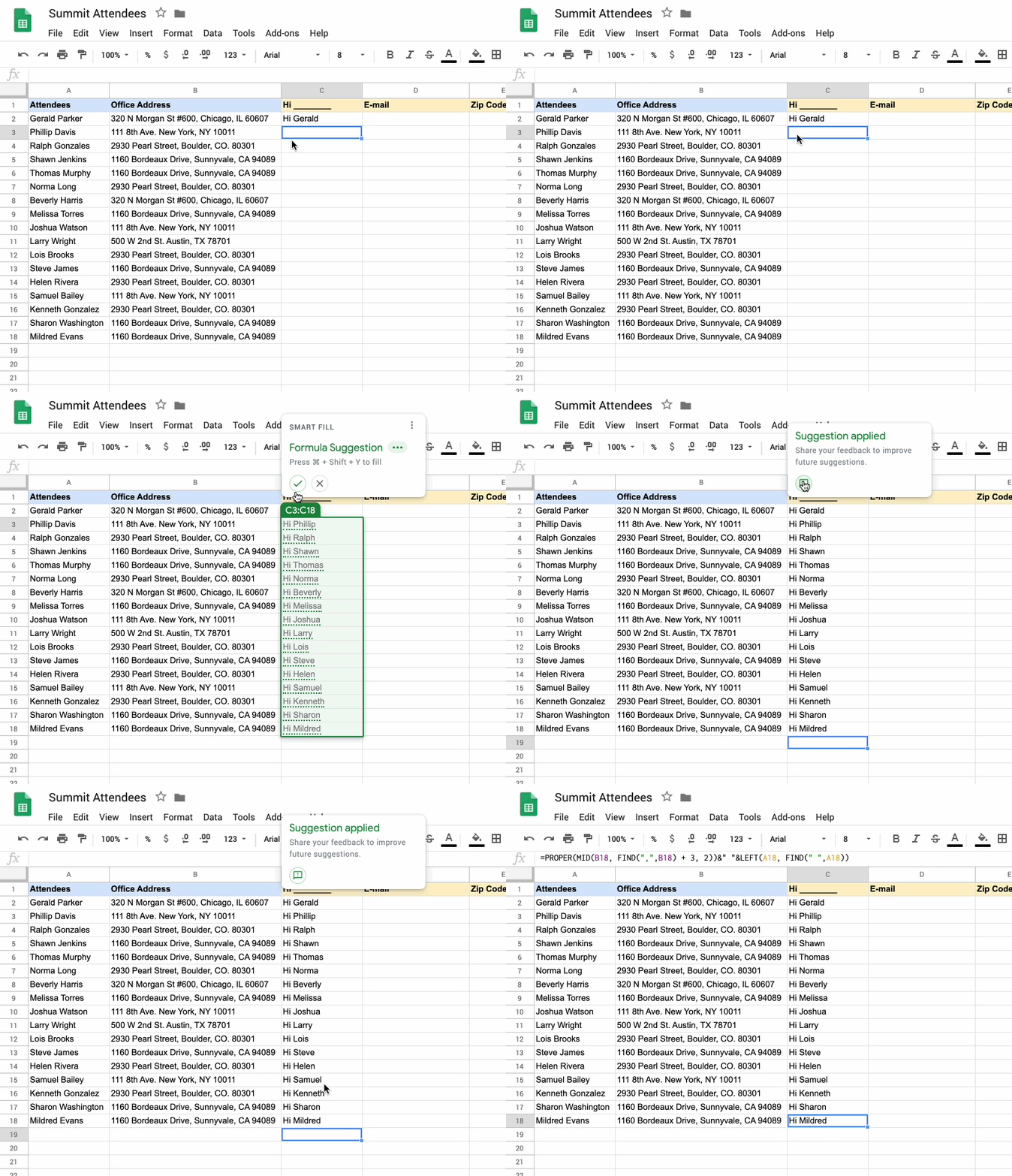
The most interesting feature here, surely, is the upcoming launch of Smart Fill. You can think of it as Smart Compose, the feature that automatically tries to finish your sentences in Gmail, but for spreadsheets. The idea here is that Smart Fill, which will launch later this year, can autocomplete your data for you.

“Say you have a column of full names, but you want to split it into two columns (first and last name, for example),” Google explains in today’s announcement. “As you start typing first names into a column, Sheets will automatically detect the pattern, generate the corresponding formula, and then autocomplete the rest of the column for you.”


That’s a nifty feature, though it’s worth noting that Microsoft has made some major strides in bringing a lot of ML-based features to Excel, too, which can now automatically create new columns based on its understanding of what your spreadsheet is about, for example. It just extended the number of these AI-driven data types to well over 100 at its Build developer conference. The use case here is a bit different, but both companies are using similar techniques to make building spreadsheets easier.

One feature that’s nice about how Google built this is that it doesn’t so much auto-magically fill a column but that it builds a formula to fill it, giving you quite a bit of flexibility to then manipulate that data as needed.

The second new feature that will be coming in the near future is Smart Cleanup, which, as the name implies, can help you clean up your data by finding duplicate rows and formatting issues. The tool will suggest changes, which users can then accept or ignore.

The company also today announced the general availability of Connected Sheets, a feature that connects a BigQuery data warehouse with Sheets so that you can analyze petabytes of data in sheets without having to know SQL or really any programming language. This feature aims to democratize access to big data analytics by giving anybody in a company who knows how to use a spreadsheet the ability to analyze that data and create charts based on it.

Connected Sheets is now available to G Suite Enterprise, G Suite Enterprise for Education and G Suite Enterprise Essentials users.

Google Sheets will soon be able to autocomplete data for you

Source: Microsoft

As other retailers begin the slow, cautious move to reopen, Microsoft has announced that will be permanently shutting down the vast majority of its retail stores. There are some exceptions, including flagships in urban hubs including London, New York City, Sydney and its own campus in Redmond, Washington, but the remainder of the locations are going away.

In a post optimistically titled, “Microsoft Store announces new approach to retail,” the company spells out what amounts to a profound shift in an approach to retail that had previously found the company looking to compete with Apple at its own brick and mortar game.

It notes the planned temporary shutdown of locations due to COVID-19, but while the pandemic no doubt had an impact on that sector, this was likely a long time coming. In June of late year, it closed its smaller Specialty Stores and kiosks in the U.S.

“Our sales have grown online as our product portfolio has evolved to largely digital offerings, and our talented team has proven success serving customers beyond any physical location,” said Corporate VP David Porter says in the post.

Some goodish news in all of this. Microsoft has committed to transitioning retail employees to new sales and other roles, as the company shifts resources back into online commerce.

“The company’s retail team members will continue to serve customers from Microsoft corporate facilities and remotely providing sales, training, and support,” it writes. “Microsoft will continue to invest in its digital storefronts on Microsoft.com, and stores in Xbox and Windows, reaching more than 1.2 billion people every month in 190 markets.”

Nearly all of Microsoft’s retail stores will close for good

Source: Microsoft

Microsoft is killing its Twitch competitor Mixer next month and is partnering with Facebook to push its users toward the Facebook Gaming service.

The app is winding down on July 22. The sudden move comes after Microsoft has dumped considerable efforts into its gaming-centric streaming service, acquiring streaming rights to some of the biggest esports personalities like Ninja and Shroud. Microsoft couldn’t spend its way into meaningfully competition with Amazon’s Twitch and Alphabet’s YouTube Gaming.

The company launched its Mixer service in 2017 after acquiring the gaming startup Beam Interactive in 2016.

Microsoft announced that when the service sunsets, it will be transitioning partnerships to Facebook Gaming and redirecting its users to the service as well. The partnership between the two is a T-Mobile and Sprint partnership of sorts, as the two were clearly trailing far behind the YouTube Gaming/Twitch duopoly. The Facebook partnership goes deeper than just watching streams; Microsoft will integrate their xCloud game-streaming service into Facebook Gaming so users can quickly play titles that they see inside the service.

According to an interview in The Verge, top streamers like Ninja won’t be forced to migrate to Facebook Gaming and will be able to rejoin Twitch if they choose. Microsoft’s gaming chief Phil Spencer pinned the shutdown on the service’s inability to catch up with competitors:

We started pretty far behind, in terms of where Mixer’s monthly active viewers were compared to some of the big players out there,” says Phil Spencer, Microsoft’s head of gaming, in an interview with The Verge. “I think the Mixer community is really going to benefit from the broad audience that Facebook has through their properties, and the abilities to reach gamers in a very seamless way through the social platform Facebook has.

According to data from SensorTower, year-to-date downloads of the app on the App Store and Google Play were down 23% in 2020 compared to the same period of 2019, with the app seeing 3.4 million downloads this year. The company says their data shows that the app has been installed about 21 million times in total.

The announcement came in the midst of Apple’s WWDC keynote, so fair to say that Microsoft was likely aiming to minimize attention on this high-profile shutdown.


Microsoft kills Mixer, will push users to Facebook Gaming

Source: Microsoft

Microsoft acquires a security startup, Canva raises $60 million and Apple kicks off a virtual WWDC.

Here’s your Daily Crunch for June 22, 2020.

1. Microsoft confirms acquisition of CyberX to boost security in its Azure IoT business

Microsoft announced today that it’s acquiring CyberX, a security startup that focuses on detecting, stopping and predicting security breaches on Internet of Things networks and the networks of large industrial organizations. Terms of the deal are not being disclosed, but sources say that it’s in the region of $165 million.

The deal also illustrates how bigger tech companies are using the economic slowdown to focus on their longer-term strategies and shore up assets to support those strategies.

2. Canva raises $60 million on a $6 billion valuation

At the beginning of the pandemic, Canva made a commitment to continue paying all of its contracted workers, but froze hiring. The company also made quick moves to shut down the office and move to remote work. At the same time, Canva says it’s getting a boost from the world moving to work from home.

3. Live from Apple’s virtual WWDC 2020

What will Apple announce today? You can wait for tomorrow’s Daily Crunch to find out, or you can follow along with our live blog. The keynote starts at 10 a.m. Pacific/1 p.m. Eastern.

4. Virgin Galactic to buy seats on rockets and train private astronauts for Space Station trips

Virgin Galactic is in the process of developing a sub-orbital space tourism program using its own spacecraft, but this deal would involve use of other spacecraft that have the capacity to reach orbit and the ISS — which Virgin Galactic’s SpaceShipTwo can’t do.

5. Ideas for a post-COVID-19 workplace

As a workplace strategist, Albert De Plazaola says he’s constantly asked, “What is the workplace of the future?” But in his view, Frank Lloyd Wright already designed the solution. (Extra Crunch membership required.)

6. BMW, Mercedes-Benz end ‘long-term’ automated driving alliance, for now

BMW Group and Mercedes-Benz AG have punted on what was meant to be a long-term collaboration to develop next-generation automated driving technology together, less than a year after announcing the agreement.

7. This week’s TechCrunch podcasts

The latest full-length Equity episode discusses the Hey email app and its developer’s dispute with Apple, while the Monday news roundup recaps recent fundings. And on Original Content, we review Spike Lee’s new movie on Netflix, “Da 5 Bloods.”

The Daily Crunch is TechCrunch’s roundup of our biggest and most important stories. If you’d like to get this delivered to your inbox every day at around 9am Pacific, you can subscribe here.

Daily Crunch: Microsoft acquires CyberX

Source: Microsoft

It’s raised $5.7 billion from Facebook. It’s taken $1.5 billion from KKR, another $1.5 billion from Vista Equity Partners, $1.5 billion from Saudi Arabia’s Public Investment Fund$1.35 billion from Silver Lake, $1.2 billion from Mubadala, $870 million from General Atlantic, $750 million from Abu Dhabi Investment Authority, $600 million from TPG, and $250 million from L Catterton.

And it’s done all that in just nine weeks.

India’s Reliance Jio Platforms is the world’s most ambitious tech company. Founder Mukesh Ambani has made it his dream to provide every Indian with access to affordable and comprehensive telecommunications services, and Jio has so far proven successful, attracting nearly 400 million subscribers in just a few years.

The unparalleled growth of Reliance Jio Platforms, a subsidiary of India’s most-valued firm (Reliance Industries), has shocked rivals and spooked foreign tech companies such as Google and Amazon, both of which are now reportedly eyeing a slice of one of the world’s largest telecom markets.

What can we learn from Reliance Jio Platforms’s growth? What does the future hold for Jio and for India’s tech startup ecosystem in general?

Through a series of reports, Extra Crunch is going to investigate those questions. We previously profiled Mukesh Ambani himself, and in today’s installment, we are going to look at how Reliance Jio went from a telco upstart to the dominant tech company in four years.

The birth of a new empire

Months after India’s richest man, Mukesh Ambani, launched his telecom network Reliance Jio, Sunil Mittal of Airtel — his chief rival — was struggling in public to contain his frustration.

That Ambani would try to win over subscribers by offering them free voice calling wasn’t a surprise, Mittal said at the World Economic Forum in January 2017. But making voice calls and the bulk of 4G mobile data completely free for seven months clearly “meant that they have not gotten the attention they wanted,” he said, hopeful the local regulator would soon intervene.

This wasn’t the first time Ambani and Mittal were competing directly against each other: in 2002, Ambani had launched a telecommunications company and sought to win the market by distributing free handsets.

In India, carrier lock-in is not popular as people prefer pay-as-you-go voice and data plans. But luckily for Mittal in their first go around, Ambani’s journey was cut short due to a family feud with his brother — read more about that here.

How Reliance Jio Platforms became India’s biggest telecom network

Source: Microsoft

The U.S. Supreme Court ruled today that President Donald Trump’s administration unlawfully ended the federal policy providing temporary legal status for immigrants who came to the country as children.

The decision, issued Thursday, called the termination of the Obama-era policy known as the Deferred Action for Childhood Arrivals “arbitrary and capricious.” As a result of its ruling, nearly 640,000 people living in the United States are now temporarily protected from deportation.

While a blow to the Trump Administration, the ruling is sure to be hailed nearly unanimously by the tech industry and its leaders, who had come out strongly in favor of the policy in the days leading up to its termination by the current President and his advisors.

At the beginning of 2018, many of tech’s most prominent executives, including the CEOs of Apple, Facebook, Amazon and Google, joined more than 100 American business leaders in signing an open letter asking Congress to take action on the Deferred Action for Childhood Arrivals (DACA) program before it expired in March.

Tim Cook, Mark Zuckerberg, Jeff Bezos and Sundar Pichai who made a full throated defense of the policy and pleaded with Congress to pass legislation ensuring that Dreamers, or undocumented immigrants who arrived in the United States as children and were granted approval by the program, can continue to live and work in the country without risk of deportation.

At the time, those executives said the decision to end the program could potentially cost the U.S. economy as much as $215 billion.

In a 2017 tweet, Tim Cook noted that Apple employed roughly 250 of the company’s employees were “Dreamers”.

The list of tech executives who came out to support the DACA initiative is long. It included: IBM CEO Ginni Rometty; Brad Smith, the president and chief legal officer of Microsoft; Hewlett-Packard Enterprise CEO Meg Whitman; and CEOs or other leading executives of AT&T, Dropbox, Upwork, Cisco Systems, Salesforce.com, LinkedIn, Intel, Warby Parker, Uber, Airbnb, Slack, Box, Twitter, PayPal, Code.org, Lyft, Etsy, AdRoll, eBay, StitchCrew, SurveyMonkey, DoorDash, Verizon (the parent company of Verizon Media Group, which owns TechCrunch).

At the heart of the court’s ruling is the majority view that Department of Homeland Security officials didn’t provide a strong enough reason to terminate the program in September 2017. Now, the issue of immigration status gets punted back to the White House and Congress to address.

As the Boston Globe noted in a recent article, the majority decision written by Chief Justice John Roberts did not determine whether the Obama-era policy or its revocation were correct, just that the DHS didn’t make a strong enough case to end the policy.

“We address only whether the agency complied with the procedural requirement that it provide a reasoned explanation for its action,” Roberts wrote. 

While the ruling from the Supreme Court is some good news for the population of “dreamers,” the question of their citizenship status in the country is far from settled. And the U.S. government’s response to the COVID-19 pandemic has basically consisted of freezing as much of the nation’s immigration apparatus as possible.

An Executive Order in late April froze the green card process for would-be immigrants, and the administration was rumored to be considering a ban on temporary workers under H1-B visas as well.

The President has, indeed, ramped up the crackdown with strict border control policies and other measures to curb both legal and illegal immigration. 

More than 800,000 people joined the workforce as a result of the 2012 program crafted by the Obama administration. DACA allows anyone under 30 to apply for protection from deportation or legal action on their immigration cases if they were younger than 16 when they were brought to the US, had not committed a crime, and were either working or in school.

In response to the Supreme Court decision, the President tweeted “Do you get the impression that the Supreme Court doesn’t like me?”


Affirming the position of tech advocates, Supreme Court overturns Trump’s termination of DACA

Source: Microsoft

Microsoft tried to sell its facial recognition technology to the Drug Enforcement Administration as far back as 2017, according to newly released emails.

The American Civil Liberties Union obtained the emails through a public records lawsuit it filed in October, challenging the secrecy surrounding the DEA’s facial recognition program. The ACLU shared the emails with TechCrunch.

The emails, dated between September 2017 and December 2018, show that Microsoft privately hosted DEA agents at its Reston, Virginia office to demonstrate its facial recognition system, and that the DEA later piloted the technology.

It was during this time that Microsoft’s president Brad Smith was publicly calling for government regulations covering the use of facial recognition.

But the emails also show that the DEA expressed concern with purchasing the technology, fearing criticism from the FBI’s use of facial recognition at the time that caught the attention of government watchdogs.

Critics have long said this face-matching technology violates Americans’ right to privacy, and that the technology disproportionately shows bias against people of color. But despite the rise of facial recognition by police and in public spaces, Congress has struggled to keep pace and introduce legislation that would oversee the as-of-yet unregulated space.

But things changed in the wake of the nationwide and global protests after the death of George Floyd, which prompted a renewed focus about law enforcement and racial injustice.

An email from a Microsoft account executive inviting DEA agents to its Reston, Virginia office to demo its facial recognition technology. (Source: ACLU/supplied)

Microsoft was the third company last week to say it will no longer sell its facial recognition technology to police until more federal regulation is put into place, following in the footsteps of Amazon, which put a one-year moratorium on selling its technology to police. IBM went further, saying it will wind down its facial recognition business entirely.

But Microsoft, like Amazon, did not say if it would no longer sell to federal departments and agencies like the DEA.

“It is bad enough that Microsoft tried to sell a dangerous technology to a law enforcement agency tasked with spearheading the racist drug war, but it gets worse,” said Nathan Freed Wessler, a senior staff attorney at the ACLU. “Even after belatedly promising not to sell face surveillance tech to police last week, Microsoft has refused to say whether it would sell the technology to federal agencies like the DEA,” said Wessler.

“This is troubling given the U.S. Drug Enforcement Administration’s record, but it’s even more disturbing now that Attorney General Bill Barr has reportedly expanded this very agency’s surveillance authorities, which could be abused to spy on people protesting police brutality,” he said.

Lawmakers have since called for a halt to the DEA’s covert surveillance of protesters, powers that were granted by the Justice Department earlier in June as protests spread across the U.S. and around the world.

When reached, DEA spokesperson Michael Miller declined to answer our questions. A spokesperson for Microsoft did not respond to a request for comment.

Microsoft pitched its facial recognition tech to the DEA, new emails show

Source: Microsoft

Part of the challenge in seeking out an effective treatment for COVID-19 is simply one of scale – protein folding is key to understanding how the virus that causes COVID-19 attaches to health cells in order to infect them. Modeling said folding gets a big boost from distributed computing efforts like the Folding@home global program, which employs even consumer computers as processing nodes to tackle big problems. Microsoft is testing pre-packed, shipping container-sized data centres that can be spun up on demand and run deep under the ocean’s surface fo sustainable, high-efficiency and cool operation to contribute to such efforts in a big way, and it’s now using one in Scotland to model viral proteins that lead to COVID-19.

This research project isn’t new for Microsoft – it’s been operating the data center at a depth of 117 feet for two years now. But the shift of its focus to COVID-19 represents a new development, and is obviously a response to the imminent need for more advances around our understanding of the SARS-CoV-19 virus and potential therapies that we could use to treat or prevent it from infecting people.

Within the tubular submerged datacenter are 864 servers, providing significant computing power. The idea of packing them into a submersible tube is intended to provide efficiencies in terms of operating temperatures. Cooling and thermal management is essential for any high-capacity processing equipment, since all that computing power generates a tremendous amount of heat. It’s why you see such elaborate cooling equipment in high-performance gaming PC builds, and it’s doubly crucial when you’re operating at the level of the data center. Deep underwater, the thermal environment provides natural cooling that allows processors to run consistently at higher speeds, without the need to pump more energy in to run fans or more elaborate liquid cooling systems.

Should this project, which Microsoft has dubbed “Natick,” work as designed, future distributed computing projects could benefit immensely from the on-demand deployment of a number of these distributed sea-floor data centers.

Microsoft employs experimental undersea data center in search for COVID-19 vaccine

Source: Microsoft

( function() {
var func = function() {
var iframe = document.getElementById(‘wpcom-iframe-fd8a23cfe199e01c991bbff489c9ffc9’)
if ( iframe ) {
iframe.onload = function() {
iframe.contentWindow.postMessage( {
‘msg_type’: ‘poll_size’,
‘frame_id’: ‘wpcom-iframe-fd8a23cfe199e01c991bbff489c9ffc9’
}, “https://tcprotectedembed.com” );
}
}

// Autosize iframe
var funcSizeResponse = function( e ) {

var origin = document.createElement( ‘a’ );
origin.href = e.origin;

// Verify message origin
if ( ‘tcprotectedembed.com’ !== origin.host )
return;

// Verify message is in a format we expect
if ( ‘object’ !== typeof e.data || undefined === e.data.msg_type )
return;

switch ( e.data.msg_type ) {
case ‘poll_size:response’:
var iframe = document.getElementById( e.data._request.frame_id );

if ( iframe && ” === iframe.width )
iframe.width = ‘100%’;
if ( iframe && ” === iframe.height )
iframe.height = parseInt( e.data.height );

return;
default:
return;
}
}

if ( ‘function’ === typeof window.addEventListener ) {
window.addEventListener( ‘message’, funcSizeResponse, false );
} else if ( ‘function’ === typeof window.attachEvent ) {
window.attachEvent( ‘onmessage’, funcSizeResponse );
}
}
if (document.readyState === ‘complete’) { func.apply(); /* compat for infinite scroll */ }
else if ( document.addEventListener ) { document.addEventListener( ‘DOMContentLoaded’, func, false ); }
else if ( document.attachEvent ) { document.attachEvent( ‘onreadystatechange’, func ); }
} )();

Contact tracing is a practice almost as old as epidemiology itself, but today’s technology means the way that we go about tracking the spread of a contagious illness within and between communities is changing very quickly. This presents an opportunity for learning more about the opportunities and challenges presented in extending contact tracing and exposure notification via digital means, especially as contact tracing is likely a key ingredient in any successful reopening of economy in light of ongoing challenges posed by COVID-19.

To that end, we’re happy to be working with the COVID-19 Technology Task Force, as well as Harvard’s Berkman Klein Center, NYU’s Alliance for Public Interest Technology, Betaworks Studios and Hangar. We’ll be playing host on TC to their live-streamed discussion (embedded above) around contact-tracing and exposure-notification efforts, as well as how and when businesses can safely reopen, and what tools can help them to do so. The day’s events will include panel chats and software demonstrations, beginning at 11 AM EDT (8 AM PDT) on Wednesday, June 17.

Below, we’ve included an agenda of the confirmed speakers and demonstrations for the day, and in case you missed it, here’s a roundup of demonstrations of contact tracing and app demonstrations built by a number of companies thus far. RSVP for tomorrow’s free event here.

Agenda

I. Contact Tracing [11AM – 12:30PM EDT]

Contact tracing: what it is, how it works, how tech can help [11:00 – 11:45AM EDT]

Using technology to enable scaled contact tracing [11:45AM – 12:05PM EDT]

Contact tracing considerations for state and city government [12:05 – 12:30PM EDT]

II. Reopening Businesses Safely [12:30-2:00PM EDT]

Reopening businesses safely [12:30-1:15PM EDT]

Demos of tools business leaders can use to help reopen safely [1:15-2:00PM EDT]

Speakers

Margaret Bourdeaux, MD, MPH, is the policy liaison for Partners in Health COVID-19 Contact Tracing Program, and holds appointments at Harvard Medical School, Brigham and Women’s Hospital, and the Belfer Center for Science and International Affairs at Harvard Kennedy School of Government.

Daniel Burka is supporting New York State’s COVID-19 response efforts through Resolve to Save Lives, an initiative of Vital Strategies, a global health initiative led by former CDC Director Dr. Tom Frieden.

Mike Flowers is leading implementation for contact tracing technology and data strategy for the State of New Jersey as a Senior Fellow with the NJ Office of Innovation. Over the last 25 years he has worked in data intelligence with companies and federal, state and local governments, including as New York City’s first Chief Analytics Officer under Mayor Mike Bloomberg

Mary L. Gray is a senior principal researcher at Microsoft Research and an Edmond J. Safra Center for Ethics Fellow at Harvard University.

Jonathan Jackson is the founder and CEO at Dimagi, a social enterprise that develops innovative technology solutions for front-line workforces and underserved populations. They have an extensive background in global health and are a leader in mobile health data collection.

Irina Krechmer is the Chief Technology Officer at Blue Apron, the premier meal-kit company whose mission is to make incredible home cooking accessible to everyone. Before joining Blue Apron, Krechmer most recently served as VP of Engineering at XO Group Inc., the premier technology company with industry-leading digital brands, including The Knot, The Bump, The Nest and GigMasters. Krechmer has over 20 years of experience designing, developing and implementing customer-focused technology solutions, primarily at e-commerce, media and consumer technology companies.

Andrew McLaughlin is helping lead the Task Force’s contact tracing/exposure notification initiative. Andrew is the Chairman of Access Now, the Former Deputy U.S. CTO for the White House, and the Former Director of Global Public Policy at Google.

Andy Moss is currently a Visiting Professor at NYU Tandon teaching entrepreneurship and innovation, as well developing the COR Methodology. He’s an active advisor/mentor to startups and business leaders, and a former Microsoft executive.

Chelsea Raiten is Of Counsel at Gunderson Dettmer Stough Villeneuve Franklin & Hachigian, LLP. Her practice primarily focuses on providing strategic advice and counseling to employers on all aspects of the employment relationship, including hiring and firing practices, layoffs and RIF’s, wage and hour laws, reasonable accommodation, leaves of absence, employee discipline, restrictive covenants, and workplace policies and procedures.

Harper Reed is helping lead the Task Force’s contact-tracing/exposure-notification initiative. Harper is a Director’s Fellow at the MIT Media Lab, a Senior Fellow at the USC Annenberg Innovation Lab and was the CTO of Barack Obama’s 2012 re-election campaign.

Mona Sloane is an NYU-based sociologist working on inequality in the context of AI design and policy. At NYU, she helps form NYU’s Alliance for Public Interest Technology, and is Co-Principal Investigator on the COVID-19 Tech Project. Mona also leads the project Terra Incognita: Mapping NYC’s New Digital Public Spaces in the COVID-19 Outbreak.

Connor Spelliscy is Director of New Platforms at Hangar, a partner at Connectivity Fund, and helps lead COVID-19 Tech Task Force initiatives.

Minerva Tantoco has served in senior technology roles at Palm, Merrill Lynch, and UBS, holds four US patents on intelligent workflow, and served as New York City’s first-ever Chief Technology Officer. Most recently, Tantoco co-founded Grasshopper Bank, an OCC-chartered digital de novo commercial bank, and is currently a consultant and speaker on AI, smart cities, digital transformation, and equity in tech.

Randall Thomas is assisting Resolve to Save Lives and other stakeholders with the New York State response to COVID-19. Randall is the CTO of Geometer, a technology incubator.

Jonathan Zittrain is a professor of law and computer science, and co-founder of Harvard’s Berkman Klein Center for Internet & Society. Jonathan’s work focuses on topics including control of digital property, privacy frameworks and the roles of intermediaries in internet architecture.

Dr. Margaret (Peggy) Hamburg is the Foreign Secretary of the National Academy of Medicine (NAM). Dr. Hamburg previously held the post of Commissioner of the United States Food and Drug Administration (USFDA) and served as Commissioner of Health for the City of New York.

Join us June 17 for a live discussion on COVID-19 contact tracing and safe reopening strategies