Source: Microsoft
Weeks after Facebook acquired a 9.9% stake in India’s Reliance Jio Platforms, two more American firms are reportedly interested in the Indian telecom market.
Google is considering buying a stake of about 5% in Vodafone Idea, the second largest telecom operator in India, according to Financial Times. Separately, Microsoft is in talks to invest up to $2 billion in Reliance Jio Platforms, Indian newspaper Mint reported Friday.
According to Financial Times, Google has also held talks with Reliance Jio Platforms, a three-and-a-half-old telecom operator that has raised $10.3 billion in the last couple of weeks from Facebook and U.S. privacy equity firms Silver Lake, KKR, General Atlantic, and Vista.
Buzz about Microsoft’s interest in Reliance Jio Platforms, the top telecom operator in India with more than 388 million subscribers, has been swirling in the market for more than a month, though both the companies have declined to comment. A spokesperson of Google declined to comment today.
India has emerged as the one of the latest global battlegrounds for American and Chinese firms that are looking for their next billion users. About half a billion Indians came online in the last decade, with just as many still living offline.
In the last decade, Facebook and Google have launched connectivity efforts in India to bring more people online. While Facebook maintains one such effort, called Express Wi-Fi, in India, Google discontinued a project that allowed millions of Indians to access mobile internet for free at more than 400 railway stations earlier this year.
Both the companies have traditionally struggled to make much money from these users in India, the world’s second largest internet market with more than 600 million users.
Facebook chief executive Mark Zuckerberg said last month that the company would work with Jio Platforms to help small merchants and businesses come online. The two companies have already kick-started their collaboration.
Already struggling to improve their profits because of Jio’s aggressive expansion, Vodafone Idea and nation’s third largest telecom operator Airtel are also scrambling to pay India billions of dollars that they owe to the government because of a decade old case.
Executives at Vodafone Idea, a joint venture between UK-headquartered Vodafone and India’s Aditya Birla Group, said earlier this year that they may have to shut the telecom operator if the government did not provide them some relief.
The American giants have formed multiple partnerships with telecom operators in the key overseas market over the years to expand their reach in the nation. Microsoft has a partnership with Reliance Jio to bring Office 365 to millions of small businesses at subsidized cost. Google maintains a similar partnership with Airtel for its Google Cloud suite.
Google and Microsoft reportedly considering stakes in telecom firms in India after Facebook deal
Source: Microsoft
TikTok isn’t the only new media app with Chinese background that’s making waves in the U.S. News Break, a news app founded by China’s media veteran Jeff Zheng with teams in Beijing, Shanghai, Seattle and Mountain View, has been sitting among the top three news apps in the U.S. App Store since March, according to third-party data from Sensor Tower.
Positioned as a news aggregator focused on local reporting, the platform surged to be the third-most downloaded U.S. iOS app across the board in mid-March.
The fledgling news app announced this week a substantial boost as it onboards Harry Shum as its board chairman. Shum is the former president of Microsoft AI and Research Group and played a key role in establishing the Microsoft Research Asia lab, which has trained a raft of China’s top AI talents including the founder of autonomous driving unicorn Momenta.

Former Microsoft executive Harry Shum joins News Break, a local news aggregator founded in the U.S. by a Chinese media veteran (Photo source: News Break)
News Break is staffed with other storied overseas Chinese tech bosses. Jeff Zheng, the founding chief executive, headed up Yahoo Labs in Beijing where he oversaw algorithm improvements in search, media, advertising and mobile. In 2011, he left Yahoo to launch Yidian Zixun, the Beijing-based startup seen early on as the main rival of Toutiao, the hit news app that made ByteDance a household name in China before Douyin emerged. Together with other algorithm-driven news apps, the duo changed the habits of hundreds of millions in China from consuming human-curated news to machine-recommended content with minimal human oversight.
News Break is Zheng’s effort to replicate Yidian Zixun’s success in foreign markets with his co-founder Ren Xuyang, a former Baidu executive. Founded in Silicon Valley in 2015, News Break now boasts 23 million monthly users with a growing network of over 10,000 content providers.
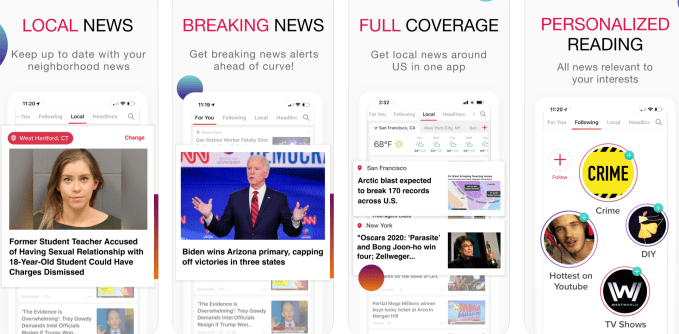
Screenshots of the News Break app (Source: News Break)
The type of personalized reading experience pioneered by Toutiao is now a default feature across media apps in the U.S., said (in Chinese) Vincent Wu, chief operating officer of News Break, at an event in Silicon Valley. To stand out from the crowd, the company serves up local news and happenings for readers, for Wu observed that America’s mainstream media focus overwhelmingly on national affairs and celebrity gossip, “news that’s irrelevant to my day-to-day.”
“Only high-quality, hyper-relevant local news can provide valuable information to readers,” he added.
ByteDance has tried exporting the Toutiao model through TopBuzz, but the overseas edition never achieved mainstream success and is reportedly looking for a buyer.
Other big names involved in News Break range from Yahoo co-founder Jerry Yang who joined as the chief advisor as well as Wu, HuffPost’s former operations head.
Particle Media, the Delaware-registered operating entity of News Break, has raised over $20 million to date from investors including IDG Capital, ZhenFund and Ding Lei, the founder of Chinese online media and gaming giant NetEase.
Meet News Break, the news app trending in America founded by a Chinese media veteran
Source: Microsoft
When Docker sold off its enterprise division to Mirantis last fall, that didn’t mark the end of the company. In fact, Docker still exists and has refocused as a cloud-native developer tools vendor. Today it announced an expanded partnership with Microsoft around simplifying running Docker containers in Azure.
As its new mission suggests, it involves tighter integration between Docker and a couple of Azure developer tools including Visual Studio Code and Azure Container Instances (ACI). According to Docker, it can take developers hours or even days to set up their containerized environment across the two sets of tools.
The idea of the integration is to make it easier, faster and more efficient to include Docker containers when developing applications with the Microsoft tool set. Docker CEO Scott Johnston says it’s a matter of giving developers a better experience.
“Extending our strategic relationship with Microsoft will further reduce the complexity of building, sharing and running cloud-native, microservices-based applications for developers. Docker and VS Code are two of the most beloved developer tools and we are proud to bring them together to deliver a better experience for developers building container-based apps for Azure Container Instances,” Johnston said in a statement.
Among the features they are announcing is the ability to log into Azure directly from the Docker command line interface, a big simplification that reduces going back and forth between the two sets of tools. What’s more, developers can set up a Microsoft ACI environment complete with a set of configuration defaults. Developers will also be able to switch easily between their local desktop instance and the cloud to run applications.
These and other integrations are designed to make it easier for Azure and Docker common users to work in in the Microsoft cloud service without having to jump through a lot of extra hoops to do it.
It’s worth noting that these integrations are starting in Beta, but the company promises they should be released some time in the second half of this year.
Docker expands relationship with Microsoft to ease developer experience across platforms
Source: Microsoft
Browser developers love to add small Easter Eggs to their apps to help you while away the hours when your Interent is down, for example. Chrome has long had the Dino game, that you can start from the ‘No internet’ error screen, for example. With its surf game, Microsoft’s Edge team built something similar into its pre-release channels earlier this year and as the company announced today, it’s now also available in the stable channel, too.
Just type in ‘edge://surf’ into your URL bar and you’re off to the races. The surf game is an endless scroller where you try to avoid obstacles, other surfers and the occasional attention-starved kraken. It’s more fun than the Dino game and also a bit more fully-featured. There are different game modes (endless, time trial, zig zag) and you can play with keyboard, mouse, touch or gamepad. If you like your games even more casual, there is a reduced speed mode and there is a high visibility mode for those with visual impairments.

After almost a year in public preview, the Edge team launched its first stable version earlier this year and only last week, Microsoft announced a slew of new features at its virtual Build developer conference. Even during its preview period, Edge was already a capable browser, though it lacked any killer features — unless being a very good Chromium-based browser made by Microsoft was really what you were always looking for. That’s slowly changing now, as the team is now building out the Edge feature set. The surf game isn’t exactly a killer feature, but it does help set the overall vibe for the browser and shows that Microsoft is looking to go beyond the basics now.
You can now surf in Microsoft’s Edge browser
Source: Microsoft
Minecraft is one of the most popular games on the planet, so it’s natural that Microsoft, after buying creator Mojang some years back, would attempt to apply the genre’s playful, blocky aesthetic to other genres. After modest success with the Story Mode adventure game and Pokémon GO-like Minecraft Earth, they’ve tried their hand at a light action-RPG à la Diablo — and unfortunately come up rather short. For now, that is.
Minecraft Dungeons is a sort of my-first-dungeon-crawler type game, a friendly, streamlined version of the genre Diablo created where players enter a procedurally-created dungeon or region, kill some monsters, get some loot, make it out alive, and do it all over again.
That’s the idea in this game as well, but of course the whole thing uses the block-based look and feel of Minecraft. As you travel through different biomes to free villagers, destroy ancient forges and so on, everything from the levels and monsters to equipment and potions looks like it came straight out of the original game. They nailed the look perfectly.
It’s refreshing, because games like this tend to court a rather grim aesthetic, and when it comes to gameplay they pile on features and mechanics until it feels more like you’re playing a spreadsheet than a game. It’s clear from the start Minecraft Dungeons was intended to provide the fun of fighting, upgrading, and exploring without the overly complex and dark trappings of the genre.
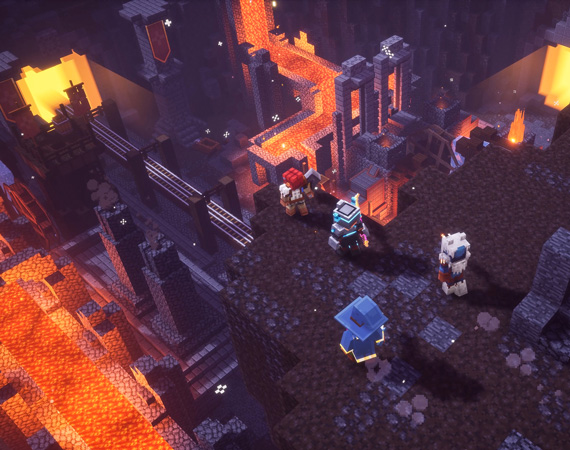
For instance, instead of having a handful of character classes each with their own skill tree, everything your character can do depends on their equipment. Weapons, armor, and accessories all have unique bonuses and abilities. So if you want to be a bow and arrow type fighter, wear the Ranger armor that gives you extra ranged damage and ammo, and use accessories that empower your arrows. Want to be a melee guy? There’s armor and swords for that too.
Customization of your play style, an important part of these games, is achieved by judicious choice of a set of random upgrades on each item. When you gain a level, you get a point can be used to activate, say, a passive ability that deflects enemy projectiles 20 percent of the time. Then it costs two points to upgrade it again, so it deflects 30 percent of the time.
You get those points back when you trash the item and can reapply them to a new one, providing low-risk, low-commitment progress — in time you’ll have lots of points banked to upgrade and experiment with whatever new item you find.
This approach is really a breath of fresh air after the convoluted overlapping systems of the likes of Diablo, Grim Dawn, and Path of Exile. There was just the right amount of “this new sword is tempting but do really I want to recycle my old one?” tension, and although you will collect trash loot, it’s easy to check and dispose of.
I didn’t get a chance to test multiplayer, but the game is definitely designed with co-adventuring in mind. Couch co-op lets you drop in a second player with a controller or connect online with others on the same platform (cross-play is coming soon). A cross-platform casual dungeon crawler is something I’ve been wanting for a long time.
It’s too bad, then, that this is where the game runs out of really positive qualities. I’m keeping in mind that this is a $20 game designed with players new to the genre in mind — not to say kids exactly — so there’s no sense comparing it directly to a major mainstream gaming franchise. But even so, Minecraft Dungeons has some serious issues.
For one thing, it really needs more variety. Part of the fun of these games is traveling from region to region and fighting new types of monsters with different tactics and abilities. That really just isn’t there in this game. The 10 different areas are visually distinct, yes, but they’re linear, similar from one run to another, and don’t differ all that much gameplay-wise. One aspect of Minecraft I’ve always loved, exploration, is nearly absent. Getting up on a hill or down in some little valley or cavern you can see usually isn’t possible — they’re just walls or bottomless pits. Side paths often run quite a distance but I eventually learned to stopped taking them because they were frequently empty and it always took forever to backtrack afterwards.
You’ll run into the same zombies, spiders, and soldiers over and over, and get the same weapons and accessories dropped over and over, often with very similar stats. Although there seems to be a good variety at first, the abilities and weapons don’t seem particularly well balanced, with some obviously and objectively better than others. Some are basically useless: One ability gives you a speedup for a few seconds after you dodge — but the game also slows you down for a few seconds after you roll, so they kind of just cancel each other out. Another returns a third of one percent of your health for every 100 blocks you uncover in the game. What?
This wouldn’t be an issue if the game had better difficulty tuning. I found in my playthrough that there was no challenge whatsoever 99 percent of the time, and then suddenly a situation would arise where I would be nearly instantly killed. These weren’t lesson-teaching deaths like other games — just sudden confluences of bad luck and, it must be said, some poor design.
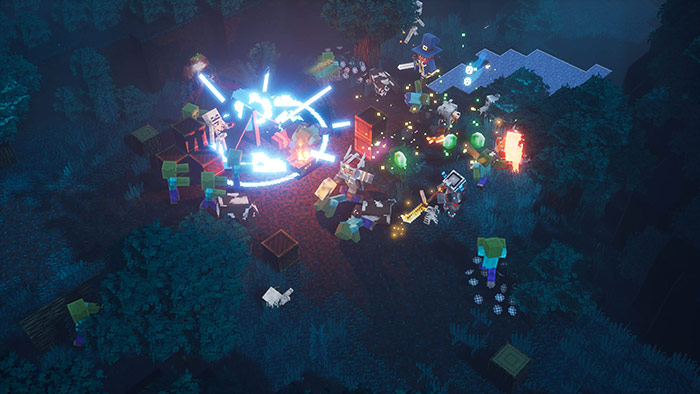
Ranged attacks from enemies will often come from off-screen, for instance. And not just a stray arrow, but many simultaneously. Enemy projectiles also go through all other enemies, unlike your own, and are very difficult to dodge, especially when there are a dozen coming from different angles. So sometimes after spending the whole level barely taking a hit, you’re reduced to an emergency situation in a fraction of a second, with very little warning, by enemies you haven’t had a chance to react to or perhaps even see. The close-zoom camera shows details well but limits your understanding of what’s happening around you.

These brutal difficulty spikes aren’t always accidental. One enemy kept popping up that repeatedly spawned huge numbers of bear traps under my character’s feet that closed before any but a really expert player could be expected to dodge. Bosses are cheap, swarming players with minions, storms of enormous projectiles, and instant, undodgeable melee attacks.
The issue here isn’t just that it’s hard, but that the game doesn’t give you the tools you need to deal with it. Dodging feels clumsy and enemies block your movement; there is little in the way of active defense like a shield or accessory you activate to repel arrows for 5 seconds; you only have one slowly recharging healing potion and health doesn’t trickle back, so little mistakes add up over time. Not that it matters, since punishment is usually swift and extreme.
What all this amounts to is a game that alternates between monotonous and frustratingly hard, even for a fan of the genre like myself. And considering you’ll run through all the areas in the game in a handful of hours — there are ten areas, each of which takes perhaps 20 minutes to clear — it’s expected that you’ll repeat them over and over to reach the gear level required to beat the final boss. I got all the way to that point and was insta-killed twice in a row.
I repeated a few areas but found them nearly indistinguishable from their earlier iterations. Ultimately I just wasn’t motivated to grind away just so I could unlock another, likely even more unfair, difficulty level.
I wouldn’t complain so much if this wasn’t, ostensibly, a game for beginners. Minecraft Dungeons innovates and simplifies in some really laudable ways, but the moment-to-moment game design is too uneven and the variety on offer isn’t enough even for a $20 game.
But it must be said that Minecraft itself also started out rather barebones and was built up over time into something remarkable and almost infinite. There are two DLC packs in the works for Dungeons, one rather crassly visible from the very start — nothing like being asked to pay more for a game you just bought. The good news is these packs will grow the game to a size that feels more like an adventure and less like a demo. I also expect that patches over the coming weeks and months will considerably tweak the equipment and difficulty — it can be, and needs to be fixed.
A year from now Minecraft Dungeons could very well be a no-brainer purchase, a cross-platform casual hack-and-slash that you can play with your kids or your friends and have a great time without thinking too hard about it (or opening Excel). But right now it’s mostly potential. I’d hold off on picking this one up until it’s been made into the game it’s meant to be.
Minecraft Dungeons has charm and potential, but needs lot more time in the furnace
Source: Microsoft
Less than a year after raising $25M led by Microsoft for its take on building API marketplaces, RapidAPI has rapidly followed that up with another infusion of capital as it reaches 20,000 APIs tracked, integrated, and used across its marketplace by millions of developers. Today the startup is announcing that it raised another $25 million from existing investors Andreessen Horowitz, DNS Capital, Green Bay Ventures, M12 (Microsoft’s Venture Fund), and Grove.
This is a second closing of RapidAPI’s Series B, which we first wrote about last year, bringing the total for the round to $50 million and $62.5 million overall. PitchBook notes that the startup’s previous valuation was $80 million, which would put this now at upwards of $105 million but likely higher, considering that the company has scaled by quite a bit. Co-founder and CEO Iddo Gino would not disclose the actual amount in an interview this week.
APIs are the building blocks of today’s digital world: developers use them to quickly integrate features, data, services and functions into their own apps, removing the need to build and scale all those elements themselves from scratch. But while the big selling point of using APIs is that they allow developers to integrate using only a few lines of code, that doesn’t tell the whole story. The issue is that a lot of API interfaces are not uniform and so sourcing and using a variety of them can become very time-consuming and on aggregate a lot more difficult than the basic concept of API would have you assume.
“You can’t build everything from scratch, and using APIs makes work a lot more efficient,” co-founder Iddo Gino once said to me. “But each API has a different format and authentication strategy. You have to speak a lot of different languages to use them all.”
RapidAPI’s approach is to create a framework that not only helps you find the API you are looking for, but lets you integrate them more easily by way of a single API key and SDK. It covers both free and paid APIs, and public as well as “private” APIs. When your company is a subscriber — by way of the RapidAPI for Teams product — it can also help keep track of your own organization’s API work.
The formula has been a success. There are now 18,000 teams using the Teams product among more than one million developers using the platform overall.
Within that number, RapidAPI — originally founded in Israel in 2015 and now based also in San Francisco — says that since January, it has added 300,000 new developers, up six-fold monthly compared the the same five months of 2019. The marketplace itself now has 20,000 APIs, doubling in the last year, with 1,000 getting added each month. Contributors to its marketplace include Microsoft, Twilio, SendGrid, Nexmo, Skyscanner and (our former stablemate) Crunchbase.
RapidAPI doesn’t charge people to use APIs that are already free to use. Rather it makes its money from subscriptions to its API management service as well as through serving paid APIs. It says that paid subscriptions have also grown by 30,000, with those using the enterprise tier — where you can develop your own white-label, in-house version of a marketplace for your own staff and customers — are on the rise with financial services, insurance companies, carriers and healthcare companies among those building marketplaces on RapidAPI’s rails.
While a lot of businesses, including even tech startups, have had to make big adjustments to work in our new environment and its focus on social distancing to help manage the spread of COVID-19, the same didn’t go for RapidAPI, noted Gino. The company already had remote teams — a consequence of being founded in one country and now essentially having two gravitational poles — and RapidAPI’s team of 75, and its customers, have in their culture working across different environments including virtualised ones.
What the current climate has pointed to, however, is that RapidAPI is the kind of company that stands to benefit from how other organizations are coping with digital transformation, by helping provide developers with libraries that they can use, wherever they happen to be.
Another interesting thing that has come up in the current climate is the impact it’s had on what APIs are getting the most calls. In addition to the regular roster of most popular APIs that include communications, payments and other financial services, Gino told me that APIs related to COVID-19 data have emerged as some of the most heavily trafficked, in line with how so many are working to make sense of what is going on, and how they might help the rest of us.
These include API calls for datasets and geolocation, as well as other statistics, some of which are free and some of which are paid. RapidAPI says that between March 1 and mid-May, the top five COVID APIs had more than 224 million calls with a peak of almost 4.5 million in a single day.
RapidAPI raises M more to expand its API marketplace
Source: Microsoft
Facebook and Instagram are making a bigger push into e-commerce, MasterClass raises $100 million and Microsoft launches a new project management tool called Lists.
Here’s your Daily Crunch for May 20, 2020.
1. Facebook and Instagram roll out Shops, turning business profiles into storefronts
Both Facebook and Instagram already supported a degree of e-commerce — for example, Facebook has its Marketplace and will likely make a bigger push through its Libra cryptocurrency initiative, while Instagram allows users to buy products featured in posts and ads. But the company’s new tools go further, enabling businesses to create a full-fledged Facebook Shop.
Creating a Shop is free. Businesses just upload their catalog, choose the products they want to feature, then customize it with a cover image and accent colors. Visitors can then browse, save and order products.
2. MasterClass just raised $100 million for celebrity-fueled content
CEO David Rogier said that the capital will be used to create new classes for students and up production to one class a week. The company is also experimenting with an audio-only mode, short form and augmented reality.
3. Microsoft launches Lists, a new Airtable-like app for Microsoft 365
The way Microsoft describes it, Lists is a tool to “track issues, assets, routines, contacts, inventory and more using customizable views and smart rules and alerts to keep everyone in sync.” It features deep integrations into Teams, SharePoint and other Microsoft products and will launch this summer on the web, with mobile apps slated for later this year.
4. Why micromobility may emerge from the pandemic stronger than before
Despite the struggles of individual operators, micromobility (things like scooters, bikes and e-bikes) as a technology will come out of this stronger than before, industry analyst Horace Dediu tells TechCrunch. After all, with ongoing concerns about the disease and social distancing, consumers may look to alternative modes of transportation. (Extra Crunch membership required.)
5. Former Stitch Fix COO Julie Bornstein just took the wraps off her app-only e-commerce startup, The Yes
The Yes is a women’s shopping platform that Bornstein and her co-founder Amit Aggarwal have been quietly building for 18 months, and that they say will create tailor-made experiences for each user.
6. Spotify signs ‘The Joe Rogan Experience’ to an exclusive multi-year deal
Rogan is arguably the biggest and most influential voice in the podcast medium, with a podcast that has dominated Apple’s charts and 8.41 million subscribers on YouTube. The program has often featured right-wing voices, including members of the so-called Intellectual Dark Web, Proud Boy founder Gavin McInnes and de-platformed conspiracy trafficker Alex Jones .
7. Extra Crunch Live: Join Verizon CEO Hans Vestberg for a live Q&A May 26 at 2pm ET/11am PT
Our boss’s boss’s boss’s boss (I’m probably forgetting a few management layers here) is coming on Extra Crunch Live next week to discuss 5G, as well as how founders can manage a company at scale.
The Daily Crunch is TechCrunch’s roundup of our biggest and most important stories. If you’d like to get this delivered to your inbox every day at around 9am Pacific, you can subscribe here.

Daily Crunch: Facebook unveils its Shops e-commerce platform
Source: Microsoft
Directly, a startup whose mission is to help build better customer service chatbots by using experts in specific areas to train them, has raised more funding as it opens up a new front to grow its business: APIs and a partner ecosystem that can now also tap into its expert network. Today Directly is announcing that it has added $11 million to close out its Series B at $31 million (it raised $20 million back in January of this year).
The funding is coming from Triangle Peak Partners and Toba Capital, while its previous investors in the round included strategic backers Samsung NEXT and Microsoft’s M12 Ventures (who are both customers, alongside companies like Airbnb), as well as Industry Ventures, True Ventures, Costanoa Ventures and Northgate. (As we reported when covering the initial close, Directly’s valuation at that time was at $110 million post-money, and so this would likely put it at $120 million or higher, given how the business has expanded.)
While chatbots have now been around for years, a key focus in the tech world has been how to help them work better, after initial efforts saw so many disappointing results that it was fair to ask whether they were even worth the trouble.
Directly’s premise is that the most important part of getting a chatbot to work well is to make sure that it’s trained correctly, and its approach to that is very practical: find experts both to troubleshoot questions and provide answers.
As we’ve described before, its platform helps businesses identify and reach out to “experts” in the business or product in question, collect knowledge from them, and then fold that into a company’s AI to help train it and answer questions more accurately. It also looks at data input and output into those AI systems to figure out what is working, and what is not, and how to fix that, too.
The information is typically collected by way of question-and-answer sessions. Directly compensates experts both for submitting information as well as to pay out royalties when their knowledge has been put to use, “just as you would in traditional copyright licensing in music,” its co-founder Antony Brydon explained to me earlier this year.
It can take as little as 100 experts, but potentially many more, to train a system, depending on how much the information needs to be updated over time. (Directly’s work for Xbox, for example, used 1,000 experts but has to date answered millions of questions.)
Directly’s pitch to customers is that building a better chatbot can help deflect more questions from actual live agents (and subsequently cut operational costs for a business). It claims that customer contacts can be reduced by up to 80%, with customer satisfaction by up to 20%, as a result.
What’s interesting is that now Directly sees an opportunity in expanding that expert ecosystem to a wider group of partners, some of which might have previously been seen as competitors. (Not unlike Amazon’s AI powering a multitude of other businesses, some of which might also be in the market of selling the same services that Amazon does).
The partner ecosystem, as Directly calls it, use APIs to link into Directly’s platform. Meya, Percept.ai, and SmartAction — which themselves provide a range of customer service automation tools — are three of the first users.
“The team at Directly have quickly proven to be trusted and invaluable partners,” said Erik Kalviainen, CEO at Meya, in a statement. “As a result of our collaboration, Meya is now able to take advantage of a whole new set of capabilities that will enable us to deliver automated solutions both faster and with higher resolution rates, without customers needing to deploy significant internal resources. That’s a powerful advantage at a time when scale and efficiency are key to any successful customer support operation.”
The prospect of a bigger business funnel beyond even what Directly was pulling in itself is likely what attracted the most recent investment.
“Directly has established itself as a true leader in helping customers thrive during these turbulent economic times,” said Tyler Peterson, Partner at Triangle Peak Partners, in a statement. “There is little doubt that automation will play a tremendous role in the future of customer support, but Directly is realizing that potential today. Their platform enables businesses to strike just the right balance between automation and human support, helping them adopt AI-powered solutions in a way that is practical, accessible, and demonstrably effective.”
In January, Mike de la Cruz, who took over as CEO at the time of the funding announcement, said the company was gearing up for a larger Series C in 2021. It’s not clear how and if that will be impacted by the current state of the world. But in the meantime, as more organizations are looking for ways to connect with customers outside of channels that might require people to physically visit stores, or for employees to sit in call centres, it presents a huge opportunity for companies like this one.
“At its core, our business is about helping customer support leaders resolve customer issues with the right mix of automation and human support,” said de la Cruz in a statement. “It’s one thing to deliver a great product today, but we’re committed to ensuring that our customers have the solutions they need over the long term. That means constantly investing in our platform and expanding our capabilities, so that we can keep up with the rapid pace of technological change and an unpredictable economic landscape. These new partnerships and this latest expansion of our recent funding round have positioned us to do just that. We’re excited to be collaborating with our new partners, and very thankful to all of our investors for their support.”
Directly, which trains customer service chatbots with expert advice, raises M more
Source: Microsoft
When he was still running Microsoft, Steve Ballmer caused quite the stir in the tech world by screaming “Developers! Developers! Developers!” Since the executive retired to spend more time with his basketball team, however, the tech giant’s current CEO is decidedly more…subtle in his approach.
In the kickoff keynote to the first all-virtual build conference, Satya Nadella delivered a speech in front of a large shelving unit packed with knickknacks and family photos. And there was “RGV2cw.” The seemingly nonsensical string of letters sat to the right of the CEO’s head. But these kinds of backdrops aren’t chosen at random. Surely there must be some meaning in the madness.
The letters sent twitter users scrambling to decode. One noted the presence of a user on a dev board with the name. Another quickly snapped up the handle to send Build related tweets. This user, however, appears to be the first to have cracked the code:
Microsoft’s Scott Hanselman confirmed the message. It was, quite literally, a coded message to developers. Specifically, it’s the word “devs” in the Base64 format. Here, run it through this decoder to see for yourself.
It doesn’t have the shouting, sweaty urgency of Ballmer, but it’s a nice tip of the fedora nonetheless.

The mystery of RGV2cw, Microsoft’s extremely nerdy secret message to developers
Source: Microsoft
“We’re living through extraordinary times,” Microsoft CEO Satya Nadella opened his Build 2020 keynote on a somber note. It was an odd tonal shift following the event introduction by hosts Seth Juarez and Dona Sarkar.
The pair spent kicked the 48 hour livestream off standing a CDC-approved social distance from one another behind a large desk, trading silly banter and dad jokes. That last bit, at least carries a sense of normality amidst these extraordinary times.
Awkward banter and goofy jokes are a mainstay in tech presentations, for better or worse — but there’s bound to be an extra level of strangeness when you strip away the live audience (particularly the overly enthusiastic employees planted in the audience). At best, it can have YouTube presenter energy and at worst, it’s like one of those videos of sitcom with the laugh track edited out.
As a necessary first time experiment, Microsoft’s Build 2020 keynote was probably more good than bad. It was arguably the first truly big tech company event on this level since pandemic really started locking things down. After all, Apple’s WWDC isn’t until next month, and Google essentially punted on I/O, removing even the online elements.
“Right now, the most important thing all of us can do is focus our attention on helping people with the new challenges we all face,” the company wrote at the time. “Please know that we remain committed to finding other ways to share platform updates with you through our developer blogs and community forums.”
It’s a difficult decision to make either way, of course. Certainly the gravity of the pandemic can make such an event seem inconsequential by comparison, but there’s also something to be said when a company can reintroduce a sense of normality — albeit through artificial means.
The Juarez/Sarkar bumpers are intended to serve as a through line through the two days of programming, and naturally a little vamping is going to be involved. In the case of the opener, it was five or so minutes of the cohosts scrolling through Twitter hashtag comments on a Surface Studio, in a bid to approximate the sense of community one has in attending an in-person developer conference.

Nadella’s presentation that followed struck a better balance. It was simple and likely pre-recorded, with the executive standing in front of a full shelving unit housing knickknacks and family photos. He addressed the camera, as the feed cut back and forth between him and clips. If things felt off, it was mostly due to the fact that it’s impossible to watch it without constantly comparing it to the pomp of previous years event.
Microsoft perhaps took a note from Nintendo, which switched from live keynotes to a prerecorded Tree House presentation at E3 several years ago. It’s a tradeoff that loses some of the excitement of the standard format, but adds the ability to perfect a presentation through multiple takes. Nintendo above all benefits from the use of countless game trailers. B-roll is an extremely important piece of that puzzle.
The curse of the live demo is gone, if you want it. Though the heavy reliance on Skype conversations in a followup Microsoft presentation really hammered home the fact that few of us live in home studios. Plane noises and lawnmowers were a regular reminder that things are just going to be weird for a while. Not bad, necessarily, but weird.
There’s certainly good to come out of this forced reformatting. For one thing, Build is accessible through a free registration. The official chat (which was a train wreck for reasons I won’t go into here) was full of excited developers and observers announcing that this was their first-ever Build. Ticket prices, travel and the limitations of in-person event spaces are difficult hurdles for many.
The next few months will determine whether this is the new normal for these sorts of events. It would be hard to blame organizers for continuing with an abundance of cautious into 2021. I suspect many will return to the in-person event, but hopefully the added accessibility of the virtual element will live on beyond the threat of COVID-19.
Microsoft’s Build keynote showcases the accessibility and awkwardness of online events

