Source: Microsoft
With the next version of Windows 10, coming this spring, Microsoft’s Cortana digital assistant will lose a number of consumer skills around music and connected homes, as well as some third-party skills. That’s very much in line with Microsoft’s new focus for Cortana, but it may still come as a surprise to the dozens of loyal Cortana fans.
Microsoft is also turning off Cortana support in its Microsoft Launcher on Android by the end of April and on older versions of Windows that have reached their end-of-service date, which usually comes about 36 months after the original release.

As the company explained last year, it now mostly thinks of Cortana as a service for business users. The new Cortana is all about productivity, with deep integrations into Microsoft’s suite of Office tools, for example. In this context, consumer services are only a distraction, and Microsoft is leaving that market to the likes of Amazon and Google .
Because the new Cortana experience is all about Microsoft 365, the subscription service that includes access to the Office tools, email, online storage and more, it doesn’t come as a surprise that the assistant’s new feature will give you access to data from these tools, including your calendar, Microsoft To Do notes and more.
And while some consumer features are going away, Microsoft stresses that Cortana will still be able to tell you a joke, set alarms and timers, and give you answers from Bing.
For now, all of this only applies to English-speaking users in the U.S. Outside of the U.S., most of the productivity features will launch in the future.
Microsoft’s Cortana drops consumer skills as it refocuses on business users
Source: Microsoft
Amazon Web Services has entered a partnership with Safaricom — Kenya’s largest telco, ISP and mobile payment provider — in a collaboration that could spell competition between American cloud providers in Africa.
In a statement to TechCrunch, the East African company framed the arrangement as a “strategic agreement” whereby Safaricom will sell AWS services (primarily cloud) to its East Africa customer network.
Safaricom — whose products include the famed M-Pesa mobile money product — will also become the first Advanced Consulting Partner for the AWS partner network in East Africa.
“The APN is…the program for technology…businesses who leverage AWS to build solutions and services for customers…and sell their AWS offerings by providing valuable business, technical, and marketing support,” Safaricom said.
“We chose to partner with AWS because it offers customers the broadest and deepest cloud platform…This agreement will allow us to accelerate our efforts to enable digital transformation in Kenya,” said Safaricom CEO Michael Joseph.
“Safaricom will be able to offer AWS services to East-African customers, allowing businesses of all sizes to quickly get started on AWS cloud,” the company statement continued.
 For now, the information provided by Safaricom is a bit sparse on the why and how of the partnership between the American company and East African mobile, financial and ISP provider.
TechCrunch has an inquiry into Amazon and some additional questions posed to Safaricom, toward additional coverage.
An initial what-this-all-means take on the partnership points to an emerging competition between American cloud service providers to scale in Africa by leveraging networks of local partners.
The most obvious rival to the AWS-Safaricom strategic agreement is the Microsoft -Liquid Telecom collaboration. Since 2017, MS has partnered with the Southern African digital infrastructure company to grow Microsoft’s AWS competitor product — Azure — and offer cloud services to the continent’s startups and established businesses.
MS and Liquid Telecom have focused heavily on the continent’s young tech companies. “We believe startups will be key employers in Africa’s future economy. They’re also our future customers,” Liquid Telecom’s Head of Innovation Partnerships Oswald Jumira told TechCrunch in 2018.
Amazon hasn’t gone fully live yet with e-commerce services in Africa, but it has aggressively positioned AWS and built a regional client list that includes startups — such as fintech venture Jumo — and large organizations, such Absa and Standard Bank.
Partnering with Safaricom plugs AWS into the network of one East Africa’s most prominent digital companies.
Safaricom, led primarily by its M-Pesa mobile money product, holds remarkable dominance in Kenya, Africa’s 6th largest economy. M-Pesa has 20.5 million customers across a network of 176,000 agents and generates around one-fourth ($531 million) of Safaricom’s ≈ $2.2 billion annual revenues (2018).
Compared to other players — such as Airtel Money and Equitel Money — M-Pesa has 80% of Kenya’s mobile money agent network, 82% of the country’s active mobile-money subscribers and transfers 80% of Kenya’s mobile-money transactions, per the latest sector statistics.
A number of Safaricom’s clients (including those it provides payments and internet services to) are companies, SMEs and startups.
Extending AWS services to them will play out next to the building of Microsoft’s $100 million Africa Development Center, with an office in Nairobi, announced last year.
AWS partners with Kenya’s Safaricom on cloud and consulting services
Source: Microsoft
Hello and welcome back to our regular morning look at private companies, public markets and the gray space in between.
Today we’re starting on a somber topic, so I’ll hold off on our usual jokes and attempts at puns. The impact of the coronavirus known as COVID-19 is starting to show up in U.S.-based technology earnings, and it’s something we need to discuss. We’ll get back to SaaS multiples, the IPO market, and riffing on startups later today, but first, some bad news from the public markets.
Let’s examine the latest from Microsoft, Nutanix, and Booking Holdings (parent company of Bookings.com), OpenTable, and Kayak. Afterwards, we’ll talk about what types of companies might be impacted, given what we’ve learned. And finally, we’ll link this all back to startups, younger technology shops sensitive to changes in market sentiment and repricing due to public market gyrations.
The coronavirus begins to impact US tech earnings
Source: Microsoft
Excitement for The Europas Awards for European Tech Startups is heating up. Here is the first wave of speakers and judges — with more coming!
The Awards — which have been running for over 10 years — will be held on 25 June 2020 in London, U.K. on the front lawn of the Geffrye Museum in Hoxton, London — creating a fantastic and fun garden-party atmosphere in the heart of London’s tech startup scene.
TechCrunch is once more the exclusive media sponsor of the awards and conference, alongside The Pathfounder.
The application form to enter is here.
We’re scouting for the top late-stage seed and Series A startups in 22 categories.
You can nominate a startup, accelerator or venture investor that you think deserves to be recognized for their achievements in the last 12 months.
CLOSING DATE FOR APPLICATIONS: 25 March 2020
For the 2020 awards, we’ve overhauled the categories to a set that we believe better reflects the range of innovation, diversity and ambition we see in the European startups being built and launched today. This year we are particularly looking at startups that are able to address the SDGs/Globals Boals.
The Europas Awards
The Europas Awards results are based on voting by experts, experienced founders, hand-picked investors and the industry itself.
But the key to it is that there are no “off-limits areas” at The Europas, so attendees can mingle easily with VIPs.
Timeline of The Europas Awards deadlines:
Submissions now open!
25 March 2020 – Submissions close
14 April – Public voting begins
25 April – Public voting ends
8 June – Shortlist Announced
25 June – Awards evening, winners announced
Amazing networking
We’re also shaking up the awards dinner itself. There are more opportunities to network. Our awards ceremony this year will be in the setting of a garden/lawn party, where you’ll be able to meet and mingle more easily, with free-flowing drinks and a wide selection of street food (including vegetarian/vegan). The ceremony itself will last less than 45 minutes, with the rest of the time dedicated to networking. If you’d like to talk about sponsoring or exhibiting, please contact Claire Dobson on claire@thepathfounder.com
Instead of thousands and thousands of people, think of a great summer event with the most interesting and useful people in the industry, including key investors and leading entrepreneurs.
The Europas Awards have been going for the last 10 years, and we’re the only independent and editorially driven event to recognise the European tech startup scene. The winners have been featured in Reuters, Bloomberg, VentureBeat, Forbes, Tech.eu, The Memo, Smart Company, CNET, many others — and of course, TechCrunch.
• No secret VIP rooms, which means you get to interact with the speakers
• Key founders and investors attending
• Journalists from major tech titles, newspapers and business broadcasters
The Pathfounder Afternoon Workshops
In the afternoon prior to the awards we will be holding a special, premium content event, The Pathfounder, designed be a “fast download” into the London tech scene for European founders looking to raise money or re-locate to London. Sessions include “How to Craft Your Story”; “Term Sheets”; “Building a Shareholding Structure”; Investor Panel; Meet the Press; and a session from former Europas winners. Followed by the awards and after-party!
The Europas “Diversity Pass”
We’d like to encourage more diversity in tech! That’s why we’ve set aside a block of free tickets to ensure that pre-seed female and BAME founders are represented at The Europas. This limited tranche of free tickets ensures that we include more women and people of colour who are specifically “pre-seed” or “seed-stage” tech startup founders. If you are a women/BAME founder, apply here for a chance to be considered for one of the limited free diversity passes to the event.
Meet some of our first speakers and judges:

Anne Boden
CEO
Starling Bank
Anne Boden is founder and CEO of Starling Bank, a fast-growing U.K. digital bank targeting millions of users who live their lives on their phones. After a distinguished career in senior leadership at some of the world’s best-known financial heavyweights, she set out to build her own mobile bank from scratch in 2014. Today, Starling has opened more than one million current accounts for individuals and small businesses and raised hundreds of millions of pounds in backing. Anne was awarded an MBE for services to financial technology in 2018.

Nate Lanxon (Speaker)
Editor and Tech Correspondent
Bloomberg
Nate is an editor and tech correspondent for Bloomberg, based in London. For over a decade, he has particularly focused on the consumer technology sector, and the trends shaping the global industry. Previous to this, he was senior editor at Bloomberg Media and was head of digital editorial for Bloomberg.com in Europe, the Middle East and Africa. Nate has held numerous roles across the most respected titles in tech, including stints as editor of WIRED.co.uk, editor-in-chief of Ars Technica UK and senior editor at CBS-owned CNET. Nate launched his professional career as a journalist by founding a small tech and gaming website called Tech’s Message, which is now the name of his weekly technology podcast hosted at natelanxon.com.

Tania Boler
CEO and founder
Elvie<br />
Tania is an internationally recognized women’s health expert and has held leadership positions for various global NGOs and the United Nations. Passionate about challenging taboo women’s issues, Tania founded Elvie in 2013, partnering with Alexander Asseily to create a global hub of connected health and lifestyle products for women.

Kieran O’Neill
CEO and co-founder
Thread
Thread makes it easy for guys to dress well. They combine expert stylists with powerful AI to recommend the perfect clothes for each person. Thread is used by more than 1 million men in the U.K., and has raised $35 million from top investors, including Balderton Capital, the founders of DeepMind and the billionaire former owner of Warner Music. Prior to Thread, Kieran founded one of the first video sharing websites at age 15 and sold it for $1.25 million at age 19. He was then CEO and co-founder of Playfire, the largest social network for gamers, which he grew to 1.5 million customers before being acquired in 2012. He’s a member of the Forbes, Drapers and Financial Times 30 Under 30 lists.

Clare Jones
Chief Commercial Officer
what3words
Clare is the chief commercial officer of what3words; prior to this, her background was in the development and growth of social enterprises and in impact investment. Clare was featured in the 2019 Forbes 30 under 30 list for technology and is involved with London companies tackling social/environmental challenges. Clare also volunteers with the Streetlink project, doing health outreach work with vulnerable women in South London.

Luca Bocchio
Principal
Accel
Luca Bocchio joined Accel in 2018 and focuses on consumer internet, fintech and software businesses. Luca led Accel’s investment in Luko, Bryter and Brumbrum. Luca also helped lead Accel’s investment and ongoing work in Sennder. Prior to Accel, Luca was with H14, where he invested in global early and growth-stage opportunities, such as Deliveroo, GetYourGuide, Flixbus, SumUp and SecretEscapes. Luca previously advised technology, industrial and consumer companies on strategy with Bain & Co. in Europe and Asia. Luca is from Italy and graduated from LIUC University.

Bernhard Niesner
CEO and c-founder
busuu<br />
Bernhard co-founded busuu in 2008 following an MBA project and has since led the company to become the world’s largest community for language learning, with more than 90 million users across the globe. Before starting busuu, Bernhard worked as a consultant at Roland Berger Strategy Consultants. He graduated summa cum laude in International Business from the Vienna University of Economics and Business and holds an MBA with honours from IE Business School. Bernhard is an active mentor and business angel in the startup community and an advisor to the Austrian Government on education affairs. Bernhard recently received the EY Entrepreneur of the Year 2018 UK Awards in the Disruptor category.

Chris Morton
CEO and founder
Lyst
Chris is the founder and CEO of Lyst, the world’s biggest fashion search platform used by 104 million shoppers each year. Including over 6 million products from brands including Burberry, Fendi, Gucci, Prada and Saint Laurent, Lyst offers shoppers convenience and unparalleled choice in one place. Launched in London in 2010, Lyst’s investors include LVMH, 14W, Balderton and Accel Partners. Prior to founding Lyst, Chris was an investor at Benchmark Capital and Balderton Capital in London, focusing on the early-stage consumer internet space. He holds an MA in physics and philosophy from Cambridge University.

Husayn Kassai
CEO and co-founder
Onfido<br />
Husayn Kassai is the Onfido CEO and co-founder. Onfido helps businesses digitally onboard users by verifying any government ID and comparing it with the person’s facial biometrics. Founded in 2012, Onfido has grown to a team of 300 across SF, NYC and London; received over $100 million in funding from Salesforce, Microsoft and others; and works with over 1,500 fintech, banking and marketplace clients globally. Husayn is a WEF Tech Pioneer; a Forbes Contributor; and Forbes’ “30 Under 30”. He has a BA in economics and management from Keble College, Oxford.
Meet the first wave of speakers & enter your startup for The Europas Awards, 25 June
Source: Microsoft
The U.K. has a strong history when it comes to processors, but the global chip market has seen some ups and downs of late. Today comes some big news that underscores how investors are doubling down on one of the big hopefuls for the next generation of chipmaking to see it through any possible winter winds. Graphcore, the Bristol-based startup that designs processors specifically for artificial intelligence applications, announced it has raised another $150 million in funding for R&D and to continue bringing on new customers. It’s valuation is now $1.95 billion.
Graphcore has now raised over $450 million and says that it has some $300 million in cash reserves — an important detail considering the doldrums that have plagued the chipmaking market in the last few months, and could become exacerbated now with the slowdown in production due to the coronavirus outbreak.
The funding is an extension of its Series D, it said, and brings the total valuation of the company to $1.95 billion. (For reference, the original Series D in December 2018 valued Graphcore at $1.7 billion.) This latest round includes investments from Baillie Gifford, Mayfair Equity Partners and M&G Investments — all new backers — as well as participation from previous investors Merian Chrysalis, Ahren Innovation Capital, Amadeus Capital Partners and Sofina. Other past backers of the startup include BMW, Microsoft, Atomico and Demis Hassabis of DeepMind.
Graphcore’s big claim to fame has been the development of what it calls its Intelligence Processing Unit (IPU) hardware and corresponding Poplar software, designed specifically for the kind of simultaneous, intensive calculations demanded of AI applications (which are designed based on how humans think, in “parallel” processing mode).
Graphcore describes its IPU as the first processor to be designed specifically for AI. However, a number of other companies including Nvidia, Intel and AMD have made huge investments into this area and have ramped up their pace of development to meet market demands — and hopefully to overtake what have been limitations in the wider area of AI processing, a problem that still continues to persist.
“Deep learning has only really existed in since 2012,” Nigel Toon, founder and CEO, said recently to TechCrunch. “When we started Graphcore, what we heard from innovators was that hardware was holding them back.”
This D2 round comes ahead of what Graphcore describes as strong demand for 2020, and is happening on the heels of a strong year for the company, including a commercial deal with one of its previous strategic backers.
“2019 was a transformative year for Graphcore as we moved from development to a full commercial business with volume production products shipping,” said Nigel Toon, founder and CEO. “We were pleased to publicly announce our close partnership with Microsoft in November 2019, jointly announcing IPU availability for external customers on the Azure Cloud, as well as for use by Microsoft internal AI initiatives. In addition, we announced availability of the DSS8440 IPU Server in partnership with Dell Technologies and the launch of the Cirrascale IPU-Bare Metal Cloud. We also announced some of our other early access customers which include Citadel Securities, Carmot Capital, and Qwant, the European search engine company.”
Here’s See Toon speaking at our recent Disrupt conference in Berlin about the prospect for chips here:
Graphcore, the AI chipmaker, raises another 0M at a .95B valuation
Source: Microsoft
It’s been a few months since Microsoft announced the impending arrival of the Xbox Series X. The somewhat redundantly named console made cameo during the Game Awards, getting a late 2020 date in the process.
We got at glimpse at the big, boxy design and peek into a handful of features, including the new wireless controllers and backward game compatibility. It didn’t, however, really get into the nitty gritty of what’s going to set the next-gen console apart. Thankfully, MS’s head of Xbox Phil Spencer is back with some honest to goodness specs.
“Xbox Series X is our fastest, most powerful console ever, designed for a console generation that has you at its center,” Spencer writes. “This means a high-fidelity gaming experience enclosed in a quiet and bold design, with the ability to discover thousands of games across four generations, all with more playing and less waiting.”
The headline feature here is, naturally, a new processor. Built on top of AMD Zen 2 and RDNA 2 architecture, Xbox says chip is able to deliver four times the processing power of the Xbox One. The silicon offers 12 teraflops of GPU performance — that’s double the Xbox One X and 8x the original Xbox One. Other notable additions include Variable Rate Shading for improved frame rates and resolution and DirectX Raytracing for better lighting.
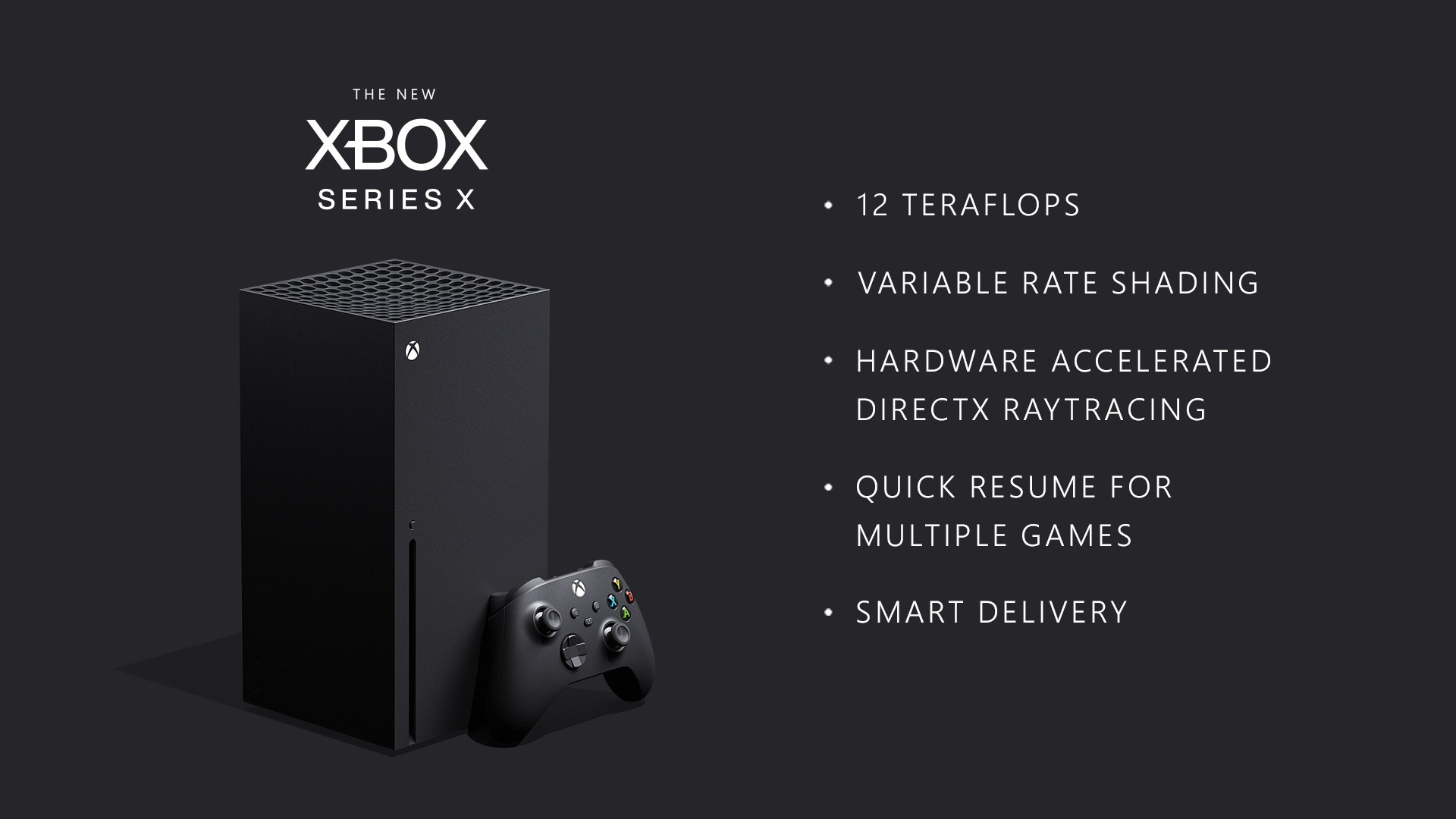
Quick Resume is basically what it sounds like, letting players pick up on multiple games, exactly where they left off. Dynamic Latency Input aims to bring more responsive feed back from controllers, by reducing latency. 120fps video will be supported by the console, along with HDMI 2.1, which automatically switches to the lowest latency mode to reduce game play lag.
As noted above, backward compatibility is central, now that Microsoft has a few generations of consoles under its belt. Game Pass is increasingly important in the company’s play moving forward, as it ramps up focus on cloud gaming.
More information is promised in “coming months.” Once again, Microsoft will have a stiff competition on its hands, with the PlayStation 5 currently slated for “holiday 2020.”
Microsoft offers a closer look at the next Xbox
Source: Microsoft
As Indian startups begin to make inroads in the world of SaaS, Microsoft has taken notice. The American tech giant today launched 100X100X100, a program aimed at business-to-business SaaS startups.
Microsoft said Monday that 100X100X100 will bring together 100 companies and 100 early and growth startups. Each committed company will spend $100,000 over a course of 18 months.
“This initiative will help build scale and create amazing opportunities for startups. Businesses can now fast-track their digital journeys through easy adoption of enterprise-grade solutions,” said Anant Maheshwari, President of Microsoft India, in a statement.
Each startup participating in the program will also have access to prospective customers at Microsoft industry and customer events. Participants also get access to Microsoft’s technology platform, and guidance in fine tuning their business and expansion models.
Microsoft is not a new face in India’s startup ecosystem. The company runs Microsoft for Startups that allows early stage B2B startups to use the company’s Azure marketplace and enterprise sales team. Early last year, the company also expanded M12, its corporate venture fund, to India.
The company’s global rivals Google and Amazon are also actively helping startups in India, sponsoring countless events and bandying out a range of goodies including thousands of dollars of credit to use their cloud platforms.
The idea is simple: If the bets work, these startups are already a customer and their solutions could be beneficial to several tens of thousands of other customers. And it’s a safe time to make these bets.
In recent years, scores of startups have emerged in India to build SaaS software following the success of firms such as Freshworks, valued at $3.5 billion, and CleverTap. Since SaaS startups are not building hardware, or disbursing loans, they often have the best profit margin.
Shekhar Kirani, a partner at Accel, told TechCrunch in a recent interview that his biggest frustration was not seeing many more entrepreneurs build SaaS services. “Anyone with some coding skills and a cheap laptop can build a service and sell to the world,” he said.
At a recent SaaS focused event, Godard Abel, chief executive of business marketplace G2, said that India was already among the top five nations for active participations for development of new business services.
As for Microsoft, expect several more announcements this week as its chief executive, Satya Nadella, appears at company’s flagship conference in the country today and tomorrow.
Microsoft launches 100X100X100 program to help Indian B2B SaaS startups
Source: Microsoft
Laiye, a Chinese startup that offers robotic process automation services to several major tech firms in the nation and government agencies, has raised $42 million in a new funding round as it looks to scale its business.
The new financing round, Series C, was co-led by Lightspeed Venture Partners and Lightspeed China Partners. Cathay Innovation, which led the startup’s Series B+ round and Wu Capital, which led the Series B round, also participated in the new round.
China has been the hub for some of the cheapest labor in the world. But in recent years, a number of companies and government agencies have started to improve their efficiency with the help of technology.
That’s where Laiye comes into play. Robotic process automation (RPA) allows software to mimic several human behaviors such as keyboard strokes and mouse clicks.
“For instance, a number of banks did not previously offer APIs, so humans had to sign in and fetch the data and then feed it into some other software. Processes like these could be automated by our platform,” said Arvid Wang, co-founder and co-chief executive of Laiye, in an interview with TechCrunch.
The four-and-a-half-year-old startup, which has raised more than $100 million to date, will use the fresh capital to hire talent from across the globe and expand its services. “We believe robotic process automation will achieve its full potential when it combines AI and the best human talent,” he said.
Laiye’s announcement today comes as the market for robotic automation process is still in nascent stage in China. There are a handful of startups looking into this space, but Laiye, which counts Microsoft as an investor, and Sequoia-backed UiPath are the two clear leaders in the market currently.
As my colleague Rita Liao wrote last year, it was only recently that some entrepreneurs and investors in China started to shift their attention from consumer-facing products to business applications.
Globally, RPA has emerged as the fastest growing market in enterprise space. A Gartner report found last year that RPA market grew over 63% in 2018. Recent surveys have shown that most enterprises in China today are also showing interest in enhancing their RPA projects and AI capabilities.
Laiye today has more than 200 partners and more than 200,000 developers have registered to use its multilingual UiBot RPA platform. UiBot enables integration with Laiye’s native and third-party AI capabilities such as natural language processing, optical character recognition, computer vision, chatbot and machine learning.
“We are very bullish on China, and the opportunities there are massive,” said Lightspeed partner Amy Wu in an interview. “Laiye is doing phenomenally there, and with this new fundraise, they can look to expand globally,” she said.
Lightspeed leads Laiye’s M round to bet on Chinese enterprise IT
Source: Microsoft
As cybercrime continues to evolve and expand, a startup that is building a business focused on endpoint security has raised a big round of funding. SentinelOne — which provides a machine learning-based solution for monitoring and securing laptops, phones, containerised applications and the many other devices and services connected to a network — has picked up $200 million, a Series E round of funding that it says catapults its valuation to $1.1 billion.
The funding is notable not just for its size but for its velocity: it comes just eight months after SentinelOne announced a Series D of $120 million, which at the time valued the company around $500 million. In other words, the company has more than doubled its valuation in less than a year — a sign of the cybersecurity times.
This latest round is being led by Insight Partners, with Tiger Global Management, Qualcomm Ventures LLC, Vista Public Strategies of Vista Equity Partners, Third Point Ventures and other undisclosed previous investors all participating.
Tomer Weingarten, CEO and co-founder of the company, said in an interview that while this round gives SentinelOne the flexibility to remain in “startup” mode (privately funded) for some time — especially since it came so quickly on the heels of the previous large round — an IPO “would be the next logical step” for the company. “But we’re not in any rush,” he added. “We have one to two years of growth left as a private company.”
While cybercrime is proving to be a very expensive business (or very lucrative, I guess, depending on which side of the equation you sit on), it has also meant that the market for cybersecurity has significantly expanded.
Endpoint security, the area where SentinelOne concentrates its efforts, last year was estimated to be around an $8 billion market, and analysts project that it could be worth as much as $18.4 billion by 2024.
Driving it is the single biggest trend that has changed the world of work in the last decade. Everyone — whether a road warrior or a desk-based administrator or strategist, a contractor or full-time employee, a front-line sales assistant or back-end engineer or executive — is now connected to the company network, often with more than one device. And that’s before you consider the various other “endpoints” that might be connected to a network, including machines, containers and more. The result is a spaghetti of a problem. One survey from LogMeIn, disconcertingly, even found that some 30% of IT managers couldn’t identify just how many endpoints they managed.
“The proliferation of devices and the expanding network are the biggest issues today,” said Weingarten. “The landscape is expanding and it is getting very hard to monitor not just what your network looks like but what your attackers are looking for.”
This is where an AI-based solution like SentinelOne’s comes into play. The company has roots in the Israeli cyberintelligence community but is based out of Mountain View, and its platform is built around the idea of working automatically not just to detect endpoints and their vulnerabilities, but to apply behavioral models, and various modes of protection, detection and response in one go — in a product that it calls its Singularity Platform that works across the entire edge of the network.
“We are seeing more automated and real-time attacks that themselves are using more machine learning,” Weingarten said. “That translates to the fact that you need defence that moves in real time as with as much automation as possible.”
SentinelOne is by no means the only company working in the space of endpoint protection. Others in the space include Microsoft, CrowdStrike, Kaspersky, McAfee, Symantec and many others.
But nonetheless, its product has seen strong uptake to date. It currently has some 3,500 customers, including three of the biggest companies in the world, and “hundreds” from the global 2,000 enterprises, with what it says has been 113% year-on-year new bookings growth, revenue growth of 104% year-on-year and 150% growth year-on-year in transactions over $2 million. It has 500 employees today and plans to hire up to 700 by the end of this year.
One of the key differentiators is the focus on using AI, and using it at scale to help mitigate an increasingly complex threat landscape, to take endpoint security to the next level.
“Competition in the endpoint market has cleared with a select few exhibiting the necessary vision and technology to flourish in an increasingly volatile threat landscape,” said Teddie Wardi, managing director of Insight Partners, in a statement. “As evidenced by our ongoing financial commitment to SentinelOne along with the resources of Insight Onsite, our business strategy and ScaleUp division, we are confident that SentinelOne has an enormous opportunity to be a market leader in the cybersecurity space.”
Weingarten said that SentinelOne “gets approached every year” to be acquired, although he didn’t name any names. Nevertheless, that also points to the bigger consolidation trend that will be interesting to watch as the company grows. SentinelOne has never made an acquisition to date, but it’s hard to ignore that, as the company to expand its products and features, that it might tap into the wider market to bring in other kinds of technology into its stack.
“There are definitely a lot of security companies out there,” Weingarten noted. “Those that serve a very specific market are the targets for consolidation.”
SentinelOne raises 0M at a .1B valuation to expand its AI-based endpoint security platform
Source: Microsoft
Microsoft announced a major update to its Dynamics 365 product line today, which correlates to the growing amount of data in the enterprise, and how to collect and understand that data to produce better customer experiences.
This is, in fact, the goal of all vendors in this space including Salesforce and Adobe, who are also looking to help improve the customer experience. James Philips, who was promoted to president of Microsoft Business Applications just this week, says that Microsoft has also been keenly focused on harnessing the growing amount of data and helping make use of that inside the applications he is in charge of.
“To be frank every single thing that we’re doing at Microsoft, not just in business applications but across the entire Microsoft Cloud, is on the back of that vision that data is coming out of everything, and that those organizations that can collect that data, harmonize it and reason over it will be in a position to be proactive versus reactive,” Philips told TechCrunch.
New customer engagement tooling
For starters, the company is adding functionality to its customer data platform (CDP), a concept all major vendors (and a growing group of startups) have embraced. It pulls together all of the customer data from various systems into one place, making it easier to understand how the customer interacts with you with the goal of providing better experiences based on this knowledge. Microsoft’s CDP is called Customer Insights.
The company is adding some new connectors to help complete that picture of the customer. “We’re adding new first- and third-party data connections to Customer Insights that allow our customers to understand, for example audience memberships, brand affinities, demographic, psychographic and other characteristics of customers that are stored and then harnessed from Dynamics 365 Customer Insights,” Philips said.
All of this, might make you wonder how they can collect this level of data and maintain GDPR/CCPA kind of compliance. Philips says that the company has been working on this for some time. “We did work at the company level to build a system that allows us and our customers to search for and then delete information about customers in each product group within Microsoft including my organization,” he explained.
The company has also added new sales forecasting tools and Dynamics 365 Sales Engagement Center. The first allows companies to tap into all this data to better predict the customers who sales is engaged with that are most likely to turn into sales. The second gives inside sales teams tools like next best action. These are not revolutionary by any means in the CRM space, but do provide new capabilities for Microsoft customers.
New operations level tooling
The operations side is related to what happens after the sale when the company begins to collect money and report revenue. To that end, the company is introducing a new product called Dynamic 365 Finance Insights, which you can think of as Customer Insights, except for money.
“This product is designed to help our customers predict and accelerate their cash flow. It’s designed specifically to identify opportunities where to focus your energy, where you may have the best opportunity to either close accounts payables or receivables or the opportunity to understand where you may have cash shortfalls,” Philips said.
Finally the company is introducing Dynamics 365 Project Operations,which provides a way for project-based business like construction, consulting and law to track the needs of the business.
“Those organizations, who are trying to operate in a project-based way now have with Dynamics 365 Project Operations, what we believe is the most widely used project management capability in Microsoft Project being joined now with all of the back-end capabilities for selling, accounting and planning that Dynamic 365 offers, all built on the same Common Data Platform, so that you can marry your front-end operations and operational planning with your back-end resource planning, workforce planning and operational processes,” he explained.
All of these tools are designed to take advantage of the growing amount of data coming into organizations, and provide ways to run businesses in a more automated and intelligent fashion that removes some of the manual steps involved in running a company.
To be clear, Microsoft is not alone in offering this kind of intelligent functionality. It is part of a growing movement to bring intelligence to all aspects of enterprise software, regardless of vendor.
Microsoft Dynamics 365 update is focused on harnessing data
