Bluetooth SIG works to include wearables in COVID-19 exposure notification systems

Source: Microsoft

Current smartphone-based exposure notification systems (ENS) like the one created jointly by Apple and Google are a clever way of leveraging modern technology to support comprehensive contact tracing efforts by health agencies worldwide. But the COVID-19 pandemic is not what anyone had in mind when the Bluetooth standard was created, so the Bluetooth Special Interest Group (SIG) is working to create a new specification that would allow wearable devices to work in tandem with smartphones to expand the reach of ENS tech.

That would mean that devices like wristworn smartwatches and activity/health trackers could also participate in systems that track potential exposure and provide notifications about potential COVID-19 contact events. It may seem like a small tweak if you assume that most smartphone users are seldom without those devices, but Bluetooth SIG points out that expanding to wearables could help include groups of people who aren’t typically smartphone users – including young, school-aged children, and older adults in care facilities – in ENS efforts.

You could easily see how that would be useful, once this new spec is completed and incorporated into deployed Bluetooth standards. Schools could potential mandate use of simple, cheap Bluetooth-enabled wearables to track potential exposure as they return to physical classroom education, for instance.

It’s too early to say exactly how and when this will be deployed – the Bluetooth SIG says that it plans to have an initial draft of the new spec available “in the next few months” for its members to review. But the group has powerful members including Apple, Microsoft, Intel and others, and the technology proposed would allow Apple and Google to incorporate wearables into their existing exposure notification platform, while preserving the privacy-protecting aspects of the tech, as illustrated in the infographic below.

View this document on Scribd

Bluetooth SIG works to include wearables in COVID-19 exposure notification systems

Microsoft’s new Flight Simulator was worth the wait

Source: Microsoft

It’s been 14 years since the launch of Flight Simulator X, which long seemed like it would be the final release in the long-running series. When the company announced it would re-launch the franchise just over a year ago, using a new graphics engine and satellite data from Bing Maps, it sure created a lot of hype among both old fans and those who had never played the older version but were drawn to the next-gen graphics the company showed off in its trailer. The good news is, the new Microsoft Flight Simulator was worth the wait and, starting August 18, you’ll be able to see for yourself.

Pricing starts at $59.99 for the standard version of Flight Simulator on both the Microsoft Store and Steam. If you want access to more planes and hand-crafted airports, you will need to buy either the $89.99 deluxe version or, for even more of those, the $119.99 premium version. You can find the details of which airports and planes are included in each version here.

Rest assured, though, especially if this is your first outing in Flight Simulator, with the base version you can still land at the same 36,000 airports as the others, and there are more than enough planes to keep you occupied — you’ll just miss out on a few extras (and if you really want to, you can buy upgrades to the more premium versions later).

The cheapest way to give the game a spin is to subscribe to the Xbox Game Pass for a month, because the standard edition is now part of Microsoft’s subscription program, and if you’re a new subscriber, the first month only costs $1.

I already dove pretty deeply into the beta a few weeks ago, but Microsoft provided me with an early review copy of the final release of the premium version, so it’s worth taking a second look at what you’ll get.

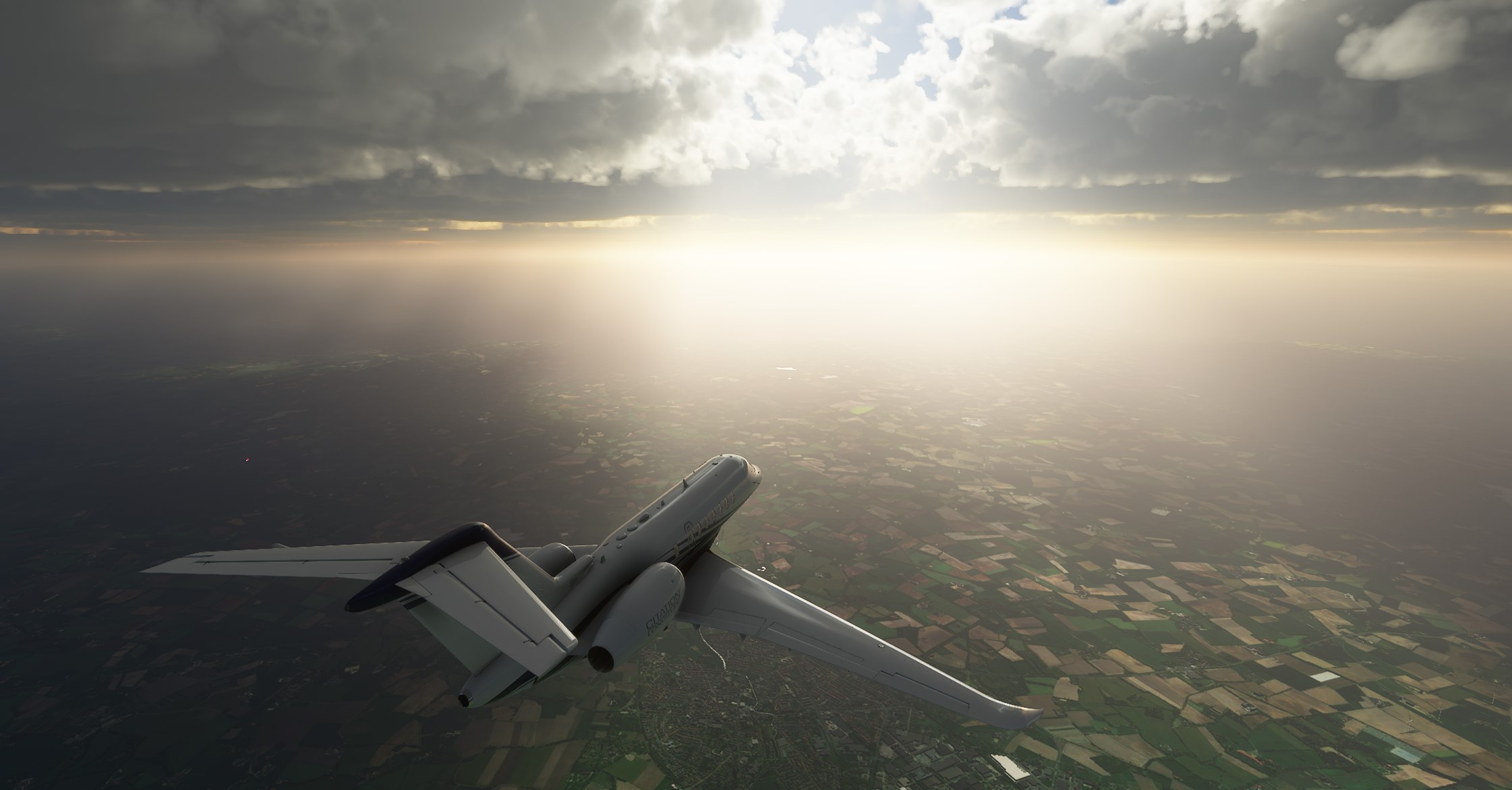
The first thing everybody I showed the new sim to told me was how beautiful it looks. That’s true for the scenery, which includes a mix of cities reconstructed in every detail thanks to the photogrammetry data in Bing Maps and those Microsoft partner Blackshark.ai reconstructed from the 2D maps (for more on how that works, here is our interview with Blackshark). What makes this work is not just the realistic cities and towns, but also that they feel pretty alive, with traffic zipping down highways and local streets and street lights and even the windows of houses lighting up at night.

And then there’s the weather model. Flight Simulator features the prettiest clouds you’ve ever seen in a game. Rain clouds in the distance look just like in real life. Wind acts realistically on your plane. If you fly in winter, snow covers the ground — and you can play around with all of those settings in real time without having to reload the game with every change.

Image Credits: TechCrunch

But since Microsoft and Asobo Studios decided to almost build a digital twin of our planet in Flight Simulator — and because the only way to do that is to use machine learning instead of placing every object by hand — you’ll still find plenty of oddness in the world, too. I had hoped that the team would fix more of these between the beta and final release, but I haven’t seen a lot of changes here. That means you’ll find bridges that look more like dams, roads that go under water and a few misplaced buildings and trees — there are so many trees where they don’t belong.

The way I look at this is that Flight Simulator is still a work in progress, and that hasn’t changed in the final release. I’m okay with that because even when there are mistakes, the cities and towns still usually look better than in any paid add-on for other flight simulators. Because a lot of this data is streamed from the Azure cloud and the team will continue to tweak its algorithms, I also expect that we’ll see fewer and fewer of these issues over time. Early on, I got hung up on this, but after a while, I realized that it doesn’t take away from enjoying the game — but it’s something to be aware of.

One area where I really hoped Microsoft would have improved the game, though, is air traffic control. This was always an area where Microsoft (and to be fair, all of its competitors) struggled. This was a problem during the alpha and beta, and it still is, which is really a shame, but what we have now just doesn’t feel very realistic.

Air traffic controllers don’t use standard phraseology (no real-life controller will ever tell you that he will contact you next when you leave his airspace, for example), don’t hand you off from tower to departure and constantly tell everybody to go around. I’m pretty sure I’ve done more go-arounds in three days with the final version of Flight Simulator than during the entire training for my pilot’s license. That feels like something that could be easily improved in the next update because, maybe even more so than the occasional graphics hiccup, it breaks the immersion for those looking for a simulator experience.

I also just wish that the controllers would call airlines by their real names. Microsoft has partnered with FlightAware to show real-life flights in the game, which depart and land on time, but somehow there are no liveries for them (except for the occasional stray United plane, which hints that we’ll see more of these over time) and only a limited set of models. Again, that’s something we’ll probably see more of in future updates.

Speaking of those flight models, Microsoft tweaked some of them a bit since the beta and, while I’ve never been in the cockpit of a 787, the single-engine Cessnas that I’ve flown still behave like I would expect them to in the sim (though I find the rudder is still pretty twitchy and needs some tweaking). I can’t vouch for the other aircraft in the game, but I expect real live pilots will find they are similarly realistic.

I still found some bugs with the flight instruments here and there and the GPS systems sometimes won’t let me activate a course, for example. I also wish the simulation of the G1000 and G3X glass cockpits would go just a little bit further. I can’t help but wonder if Microsoft and Asobo specifically held back here a bit to leave more room for add-on developers.

Image Credits: Microsoft

Performance hasn’t really changed since the beta, but I’m typically getting around 40 frames per second with the 2070 Super and i7-9700K, even when barely skimming over the roofs of cities like Barcelona or Berlin.

The only time I’ve seen real dips down into the 20s is when flying low over some of the hand-crafted airports like Frankfurt, and even then, after turning around and flying over the airport again, those numbers shot back up to the 40s.

You’ll notice that I used the words “simulator” and “game” interchangeably in this post. That’s because I think, in many ways, Flight Simulator is what you want it to be. There are plenty of game elements here, with flight training, landing challenges and bush-flying exercises. And in this age of COVID-19, there’s also something about it that just feels very relaxing when you’re flying around the planet low and slow, looking at the gorgeous scenery and forgetting about everything else for a while. I do worry, though, that most casual players will get bored after a short time.

For simmers, the new Flight Simulator is a godsend and provides a great basis for their hobby for years to come, especially given that Microsoft will continue to update it and because a lot of companies will develop all kinds of add-ons for it — and thanks to the inherent flaws in the game, there’s still room for somebody to not just build additional aircraft but also handcrafted versions of smaller airports, for example.

As I said in my preview, Flight Simulator is a technical marvel. Is it perfect? No. But I can forgive those imperfections because it does so much right.

Microsoft’s new Flight Simulator was worth the wait

Meet the startup that helped Microsoft build the world of Flight Simulator

Source: Microsoft

Microsoft’s new Flight Simulator is a technological marvel that sets a new standard for the genre. But to recreate a world that feels real and alive and contains billions of buildings all in the right spots, Microsoft and Asobo Studios relied on the work of multiple partners.

One of those is the small Austrian startup blackshark.ai from Graz that, with a team of only about 50 people, recreated every city and town around the world with the help of AI and massive computing resources in the cloud.

Ahead of the launch of the new Flight Simulator, we sat down with Blackshark co-founder and CEO Michael Putz to talk about working with Microsoft and the company’s broader vision.

Image Credits: Microsoft

Blackshark is actually a spin-off of game studio Bongfish, the maker of World of Tanks: Frontline, Motocross Madness and the Stoked snowboarding game series. As Putz told me, it was actually Stoked that set the company on the way to what would become Blackshark.

“One of the first games we did in 2007 was a snowboarding game called Stoked and S Stoked Bigger Edition, which was one of the first games having a full 360-degree mountain where you could use a helicopter to fly around and drop out, land everywhere and go down,” he explained. “The mountain itself was procedurally constructed and described — and also the placement of obstacles of vegetation, of other snowboarders and small animals had been done procedurally. Then we went more into the racing, shooting, driving genre, but we still had this idea of positional placement and descriptions in the back of our minds.”

Bongfish returned to this idea when it worked on World of Tanks, simply because of how time-consuming it is to build such a huge map where every rock is placed by hand.

Based on this experience, Bongfish started building an in-house AI team. That team used a number of machine-learning techniques to build a system that could learn from how designers build maps and then, at some point, build its own AI-created maps. The team actually ended up using this for some of its projects before Microsoft came into the picture.

“By random chance, I met someone from Microsoft who was looking for a studio to help them out on the new Flight Simulator. The core idea of the new Flight Simulator simulator was to use Bing Maps as a playing field, as a map, as a background,” Putz explained.

But Bing Maps’ photogrammetry data only yielded exact 1:1 replicas of 400 cities — for the vast majority of the planet, though, that data doesn’t exist. Microsoft and Asobo Studios needed a system for building the rest.

This is where Blackshark comes in. For Flight Simulator, the studio reconstructed 1.5 billion buildings from 2D satellite images.

Now, while Putz says he met the Microsoft team by chance, there’s a bit more to this. Back in the day, there was a Bing Maps team in Graz, which developed the first cameras and 3D versions of Bing Maps. And while Google Maps won the market, Bing Maps actually beat Google with its 3D maps. Microsoft then launched a research center in Graz and when that closed, Amazon and others came in to snap up the local talent.

“So it was easy for us to fill positions like a Ph.D. in rooftop reconstruction,” Putz said. “I didn’t even know this existed, but this was exactly what we needed — and we found two of them.

“It’s easy to see why reconstructing a 3D building from a 2D map would be hard. Even figuring out a building’s exact outline isn’t easy.

Image Credits: Blackshark.ai

“What we do basically in Flight Simulators is we looking at areas, 2D areas and then finding out footprints of buildings, which is actually a computer vision task,” said Putz. “But if a building is obstructed by a shadow of a tree, we actually need machine learning because then it’s not clear anymore what is part of the building and what is not because of the overlap of the shadow — but then machine learning completes the remaining part of the building. That’s a super simple example.”

While Blackshark was able to rely on some other data, too, including photos, sensor data and existing map data, it has to make a determination about the height of the building and some of its characteristics based on very little information.

The obvious next problem is figuring out the height of a building. If there is existing GIS data, then that problem is easy to solve, but for most areas of the world, that data simply doesn’t exist or isn’t readily available. For those areas, the team takes the 2D image and looks for hints in the image, like shadows. To determine the height of a building based on a shadow, you need the time of day, though, and the Bing Maps images aren’t actually timestamped. For other use cases the company is working on, Blackshark has that and that makes things a lot easier. And that’s where machine learning comes in again.
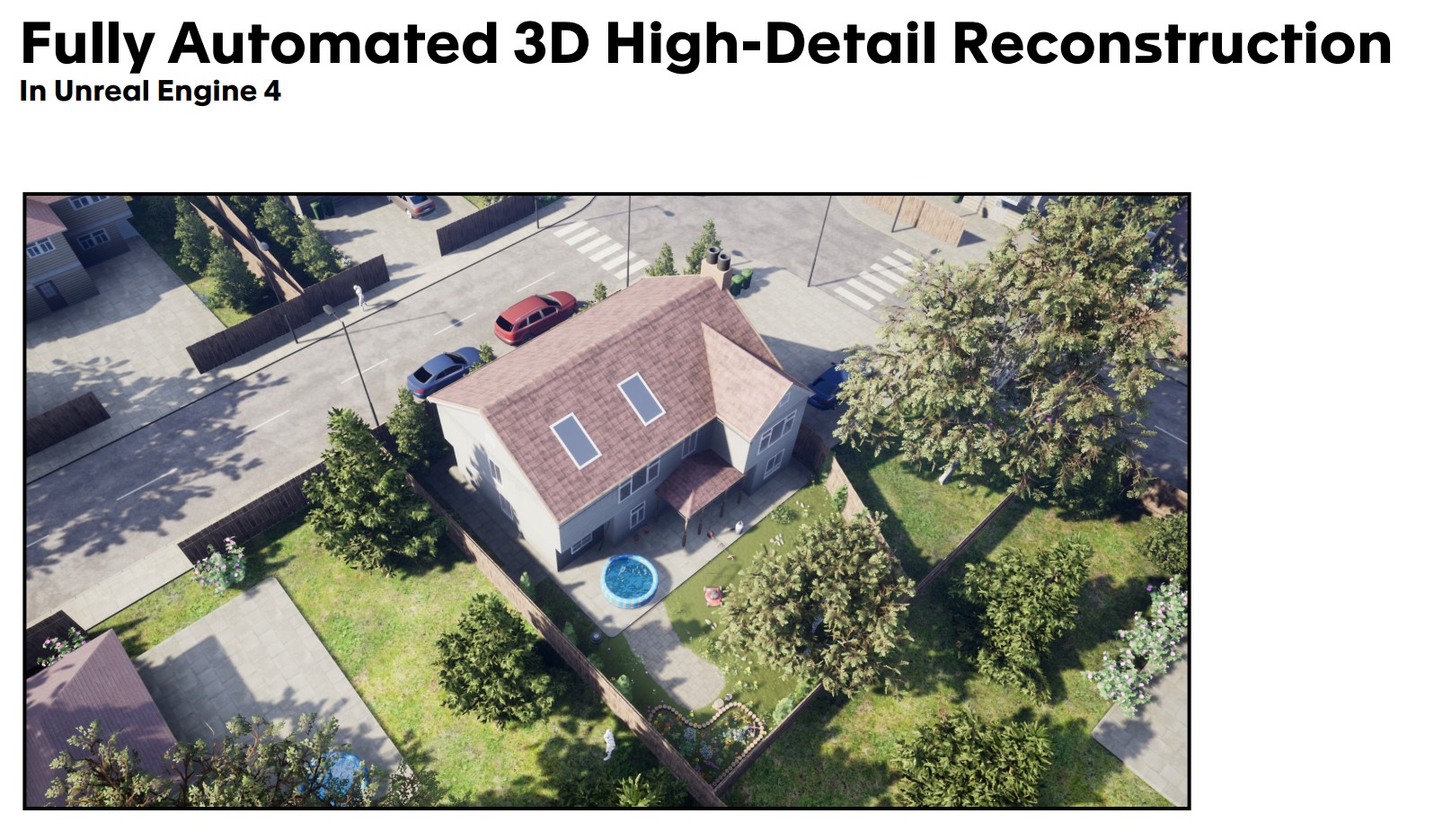
Image Credits: Blackshark.ai

“Machine learning takes a slightly different road,” noted Putz. “It also looks at the shadow, we think — because it’s a black box, we don’t really know what it’s doing. But also, if you look at a flat rooftop, like a skyscraper versus a shopping mall. Both have mostly flat rooftops, but the rooftop furniture is different on a skyscraper than on a shopping mall. This helps the AI to learn when you label it the right way.”

And then, if the system knows that the average height of a shopping mall in a given area is usually three floors, it can work with that.

One thing Blackshark is very open about is that its system will make mistakes — and if you buy Flight Simulator, you will see that there are obvious mistakes in how some of the buildings are placed. Indeed, Putz told me that he believes one of the hardest challenges in the project was to convince the company’s development partners and Microsoft to let them use this approach.

“You’re talking 1.5 billion buildings. At these numbers, you cannot do traditional Q&A anymore. And the traditional finger-pointing in like a level of Halo or something where you say ‘this pixel is not good, fix it,’ does not really work if you develop on a statistical basis like you do with AI. So it might be that 20% of the buildings are off — and it actually is the case I guess in the Flight Simulator — but there’s no other way to tackle this challenge because outsourcing to hand-model 1.5 billion buildings is, just from a logistical level and also budget level, not doable.”

Over time, that system will also improve and since Microsoft streams a lot of the data to the game from Azure, users will surely see changes over time.

Image Credits: Blackshark.ai

Labeling, though, is still something the team has to do simply to train the model, and that’s actually an area where Blackshark has made a lot of progress, though Putz wouldn’t say too much about it because it’s part of the company’s secret sauce and one of the main reasons why it can do all of this with just about 50 people.

“Data labels had not been a priority for our partners,” he said. “And so we used our own live labeling to basically label the entire planet by two or three guys […] It puts a very powerful tool and user interface in the hands of the data analysts. And basically, if the data analyst wants to detect a ship, he tells the learning algorithm what the ship is and then he gets immediate output of detected ships in a sample image.”

From there, the analyst can then train the algorithm to get even better at detecting a specific object like a ship, in this example, or a mall in Flight Simulator. Other geospatial analysis companies tend to focus on specific niches, Putz also noted, while the company’s tools are agnostic to the type of content being analyzed.
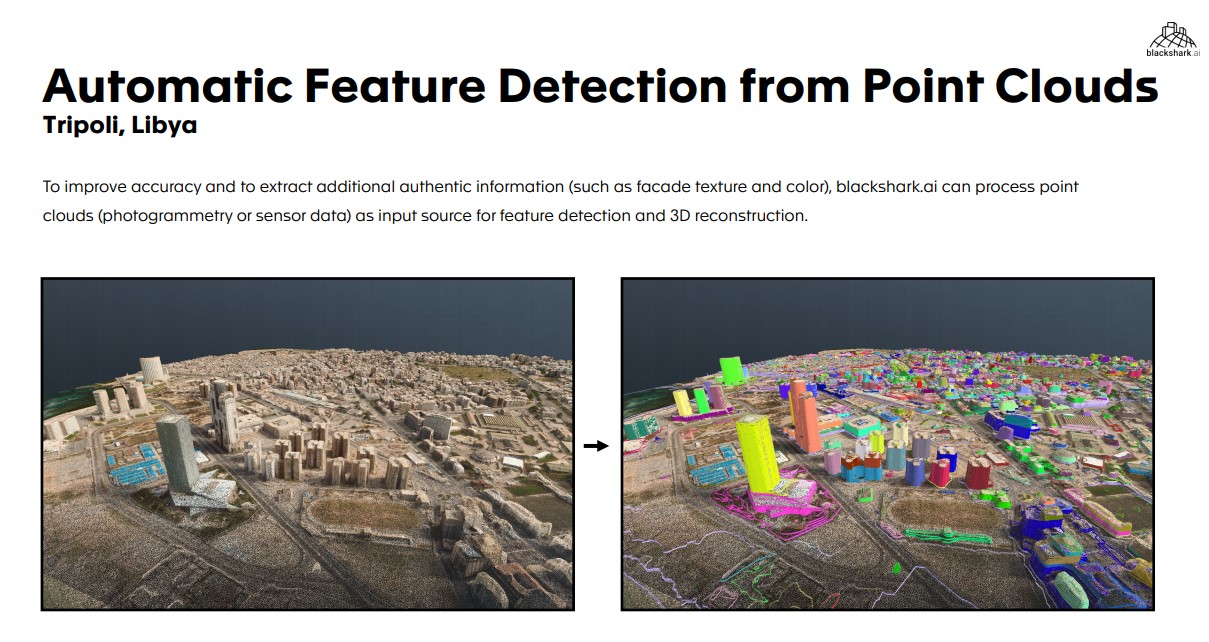
Image Credits: Blackshark.ai

And that’s where Blackshark’s bigger vision comes in. Because while the company is now getting acclaim for its work with Microsoft, Blackshark also works with other companies around reconstructing city scenes for autonomous driving simulations, for example.

“Our bigger vision is a near-real-time digital twin of our planet, particularly the planet’s surface, which opens up a trillion use cases where traditional photogrammetry like a Google Earth or Apple Maps is doing is not helping because those are just simplified for photos clued on simple geometrical structures. For this we have our cycle where we have been extracting intelligence from aerial data, which might be 2D images, but it also could be 3Dpoint counts, which are already doing another project. And then we are visualizing the semantics.”

Those semantics, which describe the building in very precise detail, have one major advantage over photogrammetry: Shadow and light information is essentially baked into the images, making it hard to relight a scene realistically. Since Blackshark knows everything about that building it is constructing, it can then also place windows and lights in those buildings, which creates the surprisingly realistic night scenes in Flight Simulator.

Point clouds, which aren’t being used in Flight Simulator, are another area Blackshark is focusing on right now. Point clouds are very hard to read for humans, especially once you get very close. Blackshark uses its AI systems to analyze point clouds to find out how many stories a building has.

“The whole company was founded on the idea that we need to have a huge advantage in technology in order to get there, and especially coming from video games, where huge productions like in Assassin’s Creed or GTA are now hitting capacity limits by having thousands of people working on it, which is very hard to scale, very hard to manage over continents and into a timely delivered product. For us, it was clear that there need to be more automated or semi-automated steps in order to do that.”

And though Blackshark found its start in the gaming field — and while it is working on this with Microsoft and Asobo Studios — it’s actually not focused on gaming but instead on things like autonomous driving and geographical analysis. Putz noted that another good example for this is Unreal Engine, which started as a game engine and is now everywhere.

“For me, having been in games industry for a long time, it’s so encouraging to see, because when you develop games, you know how groundbreaking the technology is compared to other industries,” said Putz. “And when you look at simulators, from military simulators or industrial simulators, they always kind of look like shit compared to what we have in driving games. And the time has come that the game technologies are spreading out of the game stack and helping all those other industries. I think Blackshark is one of those examples for making this possible.”

Meet the startup that helped Microsoft build the world of Flight Simulator

Microsoft’s dual-screen Surface Duo arrives September 10 for $1,399

Source: Microsoft

I can’t recall the last time people were this intrigued by a (non-Xbox) piece of Microsoft hardware. Announced a little under a year ago amid a deluge of new devices, the Surface Duo turned a lot of heads, leaving many wondering whether the product amounted to more than a concept device.

Today, however, the dual-screen mobile device takes an important step closer to reality, with a release date and price. As a matter of fact, the Duo actually goes up for pre-order starting today. It’s set to arrive in stores on September 10. As for how much it costs, well, that’s bound to be a sticking point for some.

Image Credits: Microsoft

In the grand scheme of things, $1,399 isn’t a crazy price to pay for a dual-screen, perhaps. Certainly it pales in comparison to, say, the first generation of foldable mobile devices. But it will probably be enough to deter those who were simply casually interested in the new form factor.


The price tag seems to largely be a product of the Duo very much being a first-generation product for Microsoft. To hear the company, they built the system from the ground up, including the 360-degree hinge and a cabling system that allows for a pair of batteries, each hidden behind one of the screens.

I’ll preface this by saying I have not seen the Duo in person: COVID-19 has really put a damper on my ability to travel to events. That said, the hardware looks slick, and Microsoft has done a good job here building on top of the Android foundation to ensure there’s a dynamic two-screen experience. Again, the important caveat here being that some of those foldable devices also looked slick in the initial videos/demos, so I’m holding off on making any sort of sweeping judgments until I can get my hands on a unit.

Image Credits: Microsoft

Most additions to Android are focused on things like multi-tasking. The most obvious example of this is probably the App Groups, which lets users essentially pair two apps into a single icon on the desktop top. Tapping it will open them both at the same time, so you can, say, have a book open on one display and a note-taking app on the other. Or, perhaps, two social media apps, if you want to punish yourself.

Android is, perhaps, not the most obvious choice for Microsoft, which has devoted so much time to sticking Windows 10 on as many form factors as humanly possible. But it does, perhaps, represent some growth for a company committed to choosing the best software for this specific hardware, a decision that largely came down to the lack of mobile apps on Windows. The Duo is likely to start life as a niche device, but limiting the number of potential apps will only dampen its appeal.

In addition to its own first-party productivity apps, the company has already worked with a number of developers, including Amazon on a Kindle app — that certainly makes perfect sense for the dual-screen form factor, finally realizing some degree of the long-ago abandoned promise of the Courier device. Microsoft says apps will work across the dual-screens regardless, but an API will help developers further customize them for the unique form factor.

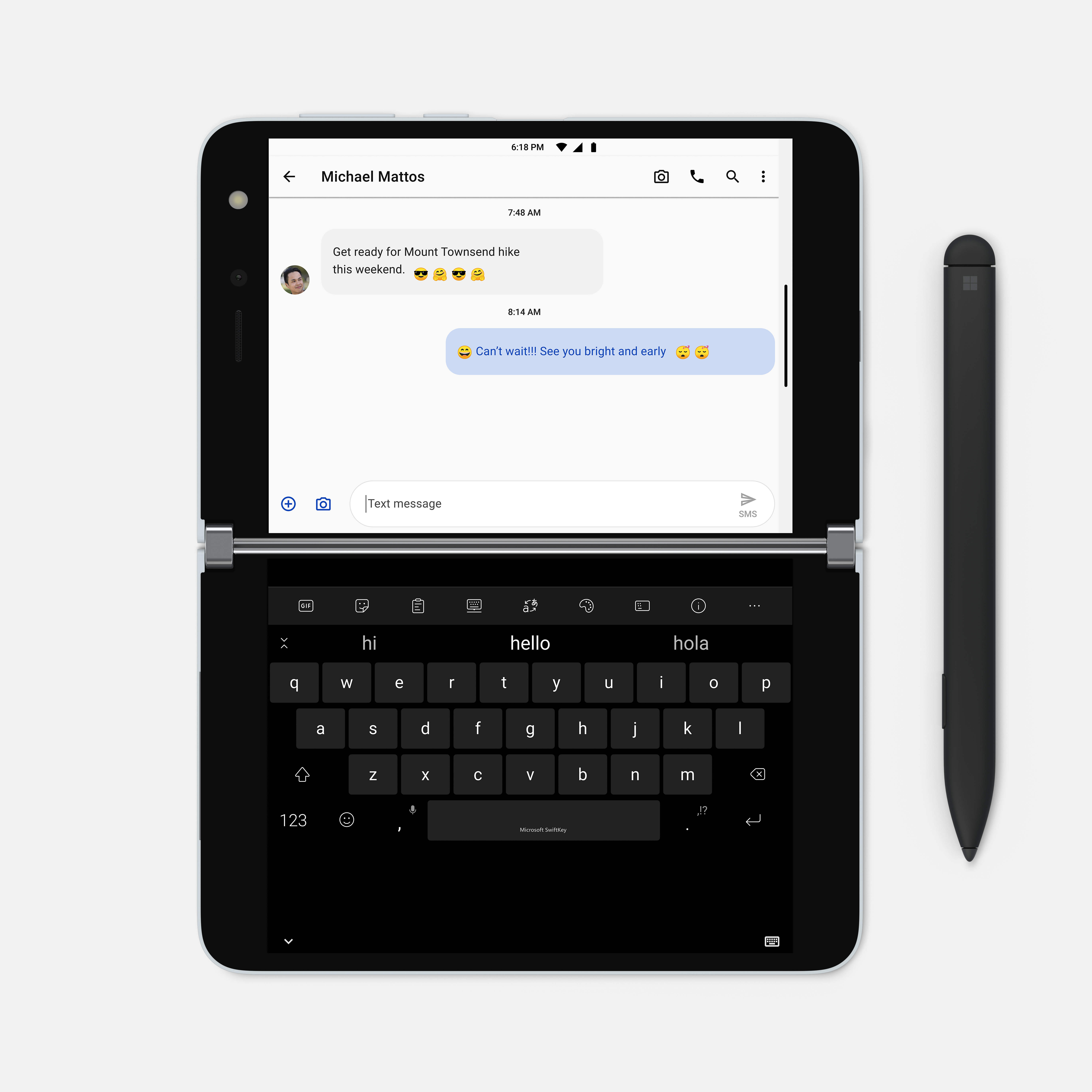
As for why the company went dual-screen instead of foldable, that appears to mostly come down to materials. A foldable display would have made it much more difficult to cover the product with a sufficiently strong glass covering, which, in turn, would have made a pen input a bit of a non starter. And Microsoft’s Surface Pen is going to be a big part of the puzzle here (even if it’s not actually included in the $1,399 price tag).

There are, of course, trade-offs. Because there are always trade-offs. That’s just how this world works, friend. Here the biggest one seems to be the gap between screens. Sure, the two displays add up to a sizable 8.1 inches, but the gap plus the bezels could be a real pain when it comes to things like watching video on the thing.

Ultimately, I suspect the Duo will very much be a learning experience for Microsoft and the industry at large, but at the very least, it’s going to be one of the more interesting ones we’ve seen from a major vendor in recent years.

Microsoft’s dual-screen Surface Duo arrives September 10 for ,399

The next-gen Xbox will ship in November

Source: Microsoft

The last few months have provided a steady trickle of information about the next Xbox console — or the Xbox Series X, as it’s known.

We know what it looks like. We know a lot about what’s inside. We know about more than a dozen titles currently being built for it.

One thing we didn’t know was when it’d actually hit the shelves. Microsoft had said it’d be ready by the holidays, but held off on getting much more specific than that. Today they’re tightening up that launch window a bit: it’ll ship sometime in November, says the company.

Microsoft doesn’t say exactly when in November, so they’ve still got some wiggle room on the exact launch date. But it’s better than the big ol’ three-month window we knew about previously!

This news comes almost simultaneously with word that 343 Industries would be delaying the launch of Halo Infinite until 2021 “to deliver a Halo game experience that meets [343’s] vision.”

The next-gen Xbox will ship in November

Scribd acquires presentation-sharing service SlideShare from LinkedIn

Source: Microsoft

SlideShare has a new owner, with LinkedIn selling the presentation-sharing service to Scribd for an undisclosed price.

According to LinkedIn, Scribd will take over operation of the SlideShare business on September 24.

Scribd CEO Trip Adler argued that the companies have very similar roots, both launching in 2006/2007 with stories on TechCrunch, and both of them focused on content- and document-sharing.

“The two products always had kind of similar missions,” Adler said. “The difference was, [SlideShare] focused on more on PowerPoint presentations and business users, while we focused more on PDFs and Word docs and long-form written content, more on the more general consumer.”

Over time, the companies diverged even further, with SlideShare acquired by LinkedIn in 2012, and LinkedIn itself acquired by Microsoft in 2016.

Scribd, meanwhile, launching a Netflix-style subscription service for e-books and audiobooks, but Adler said that both the “user-generated side” and the “premium side” remain important to the business.

“We get people who come in looking for documents, then sign up for our premium content,” he said. “But they do continue to read documents, too.”

So when Microsoft and LinkedIn approached Scribd about acquiring SlideShare, Adler saw an opportunity to expand the document side of the business. Specifically, he pointed to SlideShare’s content library of 40 million presentations and its audience of 100 million monthly unique visitors.

The deal, Adler said, is fundamentally about tapping into SlideShare’s “content and audience,” though he said there may be aspects of the service’s technology that Scribd could incorporate as well. Scribd isn’t taking on any new employees as part of the deal; instead, its existing team is taking responsibility for SlideShare’s operation.

He added that SlideShare will continue to operate as a standalone service, separate from Scribd, and that he’s hopeful that it will continue to be well-integrated with LinkedIn.

“Nothing will change in the initial months,” Adler said. “We have a lot of experience with a product like this, both the technology stack and with users uploading content. We’re in a good position make slide share really successful.”

Meanwhile, a statement from LinkedIn Vice President of Engineering Chris Pruett highlighted the work that the company has done on SlideShare since the acquisition:

LinkedIn acquired SlideShare in May 2012 at a time when it was becoming clear that professionals were using LinkedIn for more than making professional connections. Over the last eight years, the SlideShare team, product, and community has helped shape the content experience on LinkedIn. We’ve incorporated the ability to upload, share, and discuss documents on LinkedIn.


Scribd acquires presentation-sharing service SlideShare from LinkedIn

Google, Nokia, Qualcomm are investors in $230M Series A2 for Finnish phone maker, HMD Global

Source: Microsoft

Mobile device maker HMD Global has announced a $230M Series A2 — its first tranche of external funding since a $100M round back in 2018 when it tipped over into a unicorn valuation. Since late 2016 the startup has exclusively licensed Nokia’s brand for mobile devices, going on to ship some 240M devices to date.

Its latest cash injection is notable both for its size (HMD claims it as the third largest funding round in Europe this year); and the profile of the strategic investors ploughing in capital — namely: Google, Nokia and Qualcomm.

Though whether a tech giant (Google) whose OS dominates the world’s smartphone market (Android) becoming a strategic investor in Europe’s last significant mobile OEM (HMD) catches the attention of regional competition enforcers remains to be seen. Er, vertical integration anyone? (To wit: It’s a little over two years since Google was slapped with a $5BN penalty by EU regulators for antitrust violations related to how it operates Android — and the Commission has said it continues to monitor the market ‘remedies’.)

In a further quirk, when we spoke to HMD Global CEO, Florian Seiche, ahead of today’s announcement, he didn’t expect the names of the investors to be disclosed — but we’d already been sent press release material listing them so he duly confirmed the trio are investors in the round. (But wouldn’t be drawn on how much equity Google is grabbing.)

HMD’s smartphones run on Google’s Android platform, which gives the tech giant a firm business reason for supporting the mobile maker in growing the availability of Google-packed hardware in key growth markets around the world.

And while HMD likens its consistent (and consistently updated) flavor of Android to the premium ‘pure’ Android experience you get from Google’s own-brand Pixel smartphones, the difference is the Finnish company offers devices across the range of price points, and targets hardware at mobile users in developing markets.

The upshot is relatively little overlap with Google’s Pixel hardware, and still plenty of business upside for Google should HMD grow the pipeline of Google services users (as it makes money by targeting ads).

Connoisseurs of mobile history may see more than a little irony in Google investing into Nokia branded smartphones (via HMD), given Android’s role in fatally disrupting Nokia’s lucrative smartphone business — knocking the Finnish giant off its perch as the world’s number one mobile maker and ushering in an era of Android-fuelled Asian mobile giants. But wait long enough in tech and what goes around oftentimes comes back around.

“We’re extremely excited,” said Seiche, when we mention Google’s pivotal role in Nokia’s historical downfall in smartphones. “How we are going to write that next chapter on smartphones is a critical strategic pillar for the company and our opportunity to team up so closely with Google around this has been a very, very great partnership from the beginning. And then this investment definitely confirms that — also for the future.”

“It’s a critical time for the industry therefore having a clear strategy — having a clear differentiation and a different point of view to offer, we believe, is a fantastic asset that we have developed for ourselves. And now is a great moment for us to double down on this,” he added.

We also asked Seiche whether HMD has any interest in taking advantage of the European Commission’s Android antitrust enforcement decision — i.e. to fork Android and remove the usual Google services, perhaps swapping them out for some European alternatives, which is at least a possibility for OEMs selling in the region — but Seiche told us: “We have looked at it but we strongly believe that consumers or enterprise customers actually love [Google] services and therefore they choose those services for themselves.” (Millions of dollars of direct investment from Google also, presumably, helps make the Google services business case stack up.)

Nokia, meanwhile, has always had a close relationship with HMD — which was established by former Nokia execs for the sole purpose of licensing its iconic mobile brand. (The backstory there is a clause in the sale terms of Nokia’s mobile device division to Microsoft expired in 2016, paving the way for Nokia’s brand to be returned to the smartphone market without the prior Windows Mobile baggage.)

Its investment into HMD now looks like a vote of confidence in how the company has been executing in the fiercely competitive mobile space to date (HMD doesn’t break out a lot of detail about device sales but Seiche told us it sold in excess of 70M mobiles last year; that’s a combined figure for smartphones and feature phones) — as well as an upbeat assessment of the scope of the growth opportunity ahead of it.

On the latter front US-led geopolitical tensions between the West and China do look poised to generate a tail-wind for HMD’s business.

Mobile chipmaker Qualcomm, for example, is facing a loss of business, as US government restrictions threaten its ability to continue selling chips to Huawei; a major Chinese device maker that’s become a key target for US president Trump. Its interest in supporting HMD’s growth, therefore, looks like a way for Qualcomm to hedge against US government disruption aimed at Chinese firms in its mobile device maker portfolio.

While with Trump’s recent threats against the TikTok app it seems safe to assume that no tech company with a Chinese owner is safe.

As a European company, HMD is able to position itself as a safe haven — and Seiche’s sales pitch talks up a focus on security detail and overall quality of experience as key differentiating factors vs the Android hoards.

“We have been very clear and very consistent right from the beginning to pick these core principles that are close to our heart and very closely linked with the Nokia brand itself — and definitely security, quality and trust are key elements,” he told TechCrunch. “This is resonating with our carrier and retail customers around the world and it is definitely also a core fundamental differentiator that those partners that are taking a longer term view clearly see that same opportunity that we see for us going forward.”

HMD does use manufacturing facilities in China, as well as in a number of other locations around the world — including Brazil, India, Indonesia and Vietnam.

But asked whether it sees any supply chain risks related to continued use of Chinese manufacturers to build ‘secure’ mobile hardware, Seiche responded by claiming: “The most important [factor] is we do control the software experience fully.” He pointed specifically to HMD’s acquisition of Valona Labs earlier this year. The Finnish security startup carries out all its software audits. “They basically control our software to make sure we can live up to that trusted standard,” Seiche added. 

Landing a major tranche of new funding now — and with geopolitical tension between the West and the Far East shining a spotlight on its value as alternative, European mobile maker — HMD is eyeing expansion in growth markets such as Africa, Brail and India. (Currently, HMD said it’s active in 91 markets across eight regions, with its devices ranged in 250,000 retail outlets around the world.)

It’s also looking to bring 5G to devices at a greater range of price-points, beyond the current flagship Nokia 8.3. Seiche also said it wants to do more on the mobile services side. HMD’s first 5G device, the flagship Nokia 8.3, is due to land in the US and Europe in a matter of weeks. And Seiche suggested a timeframe of the middle of next year for launching a 5G device at a mid tier price point.

“The 5G journey again has started, in terms of market adoption, in China. But now Europe, US are the key next opportunity — not just in the premium tier but also in the mid segment. And to get to that as fast as possible is one of our goals,” he said, noting joint-working with Qualcomm on that.

“We also see great opportunity with Nokia in that 5G transition — because they are also working on a lot of private LTE deployments which is also an interesting area since… we are also very strongly present in that large enterprise segment,” he added.

On mobile services, Seiche highlighted the launch of HMD Connect: A data SIM aimed at travellers — suggesting it could expand into additional connectivity offers in future, forging more partnerships with carriers. 

“We have already launched several services that are close to the hardware business — like insurance for your smartphones — but we are also now looking at connectivity as a great area for us,” he said. “The first pilot of that has been our global roaming but we believe there is a play in the future for consumers or enterprise customers to get their connectivity directly with their device. And we’re partnering also with operators to make that happen.”

“You can see us more as a complement [to carriers],” he added, arguing that business “dynamics” for carriers have also changed substantially — and customer acquisition hasn’t been a linear game for some time.

“In a similar way when we talk about Google Pixel vs us — we have a different footprint. And again if you look at carriers where they get their subscribers from today is already today a mix between their own direct channels and their partner channels. And actually why wouldn’t a smartphone player be a natural good partner of choice also for them? So I think you’ll see that as a trend, potentially, evolving in the next couple of years.”

Google, Nokia, Qualcomm are investors in 0M Series A2 for Finnish phone maker, HMD Global

Google rolls out virtual business card in India

Source: Microsoft

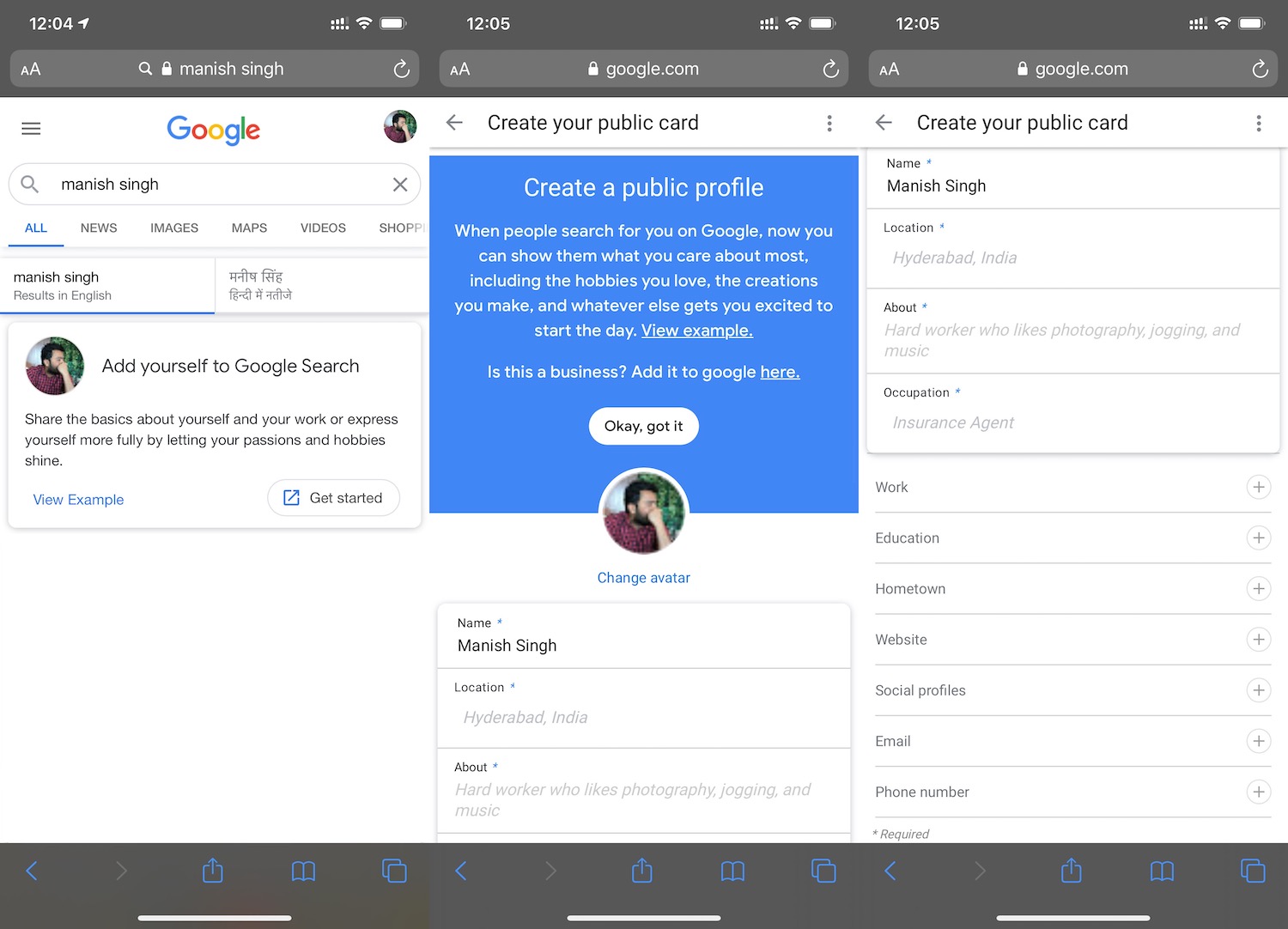
Google has rolled out a new Search feature in India that enables influencers, entrepreneurs, freelancers, or anyone else who wants to be easily discovered online create a virtual visiting card in what appears to be the company’s latest attempt to bring more of LinkedIn -esque functionalities into its search engine.

The company said it has rolled out the feature, called people cards, first in India because of the special affinity people in the world’s second largest internet market have shown toward looking up their own names on the search engine. People cards currently only supports English.

Users can create people cards about themselves by signing into their Google account and then looking up their name on Google search. This will prompt a new option called “add me to Search” or “get started”; tapping which will open a form that asks users to provide a bio (description) of themselves, their picture (by default, Google fetches the image associated with a user’s Google account), links to their website and social media profiles, and optionally, their phone number, address, work and education details, and email address.

Google said the more information a user provides, the easier it would be for others to find them on Google Search. The company said that it has put in place several measures to curb potential misuse of the new feature. One of which is limiting the number of people cards a Google account can create — it is set to one.

“We have a number of mechanisms to protect against abusive or spammy content, and if you come across low quality information or a card that you believe was created by an impersonator, you can tap the feedback link to let us know. If you no longer want your people card to appear in Search, you can delete it at any time,” wrote Lauren Clark, Product Manager for Search at Google, in a blog post.

People card appears to be Google’s latest step to bring more functionalities into Search and thereby reduce a user’s reliance on many other services. In this case, the feature is likely aimed at LinkedIn — though users can’t add other people’s profiles as connections. Two years ago, the company added jobs listing discovery feature to Search in India after unveiling it in the U.S. in 2017.

“For the millions of influencers, entrepreneurs, prospective employees, self-employed individuals, freelancers, or anyone else out there who wants to be discovered, we hope this new Search feature will help the world find them. For people in India searching on mobile phones, people cards are rolling out in English starting today,” wrote Clark.

Google rolls out virtual business card in India

Beware bankers talking TikTok

Source: Microsoft

The next few weeks are going to be critical for ByteDance-owned TikTok . The company is weeks away from a ban signed by President Trump, and while the company is expected to sue the U.S. federal government this week to block it, clearly the company’s future has at least storm clouds on the horizon.

That has led to massive speculation about who might purchase TikTok and save it from its precarious situation. The leading contender so far in media reporting has been Microsoft, with multiple press reports indicating that Microsoft CEO Satya Nadella has talked with President Trump about an outline of how a deal could be consummated. Trump has indicated he wants the buyer to pay some sort of tithe to the federal government, an argument that might even make sense for a suitor like Microsoft in the right circumstances.

Over the past week and weekend though, we are starting to get more and more names outside of Microsoft that are supposedly interested. We’ve heard Apple mentioned, and Twitter has been discussed heavily. SoftBank (which owns part of ByteDance in the Vision Fund) has been rumored to be a contender. Google was formerly in talks about potentially buying the app late last year, and presumably could stay in the mix. And private equity firms are also supposedly sniffing around the opportunity.

Here’s the deal though: All of this — outside of Microsoft’s potential deal — seems completely like smoke.

Apple has actively denied any interest in buying the company, which shouldn’t be surprising, as it makes no strategic sense whatsoever. Other supposed suitors have been more lukewarm with the typical PR blandishments that their companies “consider all strategic opportunities.”

What’s going on is that TikTok is an extremely valuable property, potentially worth tens of billions of dollars. But it is only worth that value if the company can find a number of deep-pocketed buyers who are willing to bid the price up. If Microsoft is the only suitor, then TikTok’s price may well be shockingly low.

So what do the investment bankers at the heart of the deal do? They run the deal around to every corporate development department in the country, and they leak the information to reporters to try to drum up FOMO in other departments, all in the hope that a board member somewhere starts asking, “Hey, why aren’t we taking a deep look at this?” Heck, I’m sure even Oracle is taking a look — they have data centers and “synergy” potential, and its CEO Safra Catz is a major Trump supporter as well, and could navigate the coming policy shenanigans.

Yet, the reality of the deal is the same: There just aren’t that many companies that can even consider an acquisition. Facebook is out on antitrust. Japan-headquartered SoftBank is out on foreign company concerns (the very reason why TikTok is in this position in the first place). Apple isn’t interested, and even companies like Twitter, popular and strategic as they are, don’t have the cash. Twitter is worth less than $30 billion in market cap today — can they really afford to spend, say, half the company on an acquisition? How much of a writedown would ByteDance have to take to make Twitter a logical fit?

Most of this smoke about interest is designed to push Microsoft to make a fair deal. It’s designed to encourage them to sweeten their offer, lest one of these other “suitors” potentially becomes interested. Yet, the timing of a deal (it needs to be done in a matter of weeks right now) and the scope of the price effectively precludes all but one buyer today.

So, beware bankers talking TikTok. We’re going to get a bunch of names of potential acquirers. Unless there is hard evidence of deep interest, I am going to remain skeptical of all the rumors.

Beware bankers talking TikTok

US gaming industry records another excellent quarter as pandemic fuels sales

Source: Microsoft

The COVID-19 pandemic has utterly decimated a number of industries over the past several months, but the U.S. gaming industry continues to benefit as people continue to be stuck at home. Yet another report from NPD highlights an excellent quarter, with spending hitting a new Q2 record in the States.

According to the figures, gamers spent $11.6 billion, marking a 30% increase over a year prior. It was also a 7% increase over Q1’s 10.9 billion, as spending continues while the pandemic continues to rage.

Games themselves comprised $10.2 billion of that figure (itself a 28% increase y-o-y), with some familiar titles occupying the top spots, including Animal Crossing: New Horizons, Call of Duty: Warzone and Call of Duty: Modern Warfare. The gaming hardware category saw a 57% increase from 2019, with Nintendo Switch, PlayStation 4 and Xbox One all seeing strong sales.

The Switch isn’t a surprise, given shortages experienced earlier in the year. Perhaps a bit more unexpected are continued sales on the PS4 and Xbox One, given that both consoles are set to be eclipsed by next-generation devices later in the year. Of course, those upcoming systems aren’t doing gamers much good during the current moment of stay at home orders.

US gaming industry records another excellent quarter as pandemic fuels sales