Source: Microsoft
All over the world startups are piling into the space marked “virtual interaction and collaboration”. What if a startup created a sort of ‘Club Penguin for adults’?
Step forward Cosmos Video, which has a virtual venues platform that allows people to work, hang out and socialize together. It has now raised $2.6m in seed funding LocalGlobe with participation from Entrepreneur First, Andy Chung and Phillip Moehring (AngelList), and Omid Ashtari (former President of Citymapper).
Founders Rahul Goyal and Karan Baweja previously led product teams at Citymapper and TransferWise respectively.
Cosmos allows users to create virtual venues by combining game mechanics with video chat. The idea is to bring back the kinds of serendipitous interactions we used to have in the real world. You choose an avatar, then meet up with their colleagues or friends inside a browser-based game. As you move your avatars closer to one another person you can video chat with them, as you might in real life.
The competition is the incumbent video conferencing platforms such as Zoom and Microsoft Teams, but calls on these platforms have a set agenda, and are timeboxed – they’re rigid and repetitive. On Cosmos you sit on the screen and consume one video call after another as you move around the space, so it is mimicking serendipity, after a fashion.
As well as having a social application, office colleagues can work collaboratively on tools such as whiteboards, Google documents and Figma; play virtual board games or gather around a table to chat.
Cosmos is currently being used in private beta by a select group of companies to host their offices and for social events such as Christmas parties. Others are using it to host events, meetup groups and family gatherings.
Co-founder Rahul Goyal said in a statement: “Once the pandemic hit, we both saw productivity surge in our respective teams but at the same time, people were missing the in-office culture. Video conferencing platforms provide a great service when it comes to meetings, but they lack spontaneity. Cosmos is a way to bring back that human connection we lack when we spend all day online, by providing a virtual world where you can play a game of trivia or pong after work with colleagues or gather round a table to celebrate a friend’s birthday.”
George Henry, partner, LocalGlobe: “We were really impressed with the vision and potential of Cosmos. Scaling live experiences online is one of the big internet frontiers where there are still so many opportunities. Now that the video infrastructure is in place, we believe products like Cosmos will enable new forms of live online experiences.”
Cosmos Video – a ‘Club Penguin for adults’ to socialise and work – raises .6M from LocalGlobe
Source: Microsoft
A group of industry heavyweights, including Google, Box, Citrix, Dell, Imprivata, Intel, Okta, RingCentral, Slack, VMware and Zoom, today announced the launch of the moderncomputing.com.
The mission for this new alliance is to “drive ‘silicon-to-cloud’ innovation for the benefit of enterprise customers — fueling a differentiated modern computing platform and providing additional choice for integrated business solutions.”
Whoever wrote this mission statement was clearly trying to see how many words they could use without actually saying something.
Here is what the alliance is really about: even though the word Chrome never appears on its homepage and Google’s partners never quite get to mentioning it either, it’s all about helping enterprises adopt Chrome and Chrome OS. “The focus of the alliance is to drive innovation and interoperability in the Google Chrome ecosystem, increasing options for enterprise customers and helping to address some of the biggest tech challenges facing companies today,” a Google spokesperson told me.
I’m not sure why it’s not called the Chrome Enterprise Alliance, but Modern Computing Alliance may just have more of a ring to it. This also explains why Microsoft isn’t part of it, though this is only the initial slate of members and others may follow at some point in the future.
Led by Google, the alliance’s focus is on bringing modern web apps to the enterprise, with a focus on performance, security, identity management and productivity. And all of that, of course, is meant to run well on Chrome and Chrome OS and be interoperable.
“The technology industry is moving towards an open, heterogeneous ecosystem that allows freedom of choice while integrating across the stack. This reality presents both a challenge and an opportunity,” Google’s Chrome OS VP John Solomon writes today.
As enterprises move to the cloud, building better web applications and maybe even Progressive Web Applications that work just as well as native solutions is obviously a noble goal and it’s nice to see these companies work together. Given the pandemic, all of this has taken on a new urgency now, too. The plan is for the alliance to release products — though it’s unclear what form these will take — in the first half of 2021. Hopefully, these will play nicely with any browser. A lot of these ‘alliances’ fizzle out quite quickly, so we’ll keep an eye on what happens here.
Bonus: the industry has a long history of alliance like these. Here’s a fun 1991 story about a CPU alliance between Intel, IBM, MIPS and others.
Google, Intel, Zoom and others launch a new alliance to get enterprises to use more Chrome
Source: Microsoft
As remote work continues to solidify its place as a critical aspect of how businesses exist these days, a startup that has built a platform to help companies source and bring on one specific category of remote employees — engineers — is taking on some more funding to meet demand.
Turing — which has built an AI-based platform to help evaluate prospective, but far-flung, engineers, bring them together into remote teams, then manage them for the company — has picked up $32 million in a Series B round of funding led by WestBridge Capital. Its plan is as ambitious as the world it is addressing is wide: an AI platform to help define the future of how companies source IT talent to grow.
“They have a ton of experience in investing in global IT services, companies like Cognizant and GlobalLogic,” said co-founder and CEO Jonathan Siddharth of its lead investor in an interview the other day. “We see Turing as the next iteration of that model. Once software ate the IT services industry, what would Accenture look like?”
It currently has a database of some 180,000 engineers covering around 100 or so engineering skills, including React, Node, Python, Agular, Swift, Android, Java, Rails, Golang, PHP, Vue, DevOps, machine learning, data engineering and more.
In addition to WestBridge, other investors in this round included Foundation Capital, Altair Capital, Mindset Ventures, Frontier Ventures and Gaingels. There is also a very long list of high-profile angels participating, underscoring the network that the founders themselves have amassed. It includes unnamed executives from Google, Facebook, Amazon, Twitter, Microsoft, Snap and other companies, as well as Adam D’Angelo (Facebook’s first CTO and CEO at Quora), Gokul Rajaram, Cyan Banister and Scott Banister, and Beerud Sheth (the founder of Upwork), among many others (I’ll run the full list below).
Turing is not disclosing its valuation. But as a measure of its momentum, it was only in August that the company raised a seed round of $14 million, led by Foundation. Siddharth said that the growth has been strong enough in the interim that the valuations it was getting and the level of interest compelled the company to skip a Series A altogether and go straight for its Series B.
The company now has signed up to its platform 180,000 developers from across 10,000 cities (compared to 150,000 developers back in August). Some 50,000 of them have gone through automated vetting on the Turing platform, and the task will now be to bring on more companies to tap into that trove of talent.
Or, “We are demand-constrained,” which is how Siddharth describes it. At the same time, it’s been growing revenues and growing its customer base, jumping from revenues of $9.5 million in October to $12 million in November, increasing 17x since first becoming generally available 14 months ago. Current customers include VillageMD, Plume, Lambda School, Ohi Tech, Proxy and Carta Healthcare.
Remote work = immediate opportunity
A lot of people talk about remote work today in the context of people no longer able to go into their offices as part of the effort to curtail the spread of COVID-19. But in reality, another form of it has been in existence for decades.
Offshoring and outsourcing by way of help from third parties — such as Accenture and other systems integrators — are two ways that companies have been scaling and operating, paying sums to those third parties to run certain functions or build out specific areas instead of shouldering the operating costs of employing, upsizing and sometimes downsizing that labor force itself.
Turing is essentially tapping into both concepts. On one hand, it has built a new way to source and run teams of people, specifically engineers, on behalf of others. On the other, it’s using the opportunity that has presented itself in the last year to open up the minds of engineering managers and others to consider the idea of bringing on people they might have previously insisted work in their offices, to now work for them remotely, and still be effective.
Siddarth and co-founder Vijay Krishnan (who is the CTO) know the other side of the coin all too well. They are both from India, and both relocated to the Valley first for school (post-graduate degrees at Stanford) and then work at a time when moving to the Valley was effectively the only option for ambitious people like them to get employed by large, global tech companies, or build startups — effectively what could become large, global tech companies.
“Talent is universal, but opportunities are not,” Siddarth said to me earlier this year when describing the state of the situation.
A previous startup co-founded by the pair — content discovery app Rover — highlighted to them a gap in the market. They built the startup around a remote and distributed team of engineers, which helped them keep costs down while still recruiting top talent. Meanwhile, rivals were building teams in the Valley. “All our competitors in Palo Alto and the wider area were burning through tons of cash, and it’s only worse now. Salaries have skyrocketed,” he said.
After Rover was acquired by Revcontent, a recommendation platform that competes against the likes of Taboola and Outbrain, they decided to turn their attention to seeing if they could build a startup based on how they had, basically, built their own previous startup.
There are a number of companies that have been tapping into the different aspects of the remote work opportunity, as it pertains to sourcing talent and how to manage it.
They include the likes of Remote (raised $35 million in November), Deel ($30 million raised in September), Papaya Global ($40 million also in September), Lattice ($45 million in July) and Factorial ($16 million in April), among others.
What’s interesting about Turing is how it’s trying to address and provide services for the different stages you go through when finding new talent. It starts with an AI platform to source and vet candidates. That then moves into matching people with opportunities, and onboarding those engineers. Then, Turing helps manage their work and productivity in a secure fashion, and also provides guidance on the best way to manage that worker in the most compliant way, be it as a contractor or potentially as a full-time remote employee.
The company is not freemium, as such, but gives people two weeks to trial people before committing to a project. So unlike an Accenture, Turing itself tries to build in some elasticity into its own product, not unlike the kind of elasticity that it promises its customers.
It all sounds like a great idea now, but interestingly, it was only after remote work really became the norm around March/April of this year that the idea really started to pick up traction.
“It’s amazing what COVID has done. It’s led to a huge boom for Turing,” said Sumir Chadha, managing director for WestBridge Capital, in an interview. For those who are building out tech teams, he added, there is now “No need for to find engineers and match them with customers. All of that is done in the cloud.”
“Turing has a very interesting business model, which today is especially relevant,” said Igor Ryabenkiy, managing partner at Altair Capital, in a statement. “Access to the best talent worldwide and keeping it well-managed and cost-effective make the offering attractive for many corporations. The energy of the founding team provides fast growth for the company, which will be even more accelerated after the B-round.”
PS. I said I’d list the full, longer list of investors in this round. In these COVID times, this is likely the biggest kind of party you’ll see for a while. In addition to those listed above, it included [deep breath] Founders Fund, Chapter One Ventures (Jeff Morris Jr.), Plug and Play Tech Ventures (Saeed Amidi), UpHonest Capital (Wei Guo, Ellen Ma), Ideas & Capital (Xavier Ponce de León), 500 Startups Vietnam (Binh Tran and Eddie Thai), Canvas Ventures (Gary Little), B Capital (Karen Appleton Page, Kabir Narang), Peak State Ventures (Bryan Ciambella, Seva Zakharov), Stanford StartX Fund, Amino Capital, Spike Ventures, Visary Capital (Faizan Khan), Brainstorm Ventures (Ariel Jaduszliwer), Dmitry Chernyak, Lorenzo Thione, Shariq Rizvi, Siqi Chen, Yi Ding, Sunil Rajaraman, Parakram Khandpur, Kintan Brahmbhatt, Cameron Drummond, Kevin Moore, Sundeep Ahuja, Auren Hoffman, Greg Back, Sean Foote, Kelly Graziadei, Bobby Balachandran, Ajith Samuel, Aakash Dhuna, Adam Canady, Steffen Nauman, Sybille Nauman, Eric Cohen, Vlad V, Marat Kichikov, Piyush Prahladka, Manas Joglekar, Vladimir Khristenko, Tim and Melinda Thompson, Alexandr Katalov, Joseph and Lea Anne Ng, Jed Ng, Eric Bunting, Rafael Carmona, Jorge Carmona, Viacheslav Turpanov, James Borow, Ray Carroll, Suzanne Fletcher, Denis Beloglazov, Tigran Nazaretian, Andrew Kamotskiy, Ilya Poz, Natalia Shkirtil, Ludmila Khrapchenko, Ustavshchikov Sergey, Maxim Matcin and Peggy Ferrell.
Turing nabs M more for an AI-based platform to source and manage engineers remotely
Source: Microsoft
With Slack being acquired by Salesforce for $28bn, the world of collaborative tools for teams is on fire right now. Notion is super hot and last year Frame.io raised $50 million and Microsoft has Fluid. Now, after some months in private beta, JetBrains – which also makes development environments (IDE) for various programming languages — has publicly launched Space, an all-in-one collaboration platform for creative teams.
In beta since last year, JetBrains says it had over 35,000 requests from companies to join the beta.
Space combines general collaboration tools: chats, team and project management, meeting scheduling and documents with workflows for specific verticals. It covers the software development cycle and the startup will be adding domain-specific tools for other roles and departments in the future.
Maxim Shafirov, JetBrains CEO, said: “JetBrains started as a company of developers but now 40% of our team represent different creative roles: designers, marketing, copywriters, and others. We’ve built Space so we could still work together as one team and we believe other companies will benefit from it as well.”
Space provides free tier and subscription options, starting at $8 per active user per month for wider team collaboration. Space is available in the cloud but will also will have an on-premise version in the near future.
It includes chats, meetings, calendars, issues, mobile apps, launched documents, issue boards, automation CI/CD, personal to-do lists, and added turn-based code reviews.
In the future, Space will have syncing with Google Calendar and Outlook, as well as integrations with other popular tools. In terms of extensibility, the team has introduced HTTP API, webhooks, Space Client SDK, custom fields, automations, and will be adding private and Marketplace applications soon, along with other extensibility features.
JetBrains presses go on its Space project management platform for developers
Source: Microsoft
Productivity software has been getting a major re-examination this year, and human resources platforms — used for hiring, firing, paying and managing employees — have been no exception. Today, one of the startups that’s built what it believes is the next generation of how HR should and will work is announcing a big fundraise, underscoring its own growth and the focus on the category.
Hibob, the startup behind the HR platform that goes by the name of “bob” (the company name is pronounced, “Hi, Bob!”), has picked up $70 million in funding at a valuation that reliable sources close to the company tell us is around $500 million.
“Our mission is to modernize HR technology,” said Ronni Zehavi, Hibob’s CEO, who co-founded the company with Israel David. “We are a people management platform for how people work today. Whether that’s remotely or physically collaborative, our customers face challenges with work. We believe that the HR platforms of the future will not be clunky systems, annoying, giant platforms. We believe it should be different. We are a system of engagement rather than record.”
The Series B is being led by SEEK and Israel Growth Partners, with participation also from Bessemer Venture Partners, Battery Ventures, Eight Roads Ventures, Arbor Ventures, Presidio Ventures, Entree Capital, Cerca Partners and Perpetual Partners, the same group that also backed Hibob in its last round (a Series A extension) in 2019. It has raised $124 million to date.
The funding comes in a year that may have highlighted the significance of flexible and more inclusive HR systems, but it also comes on the heels of some strain for Hibob itself. The company faced a sexual harassment scandal involving a top executive, and it was further accused of trying to cover it up. The chief revenue officer in question has since been replaced after reports emerged in the media.
“Hibob does not tolerate harassment of any form. The integrity of the company and its people are of paramount importance. When this incident was brought to our attention it was taken very seriously and was thoroughly reviewed. In the end the employee in question was removed from the business,” a spokesperson said in a statement to TechCrunch. “Hibob institutes extensive company guidelines and training, and works with a steering committee to ensure we continue to maintain a safe workplace and healthy company culture. Our employees are clear of the consequences for inappropriate behavior.”
Hibob has its roots in Israel but these days describes its headquarters as London and New York, and the funding comes on the back of strong growth in multiple markets.
In an interview, Zehavi said that Hibob specialises in the mid-market customers and says that it has more than 1,000 of them currently on its books across the U.S., Europe and Asia, including Monzo, Revolut, Happy Socks, ironSource, Receipt Bank, Fiverr, Gong and VaynerMedia. In the last year Hibob has had “triple-digit” year-on-year growth (it didn’t specify what those digits are).
Human resources has never been at the more glamorous end of how a company works, and it can sometimes even be looked on with some disdain. However, HR has found itself in a new spotlight in 2020, the year when every company — whether one based around people sitting at desks or in more interactive and active environments — had to change how it worked.
That might have involved sending everyone home to sign in from offices possibly made out of corners of bedrooms or kitchens, or that might have involved a vastly different set of practices in terms of when and where workers showed up and how they interacted with people once they did. But regardless of the implementations, they all involved a team of people who needed to be linked together, still feeling connected and managed; and sometimes hired, furloughed, or let go.
That focus has started to reveal the strains of how some legacy systems worked, with older systems built to consider little more than creating an employee identity number that could then be tracked for payroll and other purposes.
Hibob — Zehavi said they chose the name after the person who owned the bob.com domain wanted too much to sell it, but they liked “bob” for the actual product — takes an approach from the ground up that is in line with how many people work today, balancing different software and apps depending on what they are doing, and linking them up by way of integrations: its own includes Slack, Microsoft Teams and Mercer, and other packages that are popular with HR departments.
While it covers all of the necessary HR bases like payroll and further compensation, onboarding, managing time off and benefits, it further brings in a variety of other features that help build out bigger profiles of users, such as performance and culture, with the ability for peers, managers and workers themselves to provide feedback to enhance their own engagement with the company, and for the company to have a better idea of how they are fitting into the organization, and what might need more attention in the future.
That then links into a bigger organizational chart and conceptual charts that highlight strong performers, those who are possible flight risks, those who are leaders and so on. While there have been a number of others in the HR world that have built standalone apps that cover some of these features (for example, 15five was early to spot the value of a platform that made it much easier to set goals and provide feedback), what’s notable here is how they are all folded into one system together.
The end effect, as you can see here, looks less like word salad and more interactive, graphic interfaces that are presumably a lot more enjoyable and at least easier to use for HR people themselves.
The importance for investors has been that the product and the startup has identified the opportunity, but has delivered not just more engagement, but a strong piece of software that still provides the essentials.
“This is certainly not a Workday,” said Adam Fisher, a partner at Bessemer, in an interview. “Our overall thesis has been that HR is only growing in importance. And while engagement is super important, that opportunity is not enough to create the market.”
The end result is a platform that has a significant shot at building in even more over time. For example, another large area that has been seeing traction in the world of enterprise and B2B software is employee training. Specifically, enterprise learning systems are creating another way to help keep people not only up to speed on important aspects of how they work, but also engaged at a time when connections are under strain.
“Training, a SuccessFactors -style offering, is definitely in our road map,” said Zehavi, who noted they are adding new features all the time. The latest has been compensation, sometimes known as merit increase cycles. “That is a very complex issue and requires deeper integrations finance and the CFO’s office. We streamlined it and made it easy to use. We launched two months ago and it’s on fire. After learning and development there are other modules also down the road.”
Updated with further detail about Hibob’s news this year.
Hibob raises M for its new take on human resources
Source: Microsoft
Power Automate is Microsoft’s platform for streamlining repetitive workflows — you may remember it under its original name: Microsoft Flow. The market for these robotic process automation (RPA) tools is hot right now, so it’s no surprise that Microsoft, too, is doubling down on its platform. Only a few months ago, the team launched Power Automate Desktop, based on its acquisition of Softomotive, which helps users automate workflows in legacy desktop-based applications, for example. After a short time in preview Power Automate Desktop is now generally available.
The real news today, though, is that the team is also launching a new tool, the Process Advisor, which is now in preview as part of the Power Automate platform. This new process mining tool provides users with a new collaborative environment where developers and business users can work together to create new automations.
The idea here is that business users are the ones who know exactly how a certain process works. With Process Advisor, they can now submit recordings of how they process a refund, for example, and then submit that to the developers, who are typically not experts in how these processes usually work.
What’s maybe just as important is that a system like this can identify bottlenecks in existing processes where automation can help speed up existing workflows.
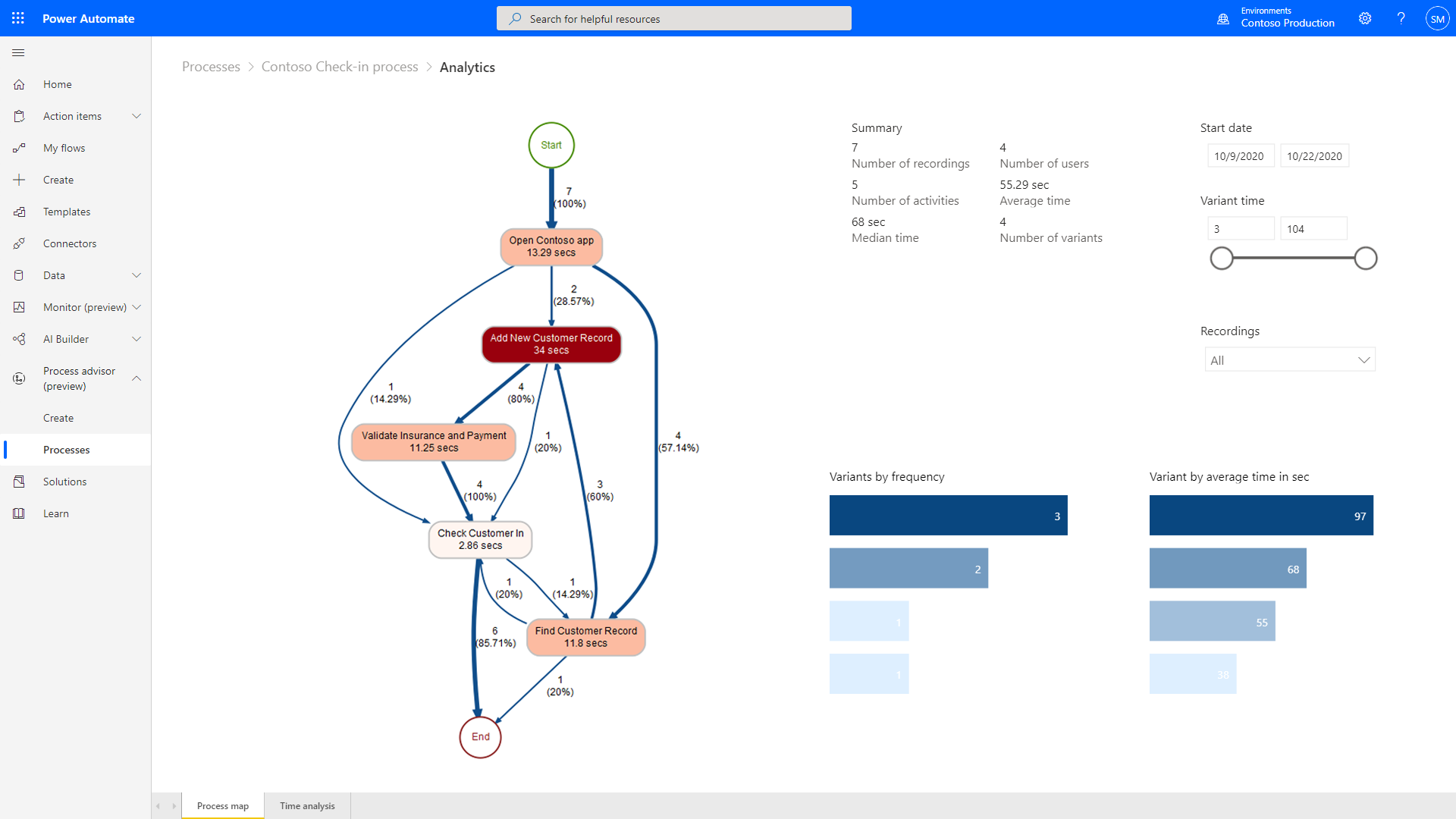
Image Credits: Microsoft
“This goes back to one of the things that we always talk about for Power Platform, which, it’s a corny thing, but it’s that development is a team sport,” Charles Lamanna, Microsoft’s corporate VP for its Low Code Application Platform, told me. “That’s one of our big focuses: how do bring people to collaborate and work together who normally don’t. This is great because it actually brings together the business users who live the process each and every day with a specialist who can build the robot and do the automation.”
The way this works in the backend is that Power Automate’s tools capture exactly what the users do and click on. All this information is then uploaded to the cloud and — with just five or six recordings — Power Automate’s systems can map how the process works. For more complex workflows, or those that have a lot of branches for different edge cases, you likely want more recordings to build out these processes, though.
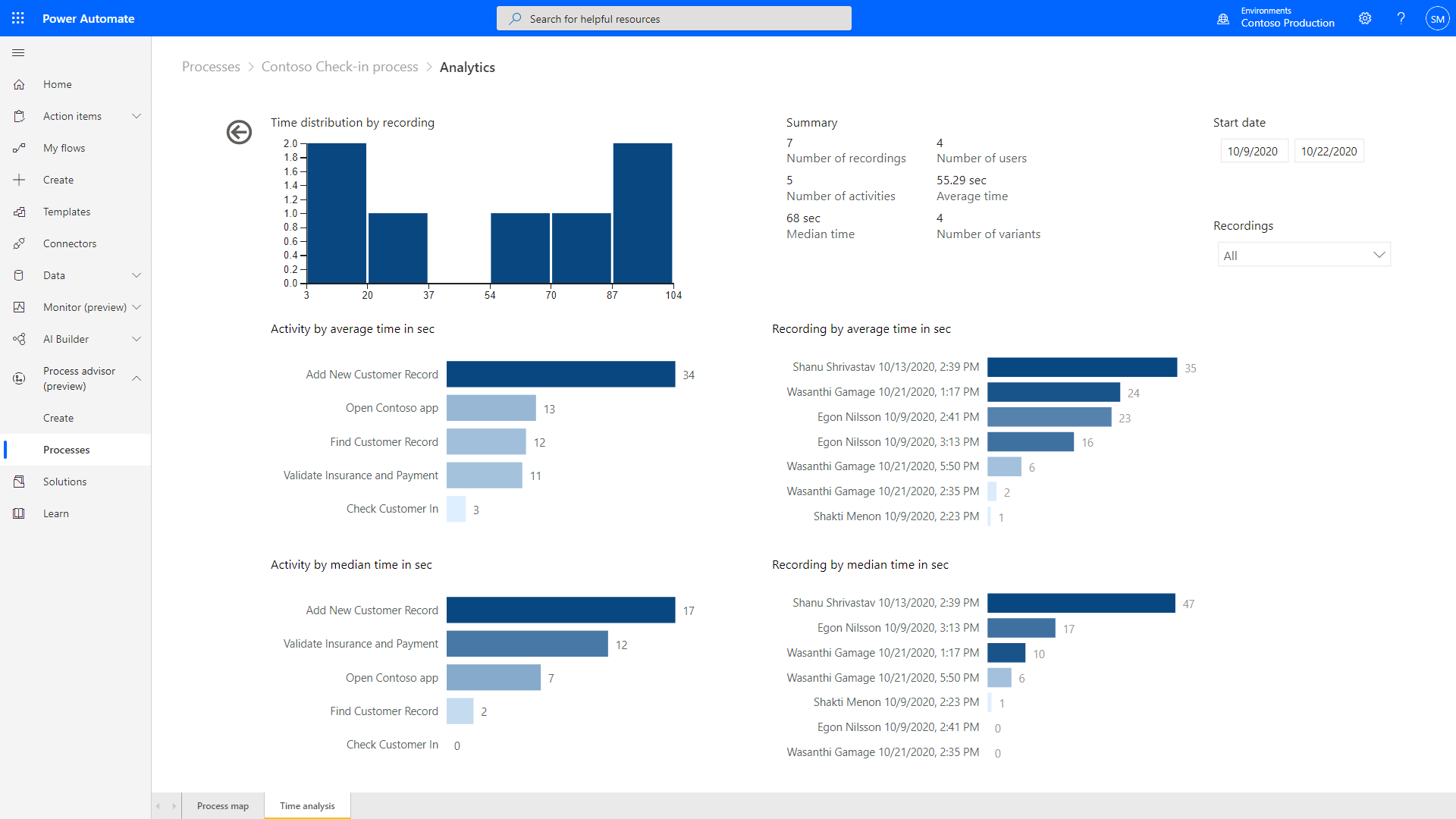
Image Credits: Microsoft
As Lamanna noted, building out these workflows and process maps can also help businesses better understand the ROI of these automations. “This kind of map is great to go build an automation on top of it, but it’s also great because it helps you capture the ROI of each automation you do because you’ll know for each step, how long it took you,” Lamanna said. “We think that this concept of Process Advisor is probably going to be one of the most important engines of adoption for all these low-code/no-code technologies that are coming out. Basically, it can help guide you to where it’s worth spending the energy, where it’s worth training people, where it’s worth building an app, or using AI, or building a robot with our RPA like Power Automate.”
Lamanna likened this to the advent of digital advertising, which for the first time helped marketers quantify the ROI of advertising.
The new process mining capabilities in Power Automate are now available in preview.
Microsoft brings new process mining features to Power Automate
Source: Microsoft
Microsoft has shared some details about the roadmap for its cloud gaming service. In addition to Android devices, the company confirms that it plans to add support for more platforms. In Spring 2021, Microsoft will launch its cloud gaming service on iOS and on computers.
Originally called Project xCloud, Microsoft’s cloud gaming service lets you play Xbox games on non-Xbox devices. The games run on a server in a data center near you. The video is streamed to your device, and your interactions are relayed to the server in real time.
Xbox cloud gaming isn’t a separate subscription. People who subscribe to the Xbox Game Pass Ultimate for $14.99 per month can access cloud gaming as part of their subscription. The plan also includes access to a library of games, EA Play and Xbox Live Gold.
When it comes to new devices, you’ll soon be able to launch a game on Xbox cloud gaming from a PC. The service will be available in the Xbox app and using a web browser.
While you can download games to your PC if you’re an Xbox Game Pass Ultimate subscriber, cloud gaming is going to be particularly useful for people who don’t have a powerful GPU in their computer. It’s going to be interesting to see whether Microsoft limits its service to web browsers running on Windows computers. I’m sure many people would like to access the service from a Mac as well.
As for iOS, Microsoft will launch cloud gaming through web browsers exclusively due to restrictive App Store rules. Nvidia already launched a beta version GeForce Now for iOS web browsers. I tried Nvidia’s service from an iPhone and an iPad, and the web browser workaround works really well.
If you have an Android phone or tablet, Xbox cloud gaming is already accessible from the Xbox Game Pass app. Your experience will greatly vary depending on your internet connection and the quality of your Wi-Fi network.
You also need to be located near a data center to minimize latency. That’s why Xbox cloud gaming is only accessible in a handful of countries — mostly the U.S., Canada, South Korea and part of Europe.
In its blog post, Microsoft says that the company is opening more data centers and expanding to new markets. You can expect Xbox cloud gaming in Australia, Brazil, Japan and Mexico soon.
Xbox cloud gaming coming to iOS and PC in Spring 2021
Source: Microsoft
We already knew that Halo Infinite was delayed until next year. Initially intended to launch alongside the new Xboxes, Microsoft announced back in August that it would instead ship in 2021.
Exactly when in 2021, though, was still anyone’s guess. A new blog post from 343 Industries narrows it down a bit: it’ll be released in Fall.
Assuming they mean Fall in the Northern Hemisphere (which, well, they probably do,) this narrows the launch window to sometime between the end of September and the end of December. So it’ll be a while… but a late game is better than a bad game, right?
343 has a blog post and interview outlining the team’s thinking on the timing (and a bit about what they’re still working on) but it really all boils down to one point: they “needed more time to do things right.”
Halo Infinite now scheduled for release in ‘Fall 2021’
Source: Microsoft
Buzzy face-swap video app Reface, which lends users celebrity ‘superpowers’ by turning their selfies into “eerily realistic” famous video clips at the tap of a button, has caught the attention of Andreessen Horowitz. The Silicon Valley venture firm leads a $5.5 million seed round in the deep tech entertainment startup, announced today.
Reface tells us its apps (iOS and Android) have been downloaded some 70 million times since it launched in January 2020 — up from 20M when we spoke to one of its (seven) co-founders back in August. It’s also attained ‘top five’ leading app status in around 100 countries, the US included — as well as bagging a ‘top app’ award in the annual Google Play best of. Quite the year, then.
That kind of viral growth clip has been turning heads all over the place. As well as nabbing a16z for its seed lead, Reface has pulled in funding from a number of prominent angel investors across the gaming, music, film/content creation and tech industries.
This includes — from the gaming industry — Ilkka Paananen, CEO of Supercell; and David Helgason, founder of Unity Technologies. From the world of music: Scooter Braun (managing partner of TQ Ventures, known for managing top pop stars like Justin Bieber and Ariana Grande); and Adam Leber, a manager to Britney Spears and Miley Cyrus, and an Uber investor.
On the film/content creation side its angels include Matt Stone, Trey Parker, and Peter Serafinowicz (via Deep Voodoo); Bryan Baum and Michael Kives, founder of K5 Global (whose clients have included the likes of Bruce Willis, Jesse Eisenberg and Eric Stonestreet); and Natalia Vodianova, a model, philanthropist, and actress.
Tech industry investors joining the round as angels are: Josh Elman (ex-investment partner at Greylock and on the boards of Medium, Operator, Musical.ly and Jelly); and Sriram Krishnan (investor and former product lead at Microsoft, Facebook, Snap and Twitter).
It’s the kind of broad-based excitement that can be generated when hot trend streams like ‘no code’ and viral social video get crossed. (At least if, like a rubbery face mask, we stretch the definition of ‘no code’ to cover — in Reface’s case — a push-button, AI tool for pro-style content creation; the ‘no code’ label typically refers to b2b tools that simplify app building but the common theme is supercharged accessibility.)
With such a sparkling portfolio of early stage backers Reface’s Ukrainian founders are surely proving the value of sticking with it where deep tech is concerned. As we reported back in the summer, three of the founders began working together almost a decade ago — honing their machine learning chops straight out of university. Their tenacity is now paying off in viral spades.
“The Reface team has taken their highly sophisticated, machine learning technology and transformed it into a consumer experience that is seamless to use and fun to share with your friends,” said Connie Chan, general partner at Andreessen Horowitz in a supporting statement on the funding.
“We’re just beginning to see the potential applications for their core technology across consumer, entertainment, and marketing experiences and the Reface team has the creativity and expertise to help shape that future,” she added.
“I believe that Reface has the potential to be the next-generation personalization platform that enables the gamification of movies, sports, music videos, and many other fields that people are passionate about,” added Supercell’s Paananen in another statement. “I’m excited to see the team grow Reface into a community that allows people to create active personal connections with artists and each other through content they love.”
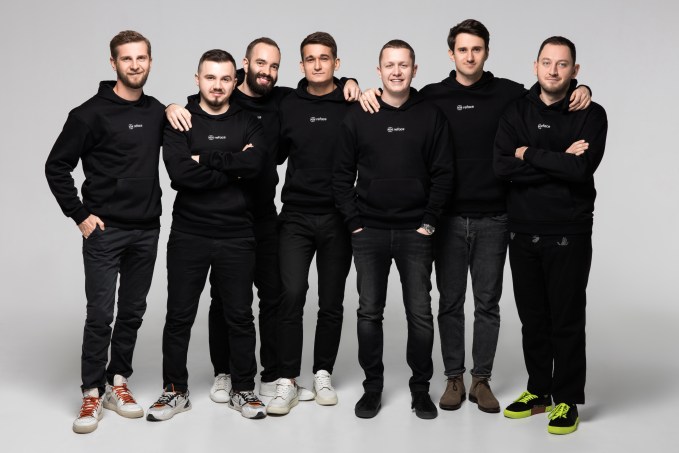
Reface’s co-founders, Denys Dmytrenko, Oles Petriv, Ivan Altsybieiev, Roman Mogylnyi, Yaroslav Boiko, Dima Shvets and Kyrylo Syhyda (Image credit: Reface)
Reface says the seed funding will allow it to step on the growth gas. Including stepping up work on a tool that’s capable of detecting its own fakes, which it wants to build to shrink the risk of the tech being misused.
Earlier this year the startup told us the detection tech would be ready by fall so it’s evidently taking a bit longer than expected. But garnering viral growth for its celeb-video face-swaps may well have reconfigured its priorities a tad.
A previously slated fall launch of UGC video for face-swapping has also not yet fully materialized.
A community that’s currently fuelled by creating and sharing high production value celebrity video clips seems a very different kind of ‘eerie’ vs letting users loose on face-swapping themselves onto the body of their kid brother, say, or grandparent (not to mention the wider risks of not quality controlling the base material for face swaps). So taking time to get robust controls in place makes good business sense. As does focusing on stoking the viral boom with fresh celeb content by keeping content partners happy.
Asked about the delay, Reface told us UGC video has been “partly” launched at this point, since users can download their GIFs. “It’s still in beta as we’re testing and improving — detection system, moderation, communication with users — to make sure that content will not be misused,” it said, adding: “Regarding video, we have a bunch of creators who provide us with content directly. This way we can test all the UGC mechanics. We plan to launch the UGC option to the public by the end of Q1.”
On the still-in-development detection tool, Reface said the plan is to launch it alongside UGC.
“We are training our models to maximize the detection quality,” it told us on that, adding that it hopes to have the tool finalized in April 2021.
Reface’s its overarching ambition is to build “the biggest platform of personalized content” — monetizing that by partnering with content holders and celebrities to offer head-turning “creative digital marketing solutions”.
Having a near captive audience for buzzy social content during the pandemic has clearly helped the mission, even as it’s boosted social rivals like Snap.
With so many bored kids stuck at home with their phones this year, there’s been an opportunity for growth across the board of social media. (And a16z is a backer of several other social plays, including audio-based social network Clubhouse, and — for kids — the Roblox social gaming platform, to name just two.)
In August 2020, Reface says it became viral and ranked number one in the U.S. AppStore — (briefly) surpassing TikTok and Instagram. Celebrities including Justin Bieber, Snoop Dogg, Britney Spears, Joe Rogan, Chris Brown, Miley Cyrus and Dua Lipa have all shared their refaced videos on social media this year, it also notes.
This year it’s inked partnerships with entertainment industry luminaries to promote new video launches, including Bieber, Cyrus and John Legend, as well as working with Amazon Prime to advertise the Borat movie premiere — racking up “millions” more shares and refaces.
“Funding from Andreessen Horowitz will allow us to accelerate this growth, empower our team with new talents and improve technology, as we will continue work on a fake videos detection tool to guarantee responsible use of our AI technology,” co-founder Denis Dmitrenko added in a statement.
Reface grabs .5M seed led by A16z to stoke its viral face-swap video app
Source: Microsoft
While the enterprise world likes to talk about “big data”, that term belies the real state of how data exists for many organizations: the truth of the matter is that it’s often very fragmented, living in different places and on different systems, making the concept of analysing and using it in a single, effective way a huge challenge.
Today, one of the big up-and-coming startups that has built a platform to get around that predicament is announcing a significant round of funding, a sign of the demand for its services and its success so far in executing on that.
SingleStore, which provides a SQL-based platform to help enterprises manage, parse and use data that lives in silos across multiple cloud and on-premise environments — a key piece of work needed to run applications in risk, fraud prevention, customer user experience, real-time reporting and real-time insights, fast dashboards, data warehouse augmentation, modernization for data warehouses and data architectures and faster insights — has picked up $80 million in funding, a Series E round that brings in new strategic investors alongside its existing list of backers.
The round is being led by Insight Partners, with new backers Dell Technologies Capital, Hercules Capital; and previous backers Accel, Anchorage, Glynn Capital, GV (formerly Google Ventures) and Rev IV also participating.
Alongside the investment, SingleStore is formally announcing a new partnership with analytics powerhouse SAS. I say “formally” because they two have been working together already and it’s resulted in “tremendous uptake,” CEO Raj Verma said in an interview over email.
Verma added that the round came out of inbound interest, not its own fundraising efforts, and as such, it brings the total amount of cash it has on hand to $140 million. The gives the startup money to play with not only to invest in hiring, R&D and business development, but potentially also M&A, given that the market right now seems to be in a period of consolidation.
Verma said the valuation is a “significant upround” compared to its Series D in 2018 but didn’t disclose the figure. PitchBook notes that at the time it was valued at $270 million post-money.
When I last spoke with the startup in May of this year — when it announced a debt facility of $50 million — it was not called SingleStore; it was MemSQL. The company rebranded at the end of October to the new name, but Verma said that the change was a long time in the planning.
“The name change is one of the first conversations I had when I got here,” he said about when he joined the company in 2019 (he’s been there for about 16 months). “The [former] name didn’t exactly flow off the tongue and we found that it no longer suited us, we found ourselves in a tiny shoebox of an offering, in saying our name is MemSQL we were telling our prospects to think of us as in-memory and SQL. SQL we didn’t have a problem with but we had outgrown in-memory years ago. That was really only 5% of our current revenues.”
He also mentioned the hang up many have with in-memory database implementations: they tend to be expensive. “So this implied high TCO, which couldn’t have been further from the truth,” he said. “Typically we are ⅕-⅛ the cost of what a competitive product would be to implement. We were doing ourselves a disservice with prospects and buyers.”
The company liked the name SingleStore because it is based a conceptual idea of its proprietary technology. “We wanted a name that could be a verb. Down the road we hope that when someone asks large enterprises what they do with their data, they will say that they ‘SingleStore It!’ That is the vision. The north star is that we can do all types of data without workload segmentation,” he said.
That effort is being done at a time when there is more competition than ever before in the space. Others also providing tools to manage and run analytics and other work on big data sets include Amazon, Microsoft, Snowflake, PostgreSQL, MySQL and more.
SingleStore is not disclosing any metrics on its growth at the moment but says it has thousands of enterprise customers. Some of the more recent names it’s disclosed include GE, IEX Cloud, Go Guardian, Palo Alto Networks, EOG Resources, SiriusXM + Pandora, with partners including Infosys, HCL and NextGen.
“As industry after industry reinvents itself using software, there will be accelerating market demand for predictive applications that can only be powered by fast, scalable, cloud-native database systems like SingleStore’s,” said Lonne Jaffe, managing director at Insight Partners, in a statement. “Insight Partners has spent the past 25 years helping transformational software companies rapidly scale-up, and we’re looking forward to working with Raj and his management team as they bring SingleStore’s highly differentiated technology to customers and partners across the world.”
“Across industries, SAS is running some of the most demanding and sophisticated machine learning workloads in the world to help organizations make the best decisions. SAS continues to innovate in AI and advanced analytics, and we partner with companies like SingleStore that share our curiosity about how data and analytics can help organizations reimagine their businesses and change the world,” said Oliver Schabenberger, COO and CTO at SAS, added. “Our engineering teams are integrating SingleStore’s scalable SQL-based database platform with the massively parallel analytics engine SAS Viya. We are excited to work with SingleStore to improve performance, reduce cost, and enable our customers to be at the forefront of analytics and decisioning.”
SingleStore, formerly MemSQL, raises M to integrate and leverage companies’ disparate data silos
